
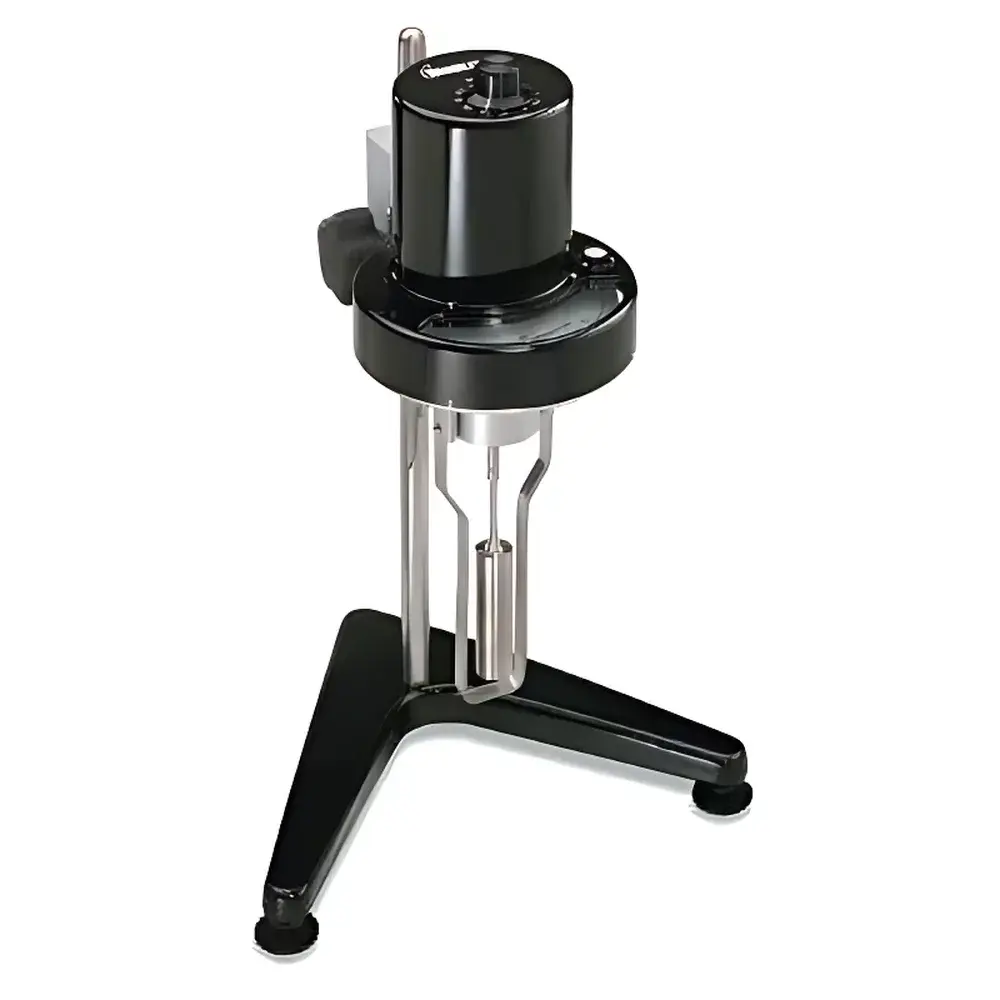
Brookfield RVT Dial-Reading Viscometer
| Brand | Brookfield |
|---|---|
| Origin | USA |
| Model | RVT |
| Accuracy | ±1.0% of full-scale reading |
| Repeatability | ±0.2% |
| Viscosity Range | 100–8,000,000 cP |
| Speed Range | 0.5–100 rpm |
| Display Type | Analog dial (torque %), convertible to centipoise (cP) |
Overview
The Brookfield RVT Dial-Reading Viscometer is a foundational instrument in rotational viscometry, engineered for precision, durability, and operational simplicity in industrial quality control and routine laboratory environments. Based on the Couette principle—where torque required to rotate a spindle at constant speed within a fluid is directly proportional to its dynamic viscosity—the RVT delivers robust analog measurement performance without reliance on digital electronics or microprocessors. Its mechanical design centers on a calibrated spring-and-gear mechanism that translates spindle drag into a torque percentage reading on a high-contrast analog dial, enabling immediate visual interpretation and rapid conversion to centipoise (cP) using included calibration charts or standardized conversion factors. As one of the longest-produced viscometers in Brookfield’s portfolio, the RVT has been widely adopted across paint, coatings, adhesives, food, pharmaceuticals, and polymer processing sectors where regulatory traceability, mechanical reliability, and minimal maintenance are critical.
Key Features
- Mechanically driven analog measurement system with no dependency on firmware, software, or battery power—ideal for environments with electromagnetic interference or strict validation requirements.
- High-stability synchronous motor delivering consistent rotational speeds from 0.5 to 100 rpm across 18 discrete settings, optimized for low-vibration operation and long-term speed stability.
- Accuracy of ±1.0% of full-scale reading and repeatability of ±0.2%, validated per ASTM D2196 and ISO 2555 procedures using Newtonian reference oils.
- Explosion-proof configuration available (UL Class 1, Group D) via motorless drive shaft coupling—enabling safe deployment in hazardous locations where intrinsic safety compliance is mandatory.
- Modular mechanical architecture supporting all standard Brookfield accessories, including small-sample adapters, thermosel jackets, UL-type spindles, and automated lift stands—extending method flexibility without hardware replacement.
- Integrated protective foot, universal mounting bracket, and rugged carrying case facilitate rapid setup, transport, and field deployment across production floors and satellite labs.
Sample Compatibility & Compliance
The RVT accommodates a broad range of sample types—from low-viscosity solvents to highly structured gels—using six standard spindles (LV series) covering a total viscosity range of 100 to 8,000,000 cP. Sample volume requirements vary by spindle geometry (e.g., 20 mL for LV-3, 500 mL for LV-4), and optional accessories such as the UL adapter enable testing of non-Newtonian behavior under controlled shear history. The instrument conforms to key international standards governing rheological testing, including ASTM D1084 (adhesives), ASTM D445 (petroleum products), ISO 3219 (polymer solutions), and USP (pharmaceutical viscosity). Its analog-only signal path eliminates electronic audit trail concerns, making it compatible with GLP and GMP workflows where software validation is not required—and particularly suited for legacy systems undergoing FDA 21 CFR Part 11 risk assessments.
Software & Data Management
As a purely analog instrument, the RVT does not incorporate embedded software, data logging, or network connectivity. All measurements are recorded manually or transcribed into LIMS or ELN platforms via operator entry. This architecture eliminates cybersecurity vulnerabilities, software qualification burdens, and firmware update cycles—significantly reducing validation effort in regulated manufacturing. Calibration records, spindle identification logs, and torque-to-cP conversion tables are maintained externally per ISO/IEC 17025 documentation protocols. Optional analog-to-digital interface kits (e.g., Brookfield Digital Readout Converter) may be deployed to generate serial output for integration with SCADA or PLC-based monitoring systems—subject to site-specific validation protocols.
Applications
- Batch release testing of industrial lubricants, transformer oils, and hydraulic fluids per ASTM D445.
- Routine QC of architectural paints, latex emulsions, and coil coatings during production line sampling.
- Stability assessment of topical pharmaceutical gels and ointments under accelerated storage conditions.
- Process consistency verification for starch slurries, chocolate masses, and dairy-based sauces in food manufacturing.
- Viscosity grading of hot-melt adhesives prior to extrusion and lamination operations.
- Teaching laboratories demonstrating fundamental rheological concepts—including Newtonian behavior, shear-thinning response, and temperature-dependent viscosity trends.
FAQ
Does the RVT require annual recalibration?
Yes—calibration against NIST-traceable reference oils is recommended annually or per internal SOP, especially when used for release testing under GMP or ISO 9001 frameworks.
Can the RVT measure non-Newtonian fluids?
It provides single-point viscosity values at defined shear rates; for full flow curves, a programmable rheometer (e.g., Brookfield DVNext) is required—but time-dependent thixotropy screening is possible via sequential timed readings.
Is the explosion-proof version certified for Class 1, Division 1 areas?
No—the UL Class 1, Group D rating applies only to Division 2 or unclassified zones; full Division 1 certification requires additional barrier systems beyond the RVT’s base configuration.
What spindle set is included with the standard RVT package?
The standard configuration includes LV-1 through LV-6 spindles, support stand, protective foot, and molded carrying case—all pre-assembled and mechanically verified at the factory.
How is temperature control achieved during testing?
The RVT itself does not regulate temperature; external thermostatic baths or Brookfield Thermosel heating jackets must be used in conjunction with appropriate spindle geometry to maintain thermal equilibrium per ASTM D445 Section 7.2.



