
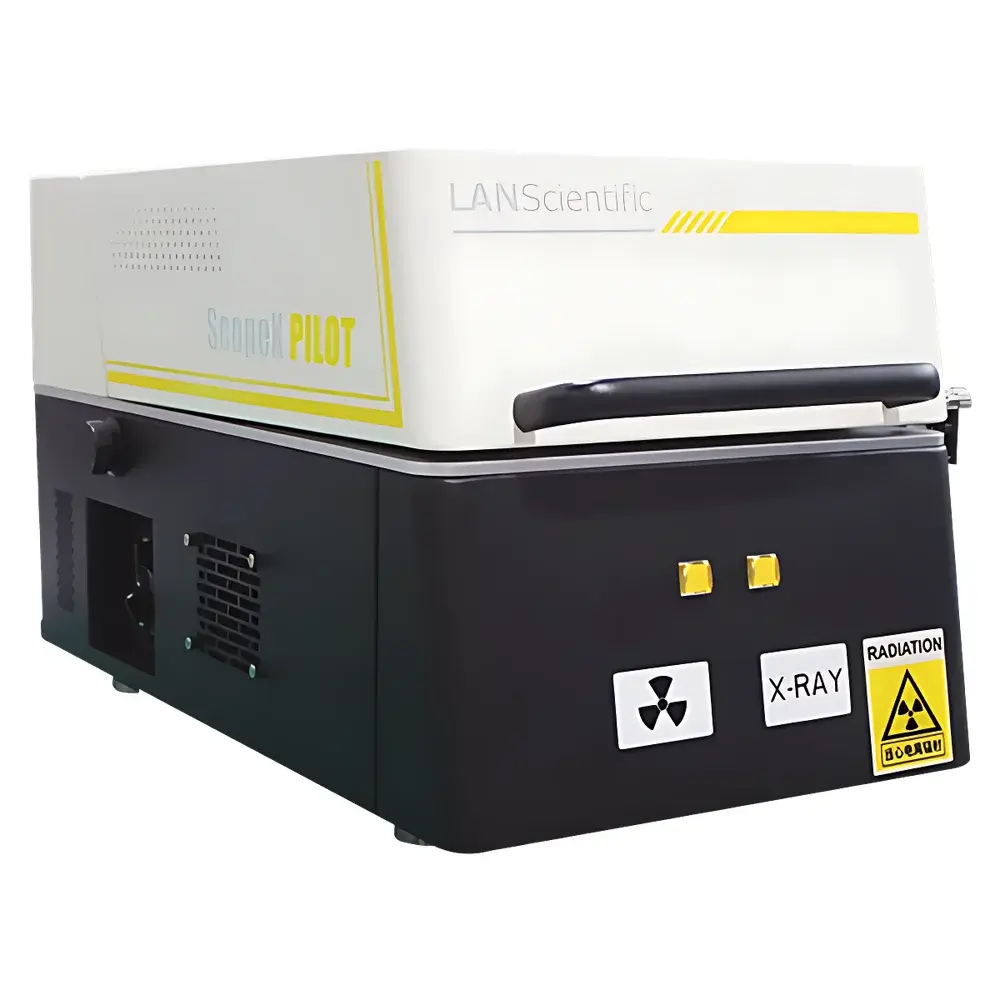
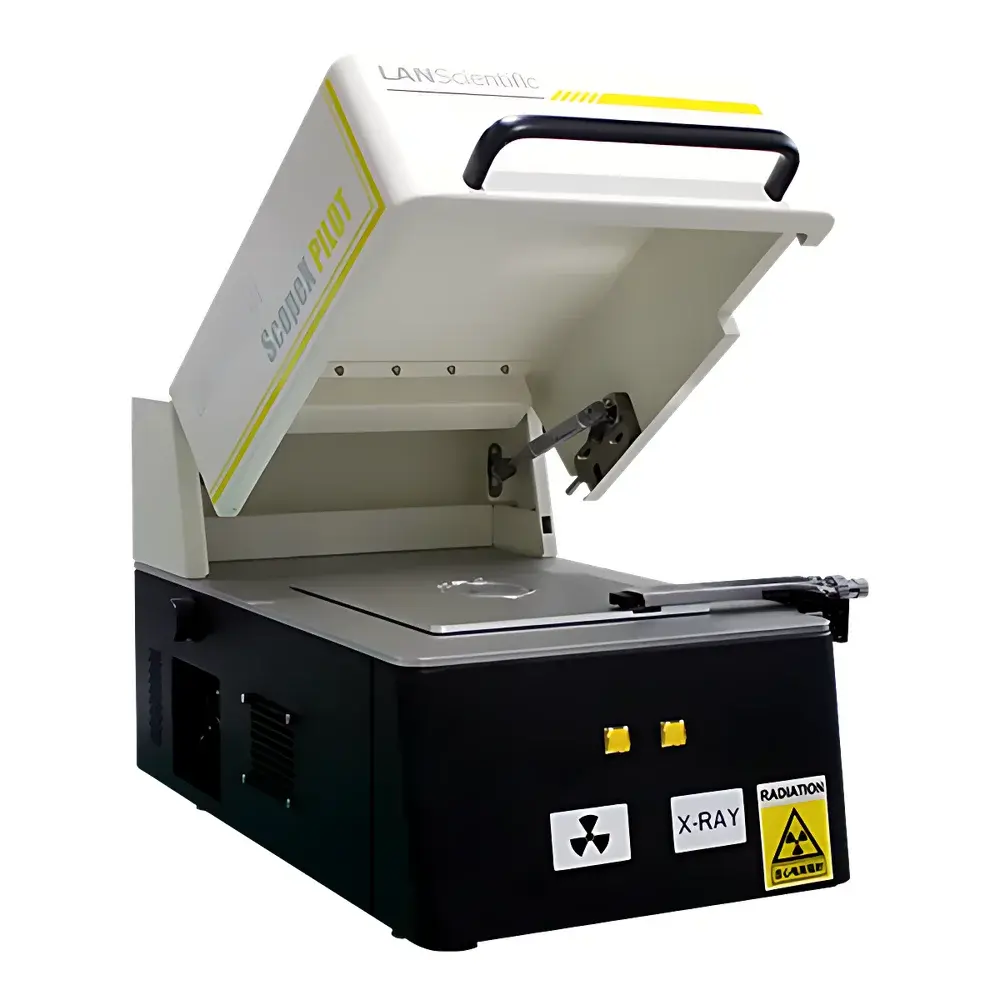
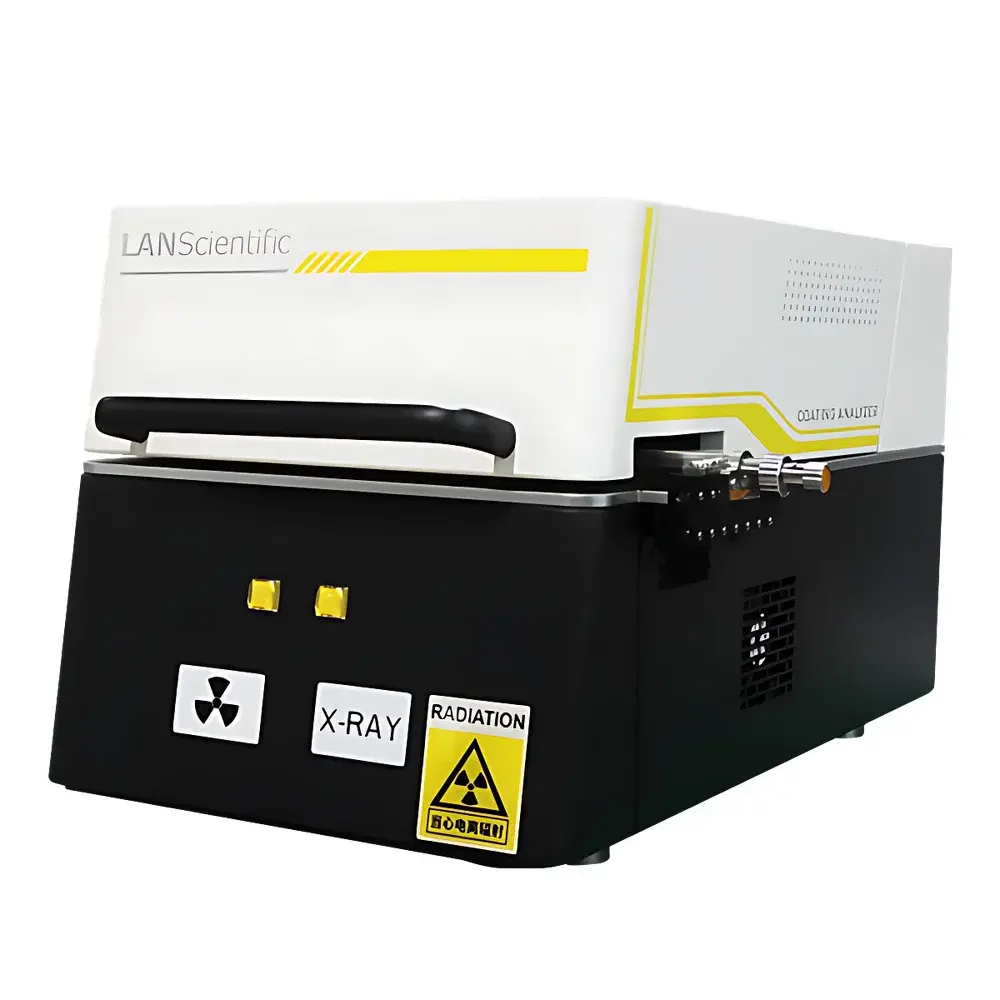
Brookfield ScopeX PC5 Benchtop X-Ray Fluorescence Coating Thickness Analyzer
| Brand | LANScientific |
|---|---|
| Origin | Jiangsu, China |
| Manufacturer Type | Manufacturer |
| Country of Origin | Domestic (China) |
| Model | ScopeX PC5 |
| Price | Upon Request |
Overview
The Brookfield ScopeX PC5 is a benchtop energy-dispersive X-ray fluorescence (EDXRF) coating thickness analyzer engineered for high-precision, non-destructive quantification of metallic and alloy coatings on substrates. It operates on the fundamental principle of X-ray fluorescence spectroscopy: primary X-rays excite atoms in the sample, inducing emission of characteristic secondary (fluorescent) X-rays whose energies and intensities are uniquely associated with elemental composition and layer mass thickness. By applying fundamental parameter (FP) algorithms—specifically the proprietary Multi-FP software—the instrument converts measured X-ray intensities into accurate, matrix-corrected coating thickness values (in µm or nm), even for multi-layer systems (e.g., Ni/Cu/Fe, Cr/Ni/steel, Au/Ni/Cu/PCB). Designed for industrial process control and final quality assurance, the ScopeX PC5 meets the metrological demands of ISO 3497, ASTM B568, and DIN 50981 standards for electroplated and vapor-deposited coatings.
Key Features
- Downward-Beam Geometry: The vertical down-looking optical path eliminates manual focusing and enables rapid, repeatable positioning of irregular, curved, or recessed samples—including threaded fasteners, stamped parts, and micro-electro-mechanical components.
- Variable-Focus Micro-X-ray Optics: Optional micro-focus X-ray source (≤50 µm spot size) allows precise analysis of features as small as 100 µm in diameter, supporting wafer-level metallization and fine-pitch PCB trace inspection.
- Motorized Multi-Channel Collimator & Filter System: Software-selectable collimators (100–1000 µm) and interference filters (Al, Cu, Ti, Mo) optimize excitation conditions for light elements (e.g., Al, Mg, Si) or heavy metals (e.g., Au, Pt, Pb), enhancing signal-to-background ratio and detection limits.
- High-Resolution Manual X-Y Stage: Precision-machined stage with 25 µm resolution enables reproducible rastering across heterogeneous surfaces, facilitating line scans and area mapping of coating uniformity.
- Depth-Resolved Measurement Capability: Integrated variable working distance (0–30 mm) and auto-focus-assisted Z-height adjustment support reliable measurement of deep recesses, blind holes, and stepped substrates without repositioning.
Sample Compatibility & Compliance
The ScopeX PC5 accommodates flat, convex, concave, and contoured samples up to Ø150 mm × H80 mm. It supports single- and multi-layer metallic coatings—including Cr, Ni, Cu, Sn, Zn, Ag, Au, Pd, Rh, and their alloys—on conductive (e.g., steel, brass, aluminum) and non-conductive (e.g., plastic, ceramic) substrates. All measurements comply with GLP and GMP documentation requirements: full audit trail, user access control, electronic signature support, and data export in CSV, PDF, and XML formats compatible with LIMS integration. The system satisfies radiation safety standards per IEC 61010-1 and is CE-marked for laboratory use in EU markets.
Software & Data Management
ScopeX Control Suite v4.2 provides intuitive workflow-driven operation—from method setup and calibration to real-time spectral visualization and statistical reporting. Built-in FP modeling libraries include pre-validated methods for common plating systems (e.g., “Au/Ni/Cu/FR4”, “Zn/Fe”, “Sn/Cu”). Each measurement record stores full spectral metadata (tube voltage/current, live time, detector temperature), raw spectrum, fitted peak parameters, and uncertainty estimation per ISO/IEC 17025 guidelines. Batch reporting includes Cp/Cpk indices, SPC charts, and pass/fail flagging against user-defined specification limits (e.g., USP / for elemental impurities in medical devices).
Applications
- Automotive: Thickness verification of Zn-Ni corrosion barriers on brake calipers and fasteners; Cr(VI)-free trivalent chromium passivation on trim components.
- Electronics: Quantitative analysis of ENIG (electroless nickel immersion gold) on PCB pads; Cu pillar bump thickness in advanced packaging.
- Jewelry & Watchmaking: Precise Au plating thickness on stainless steel watch cases and clasps; rhodium over silver for tarnish resistance.
- Aerospace: Measurement of anodized Al oxide layers (Type II/III) and hard chrome on landing gear components per AMS 2400/2417.
- Medical Devices: Validation of Pt-Ir radiopaque markers on catheter shafts and NiTi stent coatings per ISO 10993-15.
FAQ
Does the ScopeX PC5 require external cooling or vacuum pumping?
No—it uses a Peltier-cooled silicon drift detector (SDD) and operates under ambient air; no liquid nitrogen or mechanical pump is required.
Can it measure organic coatings like paint or lacquer?
No—EDXRF is insensitive to low-Z organic matrices; it is optimized for inorganic metallic layers only.
Is calibration traceable to NIST standards?
Yes—calibration standards are certified reference materials (CRMs) traceable to NIST SRM 2136 (Ni-Cu-Fe multilayer) and BAM CRM 420 (Au-Ag-Cu alloys).
What is the typical measurement repeatability for a 1-µm Au layer on Ni?
Under controlled lab conditions (25 °C, stable power), relative standard deviation (RSD) is ≤1.8% (n=10, 60 s live time).
How does the Multi-FP algorithm improve accuracy versus conventional empirical calibration?
Multi-FP accounts for inter-element absorption/enhancement effects, substrate composition, and layer stacking geometry—reducing reliance on matrix-matched standards and enabling robust cross-application transferability.



