
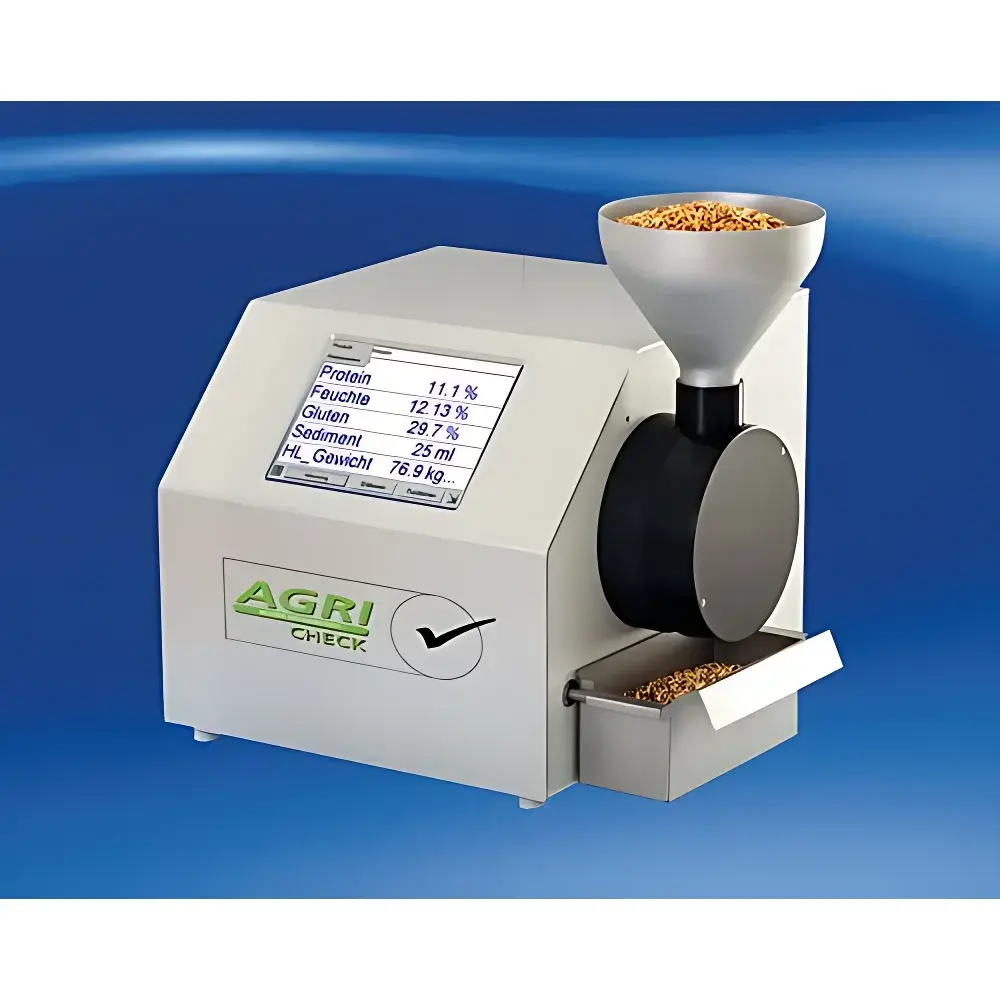
Bruins AgriCheck Near-Infrared Grain Analyzer
| Brand | Bruins |
|---|---|
| Origin | Germany |
| Model | AgriCheck |
| Instrument Type | Laboratory NIR Spectrometer |
| Optical Principle | Grating-based Scanning Monochromator |
| Wavelength Range | 730–1100 nm |
| Wavelength Resolution | 0.5 nm |
| Scan Speed | 45 scans per analysis |
| Data Sampling Interval | 3 s |
| Measurement Mode | Transmission |
| Chemometrics Software | RIMP |
| Sample Capacity | ~650 mL (whole grains) |
| Analysis Time | ~45 s |
| Sample Handling | Automated feeder with 16 independent sub-sampling positions |
| Dimensions | 385 × 420 × 385 mm |
| Weight | 21 kg |
| Power Supply | 220–240 V / 50 Hz |
| Power Consumption | 45 W |
| Environmental Protection | Dust- and moisture-resistant enclosure |
| Interface Options | USB, Ethernet, Parallel Port |
Overview
The Bruins AgriCheck Near-Infrared Grain Analyzer is a laboratory-grade, transmission-mode NIR spectrometer engineered for rapid, non-destructive compositional analysis of intact cereal grains and oilseeds. Based on grating-scanning monochromator architecture, it delivers high-fidelity spectral acquisition across the 730–1100 nm wavelength range with a resolution of 0.5 nm — optimized for strong absorption bands associated with C–H, O–H, and N–H functional groups in agricultural commodities. Unlike dispersive or filter-based systems, the patented dual-beam optical design ensures long-term photometric stability and minimizes baseline drift during routine operation. The instrument is widely deployed in international grain trading hubs, official inspection laboratories, and agri-food R&D centers where regulatory compliance, method traceability, and inter-laboratory reproducibility are mandatory. Its core function is to quantify key quality parameters—including moisture, protein, oil, starch, crude fiber, wet gluten, sedimentation value, ash, amylose, and free fatty acids—using chemometric models built and validated in accordance with ISO 12099:2017 (Animal feeding stuffs, cereals and milled cereal products — Guidelines for the application of near infrared spectroscopy) and AOAC Official Method 2011.25.
Key Features
- Patented linear grating-scanning dual-beam monochromator for high photometric linearity and signal-to-noise ratio
- Automated sample handling system enabling consistent 16-subsample measurement per analysis cycle
- Integrated transmission cell geometry optimized for heterogeneous whole-grain matrices
- Robust industrial enclosure rated for dust and moisture resistance (IP54-equivalent)
- Large-format color touchscreen interface running Windows OS with intuitive workflow navigation
- Real-time spectral preview and model diagnostics embedded within RIMP software
- Network-enabled architecture supporting remote monitoring, firmware updates, and centralized data logging via Ethernet
- Modular hardware expansion support for optional accessories including bulk density module, temperature probe, barcode reader, and thermal printer
Sample Compatibility & Compliance
The AgriCheck accommodates all major intact cereal grains and leguminous seeds without grinding or chemical pretreatment: wheat, durum wheat, barley, maize, soybean, brown rice, milled rice, paddy rice, oats, rye, triticale, sorghum, and others. Its transmission measurement mode requires uniform particle packing and consistent fill volume (~650 mL), achieved via the patented vibratory feed mechanism. Method validation adheres to internationally recognized frameworks: calibration models are developed using reference methods compliant with ISO 20483 (Cereals and pulses — Determination of nitrogen content), ISO 6540 (Crude fat in cereals and cereal products), and ICC Standard Method No. 168 (Moisture content). All RIMP-generated reports include full audit trails, timestamped metadata, and operator ID logging — supporting GLP and GMP environments subject to FDA 21 CFR Part 11 requirements when configured with electronic signature modules.
Software & Data Management
RIMP (Reference Independent Modeling Platform) is Bruins’ proprietary chemometrics suite, pre-installed and fully integrated with the AgriCheck hardware. It provides full lifecycle management of calibration models: spectral preprocessing (Savitzky-Golay smoothing, SNV, MSC, derivatives), PLS regression development, cross-validation diagnostics (RMSEC, RMSECV, R²), outlier detection, and performance monitoring over time. Models are stored in a vendor-neutral format and interoperable across all Bruins NIR platforms — facilitating seamless transfer between AgriCheck units in multi-site operations. Data export supports CSV, XML, and LIMS-compatible formats. Network connectivity enables scheduled backups to network drives and direct push to enterprise LIMS or ERP systems via configurable API endpoints. Audit trail functionality records all user actions, model edits, and instrument status changes with immutable timestamps.
Applications
- Grain procurement and pricing at elevators and cooperatives based on real-time protein and moisture assessment
- Quality control in milling and malting facilities for raw material acceptance and process optimization
- Research applications in plant breeding programs evaluating genetic variation in starch composition or oil yield
- Regulatory compliance testing for export documentation under national grain standards (e.g., USDA FGIS, GAFTA, FOSFA)
- Storage monitoring through periodic scanning to detect early-stage spoilage indicators (e.g., rising free fatty acid levels)
- Feed formulation support via rapid estimation of digestible energy components in compound feed ingredients
FAQ
What sample preparation is required prior to analysis?
No grinding, drying, or chemical treatment is needed. Whole grains are poured directly into the hopper; the automated feeder ensures homogeneous packing and consistent optical path length.
Can I develop custom calibrations for proprietary grain varieties?
Yes. Bruins provides one year of complimentary calibration support: customers supply reference lab data and representative spectra, and Bruins’ application scientists build and validate site-specific models.
Is the RIMP software compliant with 21 CFR Part 11?
RIMP supports electronic signatures, audit trails, and role-based access control when deployed on validated Windows systems with appropriate IT governance — meeting foundational requirements for Part 11 compliance.
How often does the instrument require recalibration or maintenance?
Optical alignment is factory-set and stable for ≥24 months under normal use. Annual verification using NIST-traceable ceramic standards is recommended. No consumables or lamp replacements are required during typical service life.
Does the AgriCheck support integration with existing LIMS or ERP systems?
Yes. Native Ethernet interface enables direct TCP/IP communication. Pre-built drivers and RESTful API documentation are provided for integration with major LIMS vendors (e.g., LabWare, STARLIMS, Thermo Fisher SampleManager).






