
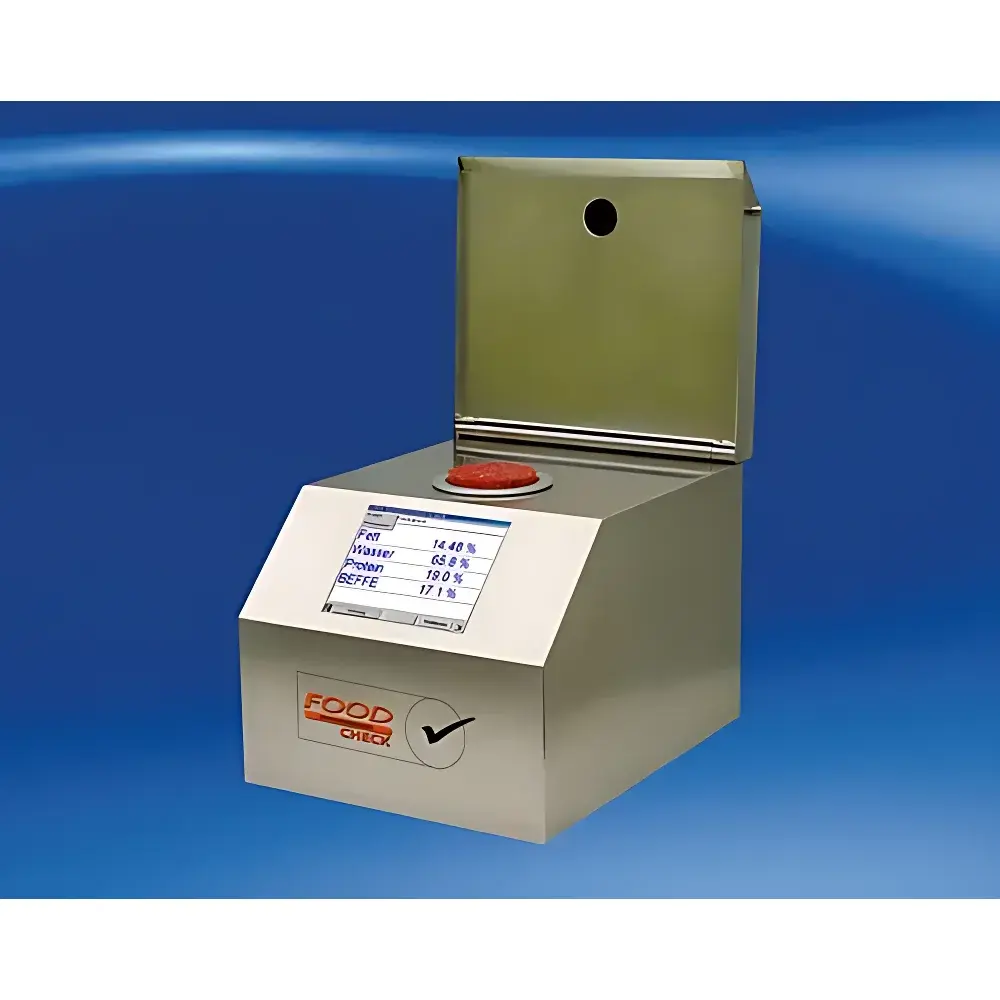
Bruins FoodCheck Near Infrared Food Analyzer
| Brand | Bruins |
|---|---|
| Origin | Germany |
| Model | FoodCheck |
| Instrument Type | Laboratory NIR Spectrometer |
| Optical Principle | Grating-based Scanning Monochromator |
| Wavelength Range | 730–1100 nm or 1400–2500 nm |
| Spectral Resolution | 0.5 nm |
| Scan Time | ~50 s |
| Sampling Mode | Transmission or Optional Diffuse Reflectance |
| Chemometrics Software | RIMP |
| Enclosure Rating | IP65 |
| Dimensions | 375 × 460 × 370 mm |
| Weight | 28 kg |
| Power Supply | 220–240 V / 50 Hz |
| Power Consumption | 33 W |
| Sample Volume | ~60 mL |
| Sample Handling | Manual Loading with Rotating Sample Tray |
| Interface | USB, Ethernet, Parallel Port |
Overview
The Bruins FoodCheck Near Infrared Food Analyzer is a dedicated laboratory-grade spectrometer engineered for rapid, non-destructive quantification of key compositional parameters in meat, dairy, and general food matrices. Operating on the principle of grating-based full-spectrum scanning, the instrument acquires high-fidelity NIR spectra across two selectable wavelength ranges—730–1100 nm (short-wave NIR) and 1400–2500 nm (mid-wave NIR)—enabling robust calibration development for diverse analytes including moisture, protein, fat, carbohydrates, dry matter, ash, and gel strength. Its dual-beam optical architecture ensures high photometric stability and long-term signal reproducibility, critical for routine QC environments where inter-day and inter-operator consistency must meet ISO 17025-aligned validation protocols.
Key Features
- Patented linear grating scanning monochromator delivering 0.5 nm spectral resolution across the full operating range, optimized for chemometric model sensitivity and baseline fidelity.
- IP65-rated stainless-steel enclosure—designed for both controlled laboratory settings and semi-industrial production floor deployment without performance compromise.
- Rotating sample tray system compatible with standard Petri dishes, minimizing consumable cost and simplifying operator workflow; supports both transmission measurement (for homogenous liquids, emulsions, and minced products) and optional diffuse reflectance accessories (for powders, granules, and viscous pastes).
- Integrated Windows-based control interface with full-color touchscreen display—designed for intuitive navigation by non-specialist operators following GLP-compliant SOPs.
- Cross-platform application database compatibility: calibration models developed on one FoodCheck unit are fully transferable to other Bruins NIR instruments, enabling harmonized method deployment across multi-site facilities.
- Network-enabled architecture supporting remote diagnostics, firmware updates, and centralized data routing via Ethernet—facilitating integration into LIMS or MES environments compliant with FDA 21 CFR Part 11 requirements for electronic records and signatures.
Sample Compatibility & Compliance
The FoodCheck accommodates a broad spectrum of food samples—including raw and processed meats (minced beef, pork, poultry), sausages, cheese varieties, butter, yogurt, ice cream, milk powder, whey protein isolates, flour, spices, and seasonings. Sample presentation is standardized using either transmission cuvettes (60 mL volume) or optional diffuse reflectance cups for particulate or heterogeneous materials. All hardware components meet CE marking requirements and conform to IEC 61000-6-2 (immunity) and IEC 61000-6-3 (emission) standards. The system’s mechanical and optical design adheres to ISO 12099:2017 (Animal feeding stuffs — General guidelines for near-infrared spectroscopic analysis) and supports method validation per AOAC Official Method 2011.01 for NIR calibration transferability.
Software & Data Management
Controlled by the RIMP chemometrics software suite, the FoodCheck provides comprehensive preprocessing (Savitzky-Golay smoothing, multiplicative scatter correction, first/second derivative transformation), PLS regression modeling, and rigorous validation tools (cross-validation, prediction residuals, RMSEP/RMSECV reporting). RIMP supports audit-trail logging with user-level access controls, time-stamped calibration history, and versioned model archives—all traceable for GMP/GLP audits. Raw spectral data is stored in vendor-neutral .jdx or .spc formats; calibration files include metadata on reference methodology (e.g., AOAC, ISO, or internal wet chemistry protocols), uncertainty estimates, and applicable scope limitations. Optional network licensing enables concurrent use across multiple workstations while maintaining centralized model governance.
Applications
The FoodCheck serves as a primary analytical tool in quality assurance laboratories for real-time batch release testing, raw material verification, and in-process monitoring. Typical use cases include: moisture content verification in cured meats prior to packaging; fat-to-protein ratio assessment in ground sausage formulations; lactose and casein quantification in infant formula powders; starch and fiber profiling in cereal-based snacks; and adulteration screening in spice blends using spectral fingerprinting. Its ability to generate quantitative results within 50 seconds—without reagents, solvents, or sample digestion—reduces labor costs and eliminates hazardous waste generation associated with classical wet chemistry methods such as Kjeldahl nitrogen analysis or Soxhlet extraction.
FAQ
What wavelength ranges does the FoodCheck support, and how do I select between them?
The instrument operates in two discrete optical modules: SW-NIR (730–1100 nm) and MW-NIR (1400–2500 nm). Selection is performed at installation based on target analytes; SW-NIR is preferred for water and lipid overtones, while MW-NIR delivers stronger absorption features for proteins and carbohydrates.
Can I develop my own calibration models, or must I rely on Bruins-supplied databases?
Users retain full ownership of calibration development. Bruins provides foundational models for three common food categories free of charge; custom model development is supported through collaborative application studies using customer-supplied reference data and spectra.
Is the FoodCheck compliant with regulatory data integrity requirements?
Yes—the RIMP software includes electronic signature capability, role-based permissions, immutable audit trails, and secure data export functionality aligned with FDA 21 CFR Part 11 and EU Annex 11 expectations.
How is sample homogeneity ensured during transmission measurement?
The rotating sample tray induces gentle agitation during acquisition, mitigating settling effects in suspensions and emulsions; for highly heterogeneous samples, optional homogenization pre-treatment is recommended per AOAC guidelines.
What maintenance is required for long-term optical stability?
No routine optical alignment is needed. The sealed monochromator and fixed-path optics eliminate drift; annual verification against NIST-traceable ceramic standards is recommended for ISO 17025 accreditation.
Related Products





