
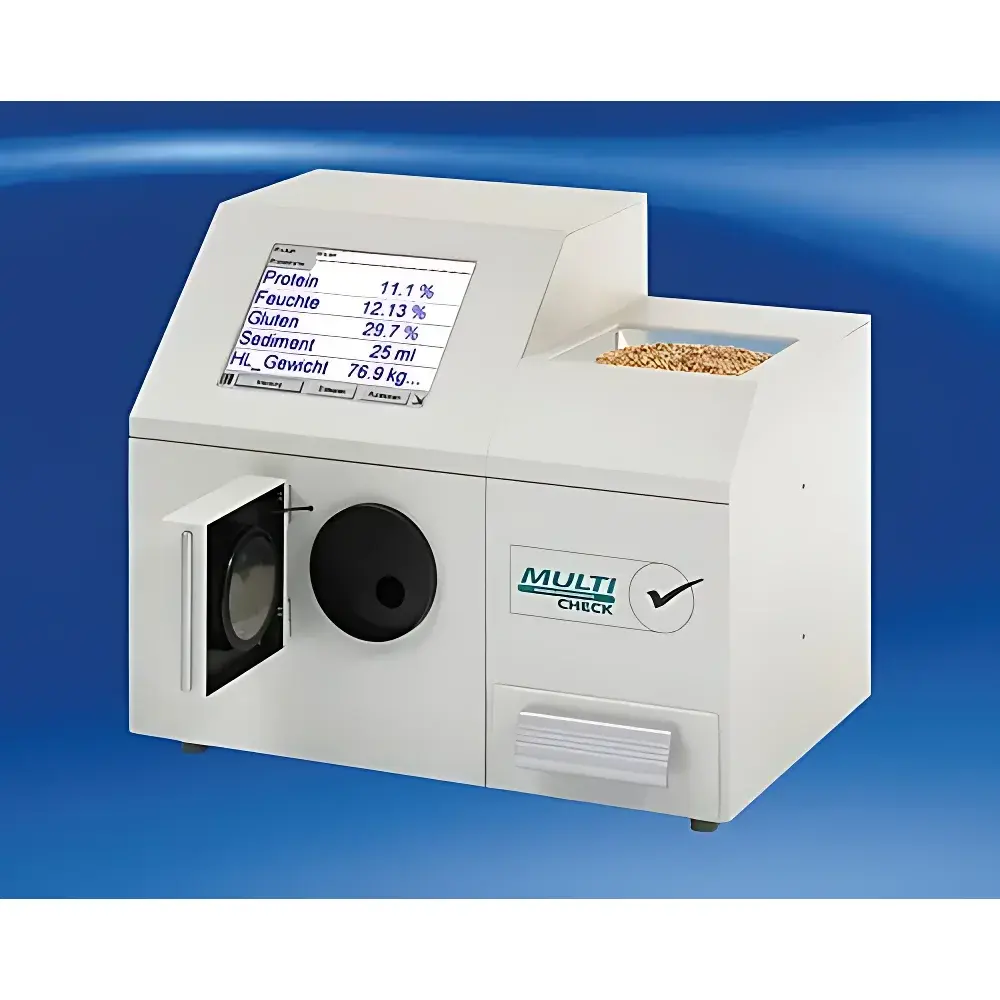
Bruins MultiCheck Near Infrared Spectrometer
| Brand | Bruins |
|---|---|
| Origin | Germany |
| Model | MultiCheck |
| Instrument Type | Laboratory NIR Spectrometer |
| Principle | Grating-based, non-scanning array detector |
| Wavelength Range | 730–1100 nm and 1400–2500 nm |
| Wavelength Resolution | 0.5 nm |
| Measurement Modes | Transmission and Diffuse Reflectance |
| Sample Throughput | ~50 s per analysis |
| Standard Pathlength | 12 mm cuvette (optional: 3–30 mm) |
| Sample Volume | 750 mL (whole grains), 60 mL (ground materials) |
| Detector | Linear CCD/CMOS array |
| Software | RIMP Chemometrics Suite |
| Compliance | Designed for GLP-compliant workflows |
| Dimensions | 585 × 420 × 480 mm |
| Weight | 31 kg |
| Power Supply | 220–240 V / 50 Hz |
| Power Consumption | 65 W |
Overview
The Bruins MultiCheck Near Infrared Spectrometer is a dual-mode, laboratory-grade analytical instrument engineered for quantitative and qualitative assessment of agricultural and food materials using near-infrared spectroscopy (NIRS). Operating on a fixed-grating, non-scanning array detection architecture, the MultiCheck eliminates mechanical wavelength scanning—enhancing long-term optical stability, measurement reproducibility, and operational robustness. Its dual optical path design enables simultaneous implementation of transmission and diffuse reflectance measurement modalities, allowing seamless analysis across heterogeneous sample forms: from intact cereal grains (e.g., wheat, barley, corn, soybeans, rice) to milled powders (e.g., flour, meal, feed pellets, oilseed cakes), pastes, and granular agro-industrial byproducts. The system covers two critical NIR regions—730–1100 nm (visible-NIR) and 1400–2500 nm (short-wave NIR)—providing comprehensive spectral coverage for quantifying moisture, protein, oil, starch, fiber, gluten content, ash, amylose, free fatty acids, and sedimentation value with chemometric calibration transferability across Bruins instrument platforms.
Key Features
- Dual optical path configuration: independent, switchable transmission and diffuse reflectance channels optimized for whole-grain and ground/powdered samples respectively
- Patented double-beam monochromator with linear grating and high-stability array detector ensures spectral linearity, photometric accuracy, and minimal drift over extended operation
- Modular sample handling: standard 12 mm pathlength transmission cell (2.5–25 mL volume range); optional pathlengths from 3 mm to 30 mm; integrated automatic grain feeder (16-subsample capacity) and rotating sample cup for homogenized materials
- Onboard physical property modules: built-in bulk density (test weight) sensor and optional temperature probe—both auto-integrated into final analytical reports
- Full Windows-based RIMP chemometrics software suite with intuitive touchscreen GUI, multilingual support, and embedded method validation tools
- Network-ready architecture: Ethernet interface enables remote diagnostics, centralized data export to LIMS, and secure firmware updates without local intervention
- Compliance-ready design: supports electronic signatures, role-based user permissions, full audit trail logging, and 21 CFR Part 11–aligned data integrity controls
Sample Compatibility & Compliance
The MultiCheck accommodates diverse agricultural matrices without sample preparation beyond standard grinding or conditioning. Whole grains—including wheat, durum, barley, maize, soybean, paddy and milled rice, oats, rye, triticale, sorghum, and rapeseed—are analyzed via transmission mode using calibrated pathlength cells (3–30 mm). Ground products—including flour, bran, soy meal, sunflower meal, beet pulp, peanut cake, alfalfa meal, compound animal feeds, and semi-solid formulations—are measured in diffuse reflectance geometry. All measurements adhere to internationally recognized NIRS validation frameworks, including ASTM E1655 (standard practices for NIR quantitative analysis), ISO 12099 (cereals and animal feeding stuffs), and USP (near-infrared spectroscopy). Instrument qualification documentation (DQ/IQ/OQ/PQ) templates are provided to support GMP/GLP-regulated environments.
Software & Data Management
RIMP (Robust Instrumental Modeling Platform) is the proprietary chemometrics environment embedded in the MultiCheck. It provides full-spectrum preprocessing (SNV, MSC, derivatives, smoothing), PLS and PCR regression modeling, outlier detection, confidence interval estimation, and cross-validation reporting. Application models developed on one Bruins instrument are directly portable to other MultiCheck units—eliminating redundant recalibration. The software supports import of reference lab data (wet chemistry values), automated model retraining, and version-controlled method archiving. Data export options include CSV, XML, and PDF report generation with embedded spectra, prediction statistics, and metadata (operator ID, timestamp, instrument ID, environmental parameters). Optional LIMS integration kits support HL7 and ASTM E1384 message protocols.
Applications
The MultiCheck serves as a primary analytical platform in cereal quality laboratories, feed mills, seed certification agencies, and academic research centers focused on plant breeding, post-harvest physiology, and food process optimization. Typical use cases include real-time monitoring of grain procurement batches against contractual specifications; rapid screening of protein/oil content in soy and canola processing lines; moisture and starch profiling in rice milling QA; gluten index prediction in wheat breeding programs; and formulation consistency checks in compound feed production. Its ability to quantify both macro-nutrients and functional parameters (e.g., sedimentation value, free fatty acid levels) makes it particularly valuable for R&D labs developing novel cereal-based ingredients or evaluating storage-induced compositional changes.
FAQ
Does the MultiCheck require daily calibration with standards?
No—calibration models are maintained through rigorous transfer validation; routine performance verification uses certified reference materials (CRMs) at user-defined intervals (e.g., weekly or per batch).
Can I develop my own calibration models?
Yes—RIMP includes full modeling tools and supports external spectral libraries; Bruins also offers application development services, including one year of complimentary model support upon instrument purchase.
Is the instrument suitable for regulated environments such as feed or food manufacturing under HACCP or FSSC 22000?
Yes—the hardware and software architecture meet traceability, data integrity, and access control requirements defined in ISO/IEC 17025, FSSC 22000, and EU Regulation (EC) No 882/2004.
What sample throughput can be expected in routine operation?
Approximately 60–70 whole-grain samples per hour (with automatic feeder) or 80–100 ground samples per hour (rotating cup mode), depending on sample homogeneity and required replicates.
Are service contracts and remote technical support available globally?
Yes—Bruins maintains authorized service partners across EMEA, APAC, and the Americas; all instruments include remote diagnostic capability via encrypted VPN connection.





