
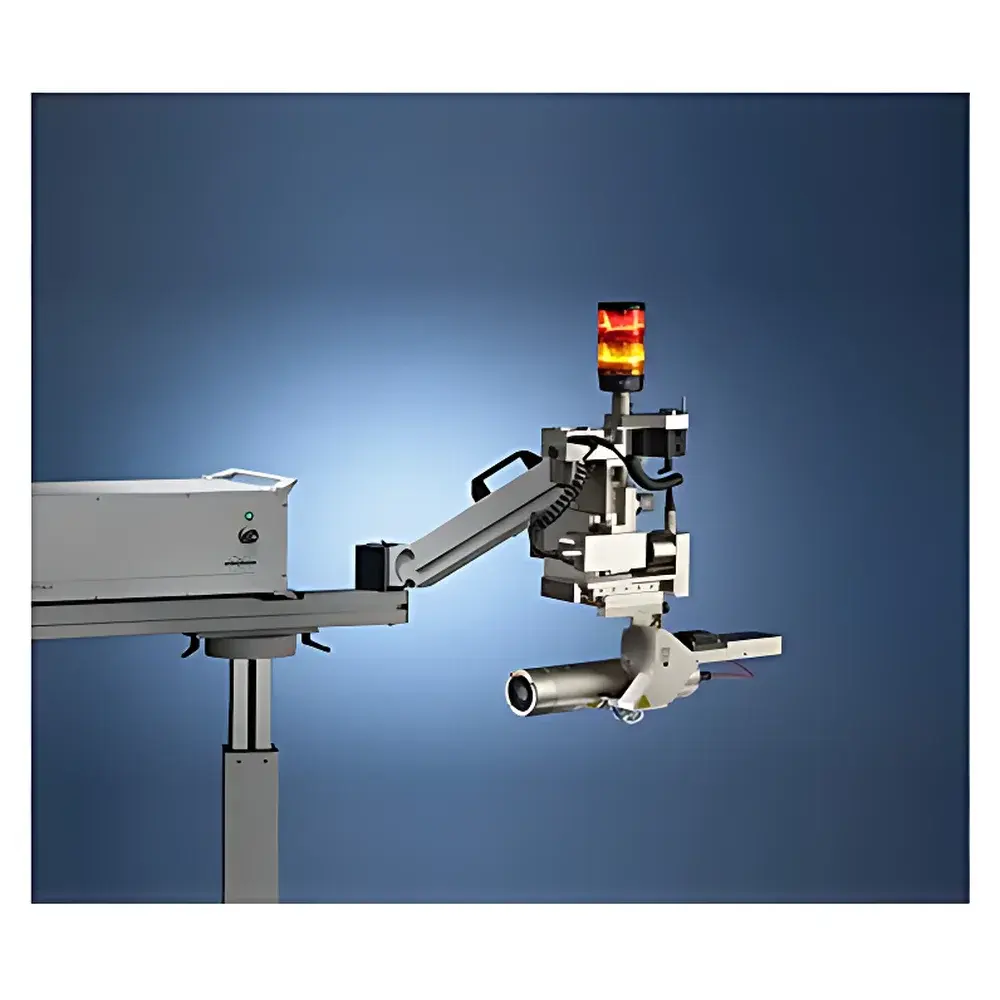
Bruker ARTAX Portable Micro-XRF Spectrometer
| Brand | Bruker |
|---|---|
| Origin | Germany |
| Model | ARTAX |
| Element Range | Na (11) – U (92) |
| Detection Limit | Down to 11Na with He purge |
| Energy Resolution | ≤165 eV at Mn Kα (100 kcps) |
| Spatial Resolution | ≤70 µm |
| Repeatability | ±10 µm |
| Detector | XFlash® Silicon Drift Detector (SDD), Peltier-cooled |
| Excitation | Low-power microfocus X-ray tube with interchangeable anodes & polycapillary optics |
| Sample Stage | Motorized XYZ positioning system with collision protection |
| Operating Mode | Benchtop / Field-deployable |
| Compliance | CE, IEC 61010-1, EN 62471 (UV/IR/X-ray safety) |
Overview
The Bruker ARTAX is a field-deployable, high-resolution micro-focus energy dispersive X-ray fluorescence (ED-XRF) spectrometer engineered for non-destructive, in-situ elemental analysis of culturally sensitive and immovable objects. Unlike conventional benchtop ED-XRF systems, the ARTAX integrates a compact excitation-detection head mounted on a motorized, tripod-based XYZ stage—enabling precise micro-regional analysis without sample removal or vacuum chamber constraints. Its core measurement principle relies on polycapillary-optic–focused X-ray excitation (spot size ≤70 µm), followed by high-count-rate detection using a Peltier-cooled XFlash® SDD detector. This architecture delivers quantitative multi-element data (Z = 11–92) with high spectral fidelity and spatial reproducibility (±10 µm), making it uniquely suited for applications where preservation integrity, operational flexibility, and regulatory traceability are paramount.
Key Features
- Microfocus X-ray source with interchangeable anodes (e.g., Cr, Cu, Mo, Rh) and high-transmission polycapillary optics—delivering >1000× higher photon flux at the sample compared to collimated tubes.
- XFlash® SDD detector with energy resolution ≤165 eV at Mn Kα (100 kcps); optional ultra-high-resolution configuration (<145 eV) available for enhanced peak separation in complex matrices.
- Motorized XYZ stage with integrated collision-safety logic, enabling automated point, line, and area mapping—fully programmable via SPECTRA software.
- Helium purge capability for light-element analysis (down to Na Kα, Z=11), eliminating need for vacuum while protecting hygroscopic or organic artifacts from desiccation or beam-induced damage.
- Integrated coaxial CCD camera and software-controllable alignment laser for real-time visual targeting and sub-millimeter registration accuracy.
- Modular excitation head design: rapid exchange of X-ray tubes and optical components without recalibration—supporting method-specific optimization across diverse sample classes.
- Radiation safety compliance: front-panel emergency stop, status-indicating warning LEDs, interlocked shielding, and dose-rate monitoring per IEC 61010-1 and EN 62471.
Sample Compatibility & Compliance
The ARTAX accommodates irregularly shaped, fragile, or oversized objects—including frescoes, archaeological ceramics, archival documents, metallic artifacts, and composite artworks—without physical contact or environmental alteration. Its helium-purged measurement geometry enables robust detection of low-Z elements (P, S, Cl, Al, Si) critical for pigment identification, corrosion product characterization, and provenance studies. The system meets EU CE marking requirements for laboratory and field instrumentation, adheres to ISO/IEC 17025-relevant measurement uncertainty principles, and supports GLP/GMP-aligned audit trails when used with SPECTRA’s 21 CFR Part 11–compliant configuration (electronic signatures, user access control, immutable data logging). All spectral acquisition and processing workflows are fully traceable and exportable in standardized formats (e.g., .csv, .rdb, .spc).
Software & Data Management
SPECTRA is Bruker’s dedicated XRF acquisition and analysis platform—designed for scientific rigor and regulatory readiness. It provides hardware synchronization for XYZ scanning, real-time spectrum visualization (up to 100 spectra simultaneously), automatic peak identification using fundamental parameter (FP) libraries, and background-subtracted net peak integration. Quantitative analysis employs the Direct Comparison of Counting Rates (DCCR) algorithm, which minimizes matrix-effect dependencies through empirical calibration against reference materials. The software supports creation of custom spectral libraries (up to 4 million spectra), similarity-based spectral matching, and hierarchical report generation compliant with museum conservation documentation standards. All raw and processed data—including instrument parameters, gas flow rates, laser coordinates, and stage positions—are embedded in metadata and archived with SHA-256 checksums.
Applications
The ARTAX serves as a primary analytical tool across heritage science and industrial QA/QC domains. In cultural heritage, it supports pigment stratigraphy in paintings, alloy composition mapping in ancient coins, and corrosion layer profiling on bronze statues—all without sampling. Forensic laboratories utilize its micro-spatial resolution for gunshot residue pattern analysis, ink differentiation in questioned documents, and trace metal screening on ballistic evidence. In advanced manufacturing, it performs coating thickness verification on aerospace components, solder composition checks in PCB assemblies, and contamination screening on semiconductor wafers. Its portability and helium-compatible operation also enable on-site analysis of geological outcrops, environmental soil cores, and industrial catalyst beds—where lab transport is impractical or prohibited.
FAQ
Does the ARTAX require liquid nitrogen cooling?
No—the XFlash® SDD detector uses solid-state Peltier cooling, eliminating cryogen dependency and enabling continuous field operation.
Can the system analyze light elements like sodium or magnesium in air?
Light-element detection below Ti (Z=22) requires helium purge; analysis in ambient air is limited to Z ≥ 22, but full Na–U coverage is achievable under He flow.
Is the XYZ stage compatible with irregular or vertically oriented objects?
Yes—the tripod-mounted kinematic platform allows arbitrary angular orientation and height adjustment; collision-sensing firmware prevents inadvertent contact with delicate surfaces.
How is data integrity ensured during long-term conservation projects?
SPECTRA supports time-stamped, user-logged acquisition sessions with cryptographic hashing, version-controlled method files, and exportable audit logs meeting ISO 14040 and ASTM E1318 requirements.
What maintenance is required for the polycapillary optic?
The optics are sealed and maintenance-free; performance stability is verified via daily automated energy calibration using built-in radioactive check sources (e.g., 55Fe).



