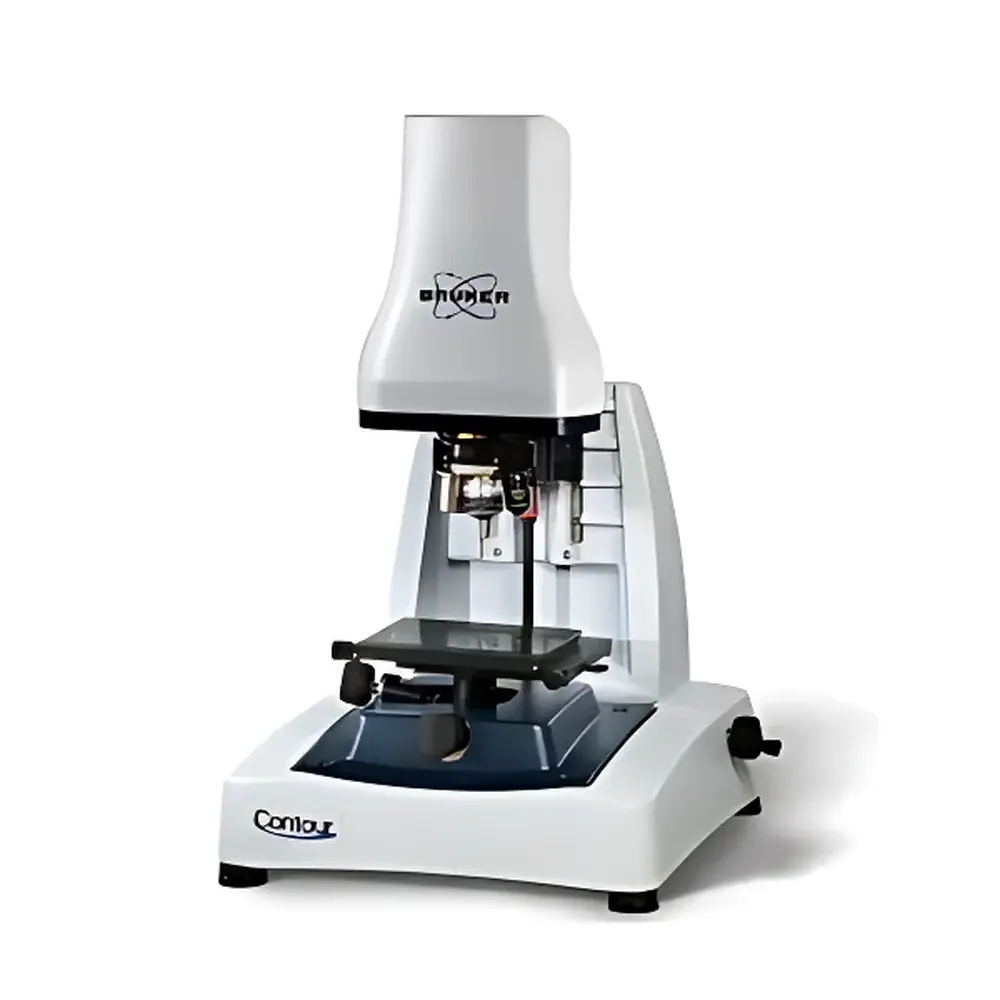
Bruker ContourX-100 White Light Interferometric Optical Profilometer
| Brand | Bruker |
|---|---|
| Origin | USA |
| Model | ContourX-100 |
| Product Type | Non-contact Optical Profilometer / Surface Roughness Analyzer |
| Operating Principle | White Light Interferometry (WLI) |
| Compliance Standards | ISO 25178, ASME B46.1, ISO 4287 |
| Field of View | Standard large FOV |
| Z-Axis Resolution | Magnification-independent |
| Vibration Isolation | Integrated high-stability passive isolation |
| Software Interface | Intuitive graphical user interface with pre-configured filters and analysis modules |
| Measurement Mode | Full-field 2D/3D topographic mapping |
Overview
The Bruker ContourX-100 is a benchtop white light interferometric (WLI) optical profilometer engineered for high-precision, non-contact surface topography and roughness metrology. Leveraging Bruker’s decades-long expertise in coherence scanning interferometry, the system delivers sub-nanometer vertical resolution and nanometer-level repeatability across a wide range of surface types — from polished optics and semiconductor wafers to textured MEMS structures and coated medical devices. Unlike stylus-based profilers, the ContourX-100 eliminates mechanical contact, preventing sample damage and enabling measurement of soft, fragile, or adhesive surfaces. Its core WLI principle relies on spatially resolved interference fringe analysis: broadband illumination generates localized interference patterns at the point of zero optical path difference, allowing pixel-by-pixel height reconstruction with exceptional fidelity. The system operates independently of objective magnification for Z-axis resolution — a critical advantage for multi-scale inspection workflows where consistent vertical metrology must be maintained across low- and high-magnification objectives.
Key Features
- True magnification-independent Z-axis resolution — ensures traceable vertical metrology regardless of objective selection (e.g., 2.5× to 100×)
- Large standard field-of-view (FOV) — enables rapid acquisition of statistically representative surface areas without stitching artifacts
- Integrated passive vibration isolation platform — provides robust measurement stability in standard laboratory environments without requiring external optical tables
- High-speed, full-field 3D data capture — acquires complete topographic maps in seconds, supporting throughput-critical QC and R&D applications
- Pre-calibrated, NIST-traceable height calibration — maintains long-term measurement integrity and supports ISO/IEC 17025-compliant lab accreditation
- Modular objective turret compatibility — accommodates standard infinity-corrected objectives for optimized lateral resolution and working distance flexibility
Sample Compatibility & Compliance
The ContourX-100 is validated for quantitative surface characterization of optically reflective to moderately diffuse surfaces, including silicon wafers, sapphire substrates, metallic coatings, polymer films, and thin-film stacks. It supports measurement of step heights from 1 mm, surface roughness (Sa, Sq, Sz) down to sub-0.1 nm, and areal texture parameters per ISO 25178-2. All analyses comply with internationally recognized standards: ISO 25178 (areal surface texture), ISO 4287 (profile-based roughness), and ASME B46.1 (surface texture nomenclature and parameters). Raw height data and metadata are stored in vendor-neutral formats (e.g., .xyz, .csv, .tif), facilitating third-party validation and audit readiness. The system architecture supports GLP/GMP-aligned workflows through optional audit trail logging and user access controls compliant with FDA 21 CFR Part 11 requirements.
Software & Data Management
Bruker’s Vision64 software provides a unified environment for acquisition, visualization, filtering, and reporting. Its workflow-driven interface includes over 30 ISO-compliant roughness and form analysis modules — such as power spectral density (PSD), bearing ratio (Abbott-Firestone curve), and motif analysis — all accessible via drag-and-drop or scriptable batch processing. Filter libraries include Gaussian, S-filter, L-filter, and robust polynomial fitting, configurable per ISO 16610. Reports are fully customizable and exportable in PDF, Excel, or HTML with embedded traceability metadata (operator ID, timestamp, instrument serial number, calibration certificate reference). Data integrity is preserved through immutable file hashing and optional database-backed storage with version control.
Applications
- Semiconductor process control: trench depth, CMP uniformity, lithography resist profile, and via sidewall angle quantification
- Optics manufacturing: scratch/dig assessment, coating thickness variation, and surface flatness verification on lenses and mirrors
- Medical device QA: surface finish evaluation of orthopedic implants, stent strut topography, and hydrophilic coating uniformity
- MEMS/NEMS development: actuator displacement mapping, release etch uniformity, and packaging-induced warpage analysis
- Academic materials research: grain boundary topography, corrosion pit morphology, and thin-film delamination quantification
FAQ
What surface reflectivity range is supported by the ContourX-100?
The system is optimized for surfaces with 1–100% reflectivity; semi-transparent or highly absorbing samples may require supplemental illumination or specialized objectives.
Can the ContourX-100 measure transparent thin films on substrates?
Yes — using phase-shifting WLI mode, it resolves film thickness and interfacial topography for single-layer dielectrics (e.g., SiO₂, Si₃N₄) with thicknesses from ~50 nm to several micrometers.
Is automated stage positioning available?
The base configuration includes manual XY stage; motorized XYZ stages and programmable tile-scan capabilities are optional upgrades for unattended multi-site metrology.
How is system calibration verified?
Height calibration is performed using NIST-traceable step-height standards; Bruker provides annual calibration services with documented uncertainty budgets aligned with ISO/IEC 17025.
Does Vision64 support scripting for custom analysis pipelines?
Yes — Python and MATLAB APIs are available for advanced users to develop and deploy proprietary algorithms within the Vision64 framework.