
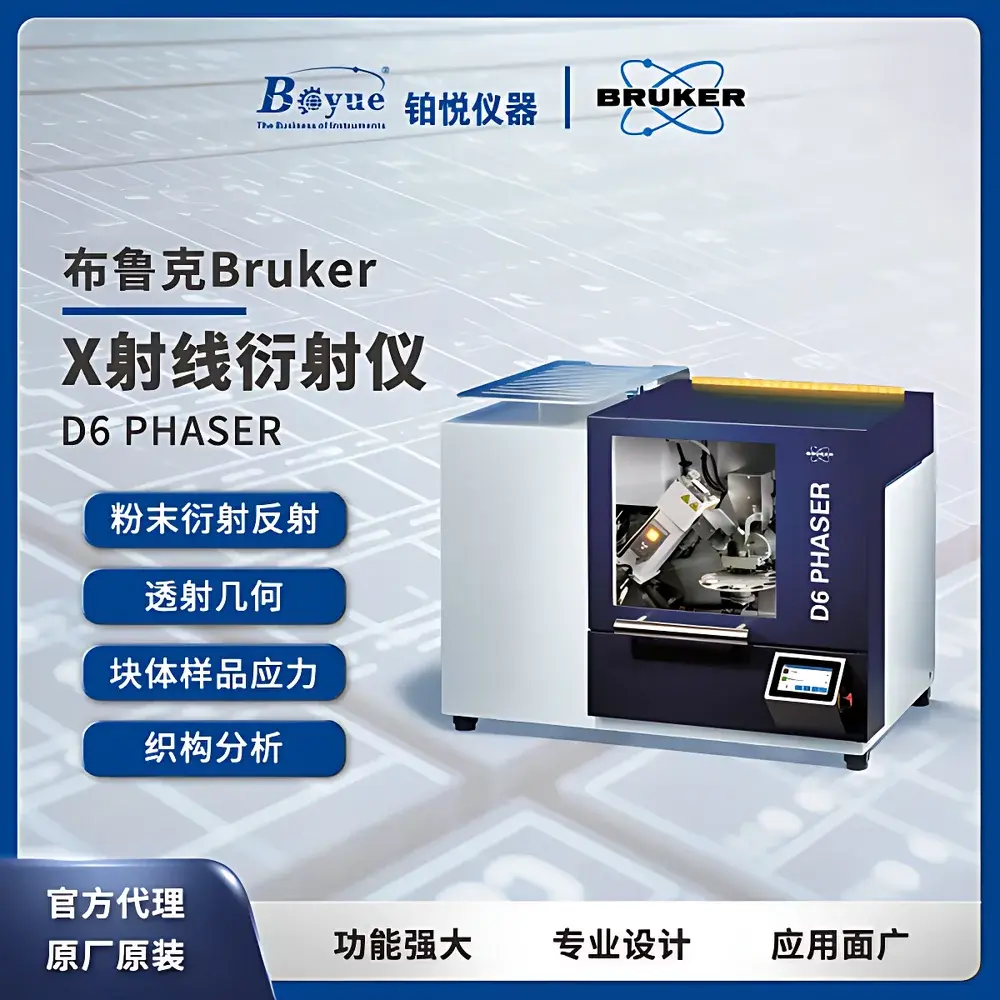
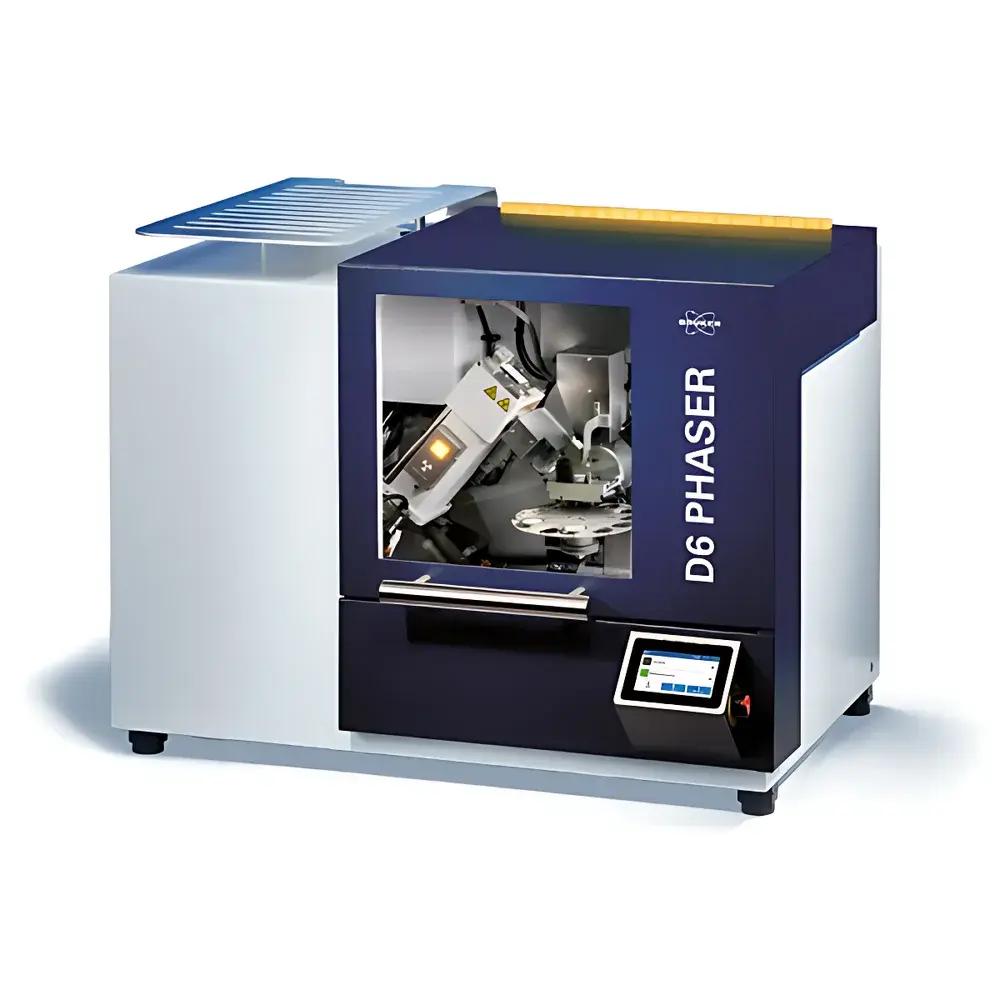
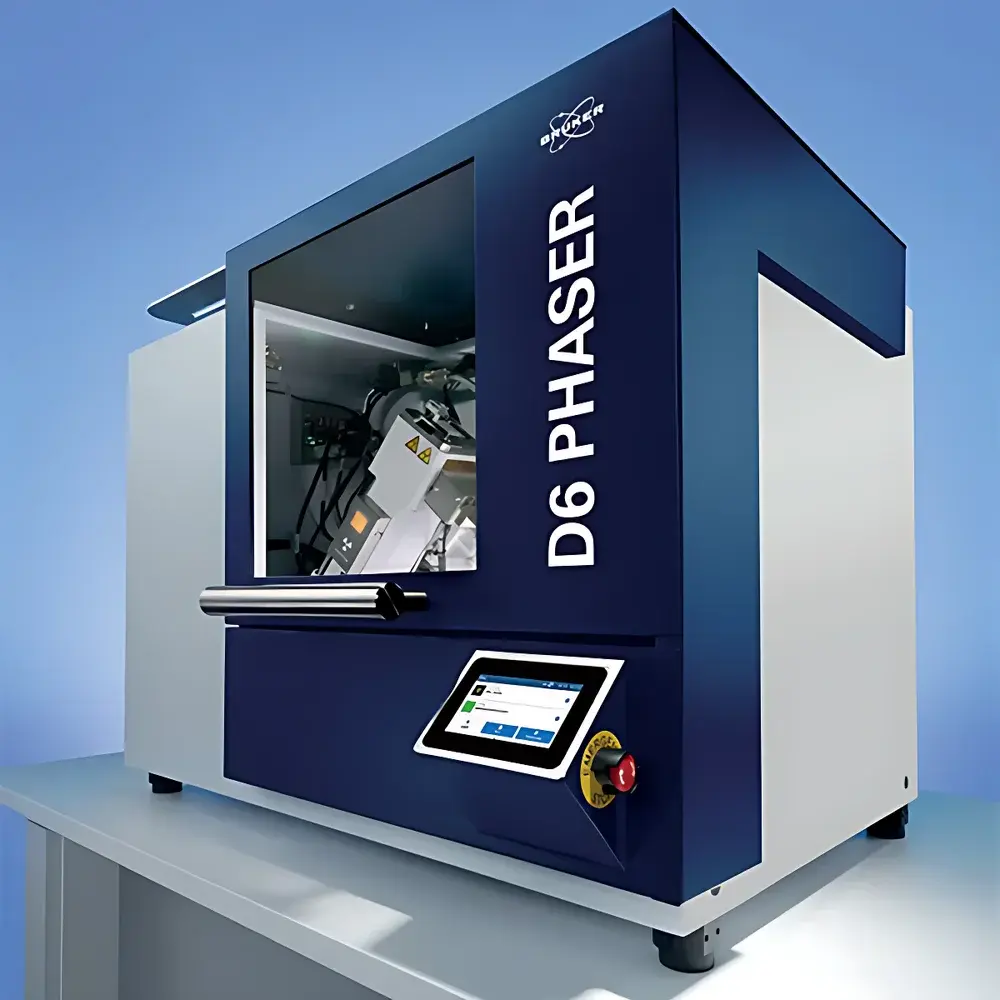

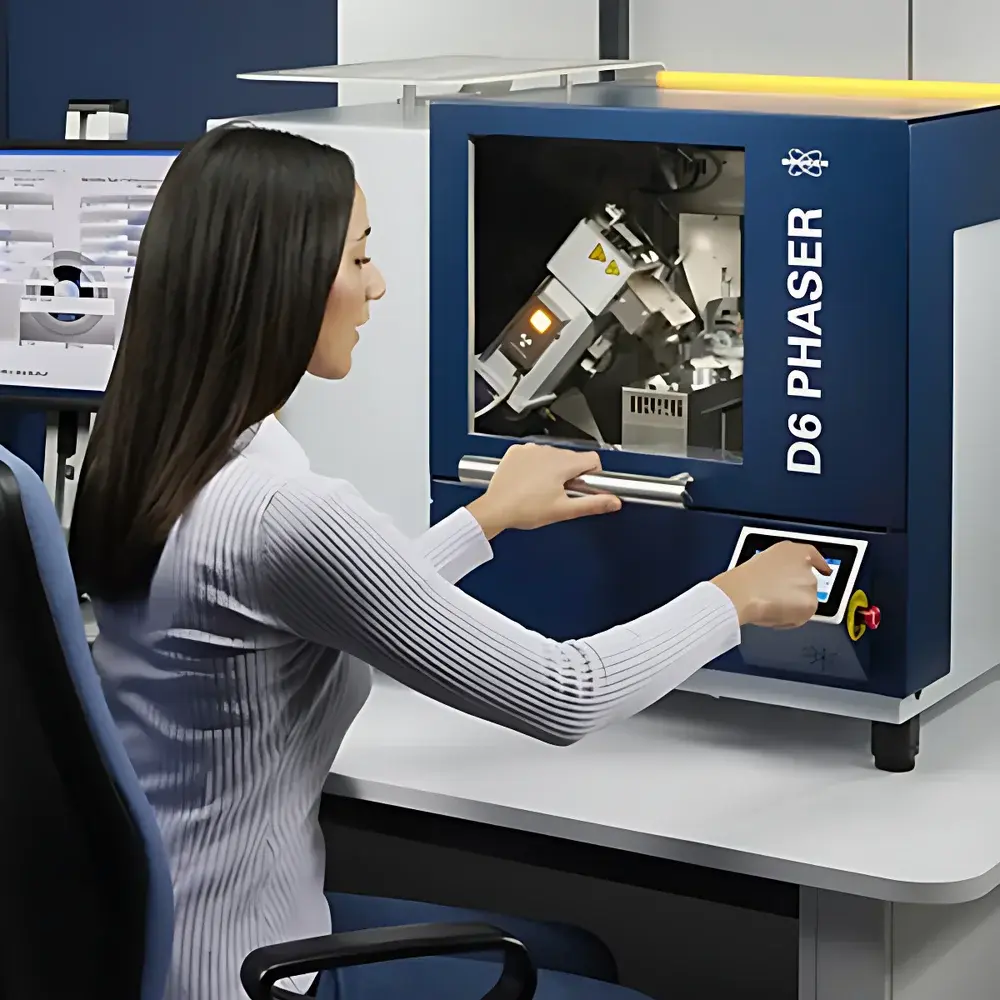
Bruker D6 PHASER Benchtop X-ray Diffractometer
| Brand | Bruker |
|---|---|
| Origin | Germany |
| Model | D6 PHASER |
| Instrument Type | Powder X-ray Diffractometer |
| Configuration | Benchtop |
| Power Options | 540 W / 600 W / 1.2 kW |
| Angular Accuracy | ±0.01° (2θ) |
| Angular Resolution | 0.01° |
| Detector | LYNXEYE XE-T Energy-Resolving Detector |
| Beam Geometry | Reflective & Transmission, Grazing Incidence (GID), X-ray Reflectivity (XRR), Stress & Texture Analysis |
| Automation | Motorized Sample Changer, Conveyor Interface, Dynamic Beam Optimization (DBO) |
| Software Suite | DIFFRAC.SUITE (MEASUREMENT CENTER, EVA), COD Database Integration |
| Compliance | Designed for GLP/GMP environments |
Overview
The Bruker D6 PHASER is a high-performance benchtop X-ray diffractometer engineered for precision powder X-ray diffraction (XRD), thin-film characterization, residual stress analysis, texture measurement, and in situ studies. Unlike conventional benchtop systems constrained to basic Bragg–Brentano geometry, the D6 PHASER implements a modular platform architecture that supports multiple beam geometries—including reflection, transmission, grazing incidence diffraction (GID), and X-ray reflectivity (XRR)—within a single compact footprint. Its core measurement principle relies on monochromatic Cu Kα radiation (λ = 1.5418 Å) generated by a sealed-tube X-ray source with selectable power outputs (540 W, 600 W, or 1.2 kW), coupled to a high-stability goniometer with sub-arcminute angular reproducibility. The system employs a LYNXEYE XE-T energy-resolving detector, enabling simultaneous acquisition of high-intensity, low-background diffraction patterns with intrinsic energy discrimination to suppress fluorescence and improve phase identification fidelity. Designed and manufactured in Germany, the D6 PHASER meets stringent mechanical and thermal stability requirements essential for long-term measurement repeatability across diverse sample classes—from nanocrystalline powders to polycrystalline bulk metals and epitaxial thin films.
Key Features
- Modular benchtop platform supporting powder XRD, GID, XRR, stress, and texture analysis without hardware reconfiguration
- High-power X-ray source options up to 1.2 kW with integrated closed-loop cooling, delivering enhanced flux for rapid data collection and weak-scatterer detection
- Dynamic Beam Optimization (DBO) technology—automatically adjusts optical alignment during sample stage or collimator changes to maintain peak position accuracy better than ±0.01° (2θ) across full angular range
- LYNXEYE XE-T detector with energy discrimination, enabling fluorescence suppression and improved signal-to-noise ratio in complex matrices
- Motorized sample changer with conveyor interface for unattended loading/unloading of up to 8 sample positions; compatible with standard sample holders and custom fixtures
- Touchscreen-driven user interface with guided workflows for method setup, calibration, and validation—no prior XRD expertise required
- Plug-and-play mechanical and electrical interfaces for rapid exchange of sample stages, slits, and beam-conditioning optics
- Integrated performance verification protocol with real-time feedback: automated assessment of peak position, intensity, and FWHM across four reference reflections; visual status indicators (green smiley/red frowny icons)
Sample Compatibility & Compliance
The D6 PHASER accommodates a broad spectrum of physical sample forms: free-flowing powders, pressed pellets, bulk solids, thin films on substrates, foils, coatings, and layered heterostructures. Optional accessories extend capability to non-ambient conditions (heating/cooling stages, humidity cells, gas environments). All configurations comply with IEC 61000-6-3 (EMC) and IEC 61000-6-4 emission standards. When deployed in regulated environments, the system supports configuration-controlled software operation under FDA 21 CFR Part 11 guidelines—including electronic signatures, role-based access control, and full audit trail logging for all measurement, calibration, and validation events. Hardware and firmware design align with ISO/IEC 17025 requirements for testing laboratories, facilitating traceable instrument qualification (IQ/OQ/PQ) and routine performance verification.
Software & Data Management
DIFFRAC.SUITE serves as the unified software environment for planning, acquisition, processing, and reporting. MEASUREMENT CENTER provides intuitive experiment definition—including scan type, step size, time per step, and detector settings—with live preview and auto-optimization suggestions. EVA enables rapid phase identification via search-match against the Crystallography Open Database (COD), quantitative Rietveld refinement, crystallinity estimation, crystallite size and microstrain analysis (using Williamson–Hall or Warren–Averbach methods), and PDF analysis. The suite supports batch processing, scripting (via Python API), and export to industry-standard formats (XYE, CIF, HDF5, CSV). For industrial users, two concurrent software licenses are included; academic institutions receive ten. All data files embed metadata (instrument parameters, calibration history, user ID, timestamp), ensuring full provenance for GLP/GMP-compliant documentation.
Applications
The D6 PHASER delivers validated analytical performance across multiple domains: pharmaceutical solid-form screening and polymorph quantification; battery cathode/anode material phase evolution during cycling; catalyst crystallinity and lattice parameter shifts under thermal treatment; metallurgical texture mapping in rolled alloys; residual stress profiling in additive-manufactured components; thin-film thickness, density, and interfacial roughness via XRR modeling; and amorphous content determination in cementitious or geological materials. Its ability to perform fast continuous scans (e.g., 5-minute full-pattern acquisitions) makes it suitable for high-throughput quality control, process monitoring, and materials discovery pipelines requiring statistical robustness across hundreds of samples.
FAQ
What sample types can be analyzed on the D6 PHASER?
Powders, pressed pellets, bulk metals, thin films (including multilayers), foils, coatings, and ceramics—provided appropriate sample stages and beam optics are selected.
Is the D6 PHASER compliant with regulatory requirements for pharmaceutical or medical device labs?
Yes—when configured with DIFFRAC.SUITE’s Part 11 mode, it supports electronic signatures, audit trails, and user access controls required for FDA-regulated environments.
How does Dynamic Beam Optimization (DBO) improve measurement reliability?
DBO dynamically compensates for mechanical drift and misalignment during component swaps, maintaining angular accuracy within ±0.01° (2θ) without manual recalibration.
Can the system perform Rietveld refinement and quantitative phase analysis?
Yes—DIFFRAC.EVA includes full Rietveld capabilities, including structure solution assistance, profile fitting, and weight-fraction quantification using internal or external standards.
What is the typical measurement time for a full 5–120° 2θ scan?
With 1.2 kW power and LYNXEYE XE-T detector, a high-S/N pattern over this range can be acquired in under 5 minutes at 0.02° step size and 0.5 s/step.





