
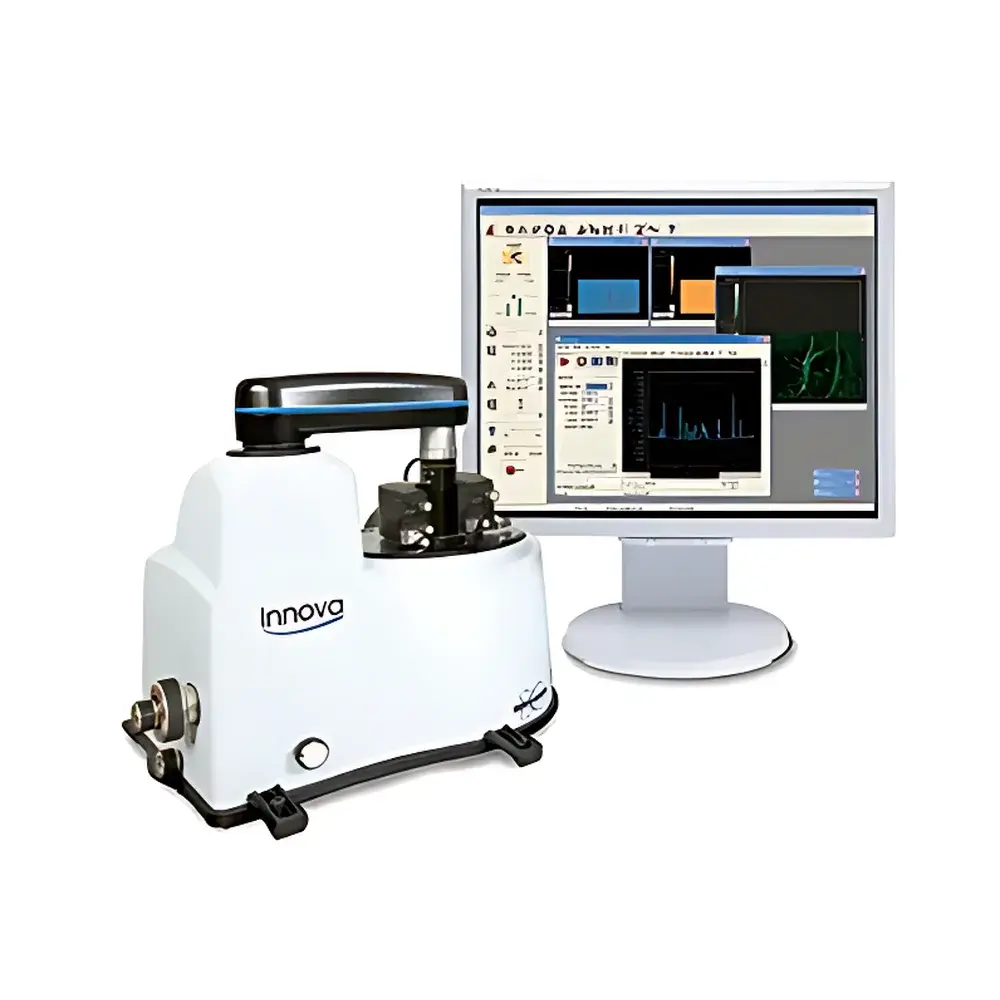
Bruker Innova Atomic Force Microscope
| Brand | Bruker |
|---|---|
| Origin | USA |
| Model | Innova |
| Instrument Type | Atomic Force Microscope (AFM) |
| Sample Stage Travel Range | 90 µm |
| Positional Detection Noise | < 0.1 nm (RMS, Z-axis, typical in air) |
| Maximum Sample Size Compatibility | 90 mm diameter × 25 mm height |
| Closed-Loop Scan Linearity | ±0.05% over full range |
| Z-Range | 10 µm (standard), upgradable to 15 µm |
| Optical Navigation Resolution | 1.3 MP color CCD with 4×–40× motorized zoom |
| AFM Mode Support | Contact, Tapping, Phase Imaging, Force Modulation, Lateral Force, Conductive AFM, Kelvin Probe Force Microscopy (KPFM), Magnetic Force Microscopy (MFM) |
Overview
The Bruker Innova Atomic Force Microscope (AFM) is a high-performance, materials-focused scanning probe microscope engineered for atomic-resolution surface topography and nanomechanical property mapping under ambient, liquid, or controlled environmental conditions. Based on the proven principles of dynamic and static force detection via piezoelectrically actuated cantilever deflection, the Innova implements a proprietary digital closed-loop scanning architecture that delivers sub-angstrom Z-positioning fidelity and linearized XY raster motion across its full 90 µm × 90 µm scan range—without mechanical hysteresis or creep-induced distortion. Unlike conventional open-loop systems, the Innova maintains RMS positional noise below 0.1 nm in Z while preserving the speed and responsiveness characteristic of analog open-loop designs. Its monolithic, low-thermal-drift mechanical platform—featuring short kinematic paths and passive vibration isolation—ensures long-term imaging stability, making it suitable for time-resolved studies, multi-hour force spectroscopy campaigns, and quantitative nanomechanical mapping compliant with ASTM E2546 and ISO/IEC 17025 frameworks.
Key Features
- Digital closed-loop XY scanning with real-time linearization and <0.05% geometric distortion across 90 µm range—enabling accurate metrology without post-acquisition correction
- Ultra-low-noise Z-sensor electronics (<0.05 nm RMS noise floor) coupled with 10 µm (extendable to 15 µm) vertical range for large-step topography and deep trench characterization
- Integrated high-resolution color optical microscope (1.3 MP, motorized 4×–40× zoom) with programmable autofocus and stage-coordinated navigation for rapid region-of-interest targeting
- Modular probe holder design supporting standard and specialty cantilevers (conductive, magnetic, high-speed, colloidal), enabling seamless mode switching without realignment
- Robust sample stage accommodating specimens up to 90 mm in diameter and 25 mm in height—compatible with wafers, MEMS chips, biological substrates, and geological thin sections
- On-the-fly closed-loop activation/deactivation during acquisition—permitting atomic-resolution zoom-in on arbitrary sub-regions without probe lift or stage repositioning
Sample Compatibility & Compliance
The Innova supports diverse sample classes without hardware modification: rigid inorganic substrates (Si, sapphire, quartz), soft polymeric films (PS, PMMA, PDMS), hydrated biological specimens (fixed cells, collagen fibrils, lipid bilayers), conductive thin films (ITO, graphene, metal oxides), and porous or rough geological samples. Its environmental chamber option enables controlled humidity (5–95% RH), temperature (−30 °C to +80 °C), and gas composition (N₂, Ar, O₂) operation. All firmware and data acquisition modules comply with FDA 21 CFR Part 11 requirements for electronic records and signatures when configured with audit-trail-enabled software; system validation documentation supports GLP and GMP laboratory environments per ISO 13485 and ICH Q5C guidelines.
Software & Data Management
Acquisition and analysis are performed using Bruker’s NanoScope Analysis v2.0+ platform—a validated, scriptable environment supporting batch processing, automated feature recognition (e.g., particle analysis, step-height quantification), and export to industry-standard formats (TIFF, HDF5, Gwyddion-compatible .spm). The software includes built-in compliance tools: electronic lab notebook (ELN) integration, user-access logging, version-controlled method templates, and raw-data immutability enforcement. Exported datasets retain full metadata—including scanner calibration constants, photodetector gain settings, and thermal drift compensation logs—ensuring traceability for regulatory submissions and inter-laboratory comparison studies.
Applications
- Materials science: Quantitative modulus mapping of polymer blends, grain boundary analysis in ceramics, defect identification in CVD-grown 2D materials
- Nanofabrication & MEMS: Critical dimension verification, sidewall angle measurement, release etch uniformity assessment
- Life sciences: Membrane protein clustering on supported bilayers, cytoskeletal remodeling dynamics, amyloid fibril morphology under physiological buffer
- Energy research: SEI layer evolution on battery electrodes, catalyst nanoparticle dispersion homogeneity, perovskite film grain coalescence kinetics
- Surface chemistry: Molecular self-assembly domain registration, Langmuir–Blodgett monolayer collapse thresholds, polymer brush conformation transitions
- Quality control: Wafer-level roughness certification (per SEMI F20), coating thickness uniformity on medical devices, adhesion failure root cause analysis
FAQ
Does the Innova require vacuum operation for atomic resolution?
No. Atomic-resolution imaging is routinely achieved in ambient air and liquid environments using appropriate probes and feedback tuning.
Can the same scanner handle both 1 µm and 90 µm scans without recalibration?
Yes. The digital closed-loop system maintains linearity and accuracy across the entire 90 µm range without hardware change or manual recalibration.
Is third-party software integration supported?
Yes—via Bruker’s documented API (C/C++, Python bindings) and standardized HDF5 data export, enabling interoperability with MATLAB, Python-based analysis pipelines, and LIMS platforms.
What level of training and application support is provided?
Bruker offers on-site installation qualification (IQ), operational qualification (OQ), and user-specific application workshops covering advanced modes (KPFM, MFM, force volume), metrology workflows, and regulatory documentation preparation.



