
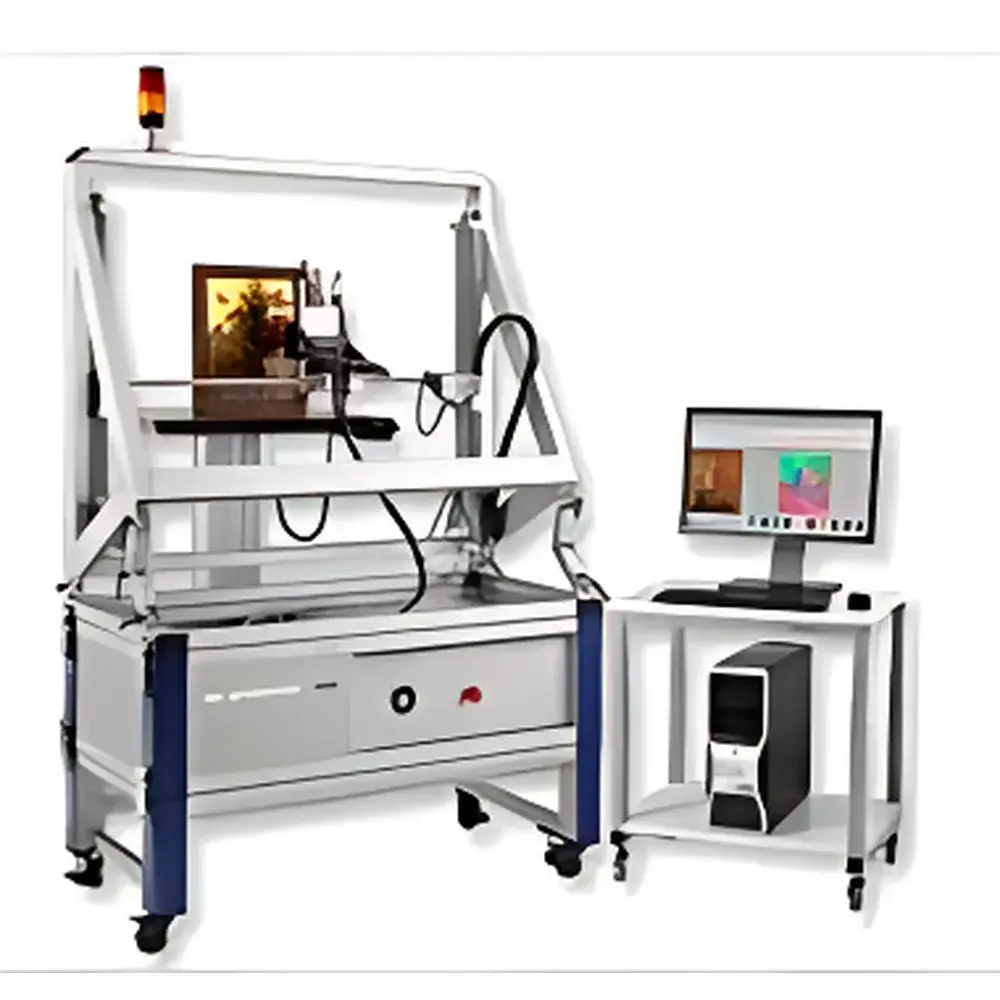
Bruker M6 JETSTREAM Micro-Focus Energy Dispersive X-Ray Fluorescence Spectrometer
| Brand | Bruker |
|---|---|
| Origin | Germany |
| Model | M6 JETSTREAM |
| Configuration | Benchtop/Floor-Standing |
| Application Field | Geological & Mineralogical Analysis |
| Elemental Range | Na (11) – U (92) |
| Quantification Range | 1 ppm – 99.99 wt% |
| Energy Resolution | <140 eV (Mn Kα) |
| Repeatability | ≤0.1% RSD |
| Detector | Silicon Drift Detector (SDD) |
| Sample Orientation | Vertical or Horizontal (motorized stage with collision avoidance) |
| Spot Size Adjustment | 5 discrete steps (25–400 µm) |
| Mobility | Modular disassembly into four transportable units |
Overview
The Bruker M6 JETSTREAM is a high-performance, micro-focus energy dispersive X-ray fluorescence (ED-XRF) spectrometer engineered for non-destructive, spatially resolved elemental analysis of heterogeneous solid samples. Unlike conventional benchtop ED-XRF systems, the M6 JETSTREAM integrates a high-brightness micro-focus X-ray tube (50 kV, 1 mA), precision motorized XYZ sample stage, and an ultra-low-noise silicon drift detector (SDD) to deliver laboratory-grade quantification with micrometer-scale lateral resolution. Its core measurement principle relies on primary X-ray excitation inducing characteristic secondary (fluorescent) X-rays from elements in the sample; photon energies are dispersed and counted by the SDD to generate quantitative elemental maps and spectra. Designed explicitly for geoscience, cultural heritage, and industrial failure analysis, the system operates under vacuum or helium purge to enhance light-element sensitivity (down to sodium), while maintaining full compliance with IEC 61000-6-3 (EMC) and IEC 62471 (photobiological safety) standards.
Key Features
- Micro-focus X-ray source with adjustable focal spot size: five discrete settings (25, 50, 100, 200, and 400 µm) enable optimized trade-offs between spatial resolution and detection sensitivity—critical for mineral zoning studies or inclusion analysis.
- Vertical/horizontal dual-mode sample positioning: motorized stage supports upright, inverted, or tilted geometries without manual reconfiguration—enabling direct analysis of drill cores, mounted thin sections, or irregularly shaped artifacts.
- Integrated ultrasonic proximity sensor: continuously monitors distance between X-ray optic and sample surface (±0.1 mm resolution), automatically halting motion if collision risk exceeds threshold—ensuring protection of both delicate samples and optics.
- High-throughput SDD detector: XFlash® 6|10 detector with >1 million cps maximum count rate and <140 eV energy resolution at Mn Kα (5.89 keV), preserving spectral fidelity across wide dynamic ranges (ppm to major-element concentrations).
- Modular mechanical architecture: instrument separates into four self-contained units (X-ray head, detector module, control electronics cabinet, and motorized stage)—each under 25 kg—for air-transport compliance and rapid deployment in field labs or museum conservation studios.
- Embedded radiation safety interlocks: hardware-based shutter control, door-integrated microswitches, and real-time dose-rate monitoring meet EU Directive 2013/59/Euratom requirements for user-operated X-ray equipment.
Sample Compatibility & Compliance
The M6 JETSTREAM accommodates samples up to 400 × 400 × 150 mm (L×W×H) and 5 kg mass, including unmounted rock slabs, polished thin sections, ceramic shards, metal alloys, and composite materials. Its open-stage design eliminates chamber constraints, allowing analysis of oversized or topographically complex specimens. All analytical protocols adhere to ISO 17025:2017 requirements for testing laboratories, with traceability to NIST SRM reference materials (e.g., SRM 278, Basalt Rock). For regulated environments—including GLP-compliant geochemical labs—the system supports audit trails, electronic signatures, and 21 CFR Part 11–compliant data archiving via optional Bruker ESPRIT software modules.
Software & Data Management
ESPRIT™ v2.5 (included) provides full workflow integration: automated spectral deconvolution using fundamental parameter (FP) algorithms, matrix-matched calibration curve generation, and pixel-by-pixel quantification for hyperspectral mapping. Raw spectra and map metadata are stored in vendor-neutral .spe/.img formats compliant with ASTM E1301-22 (standard guide for XRF data exchange). Batch processing supports ISO 18115-2:2019–aligned reporting, including uncertainty propagation per GUM (JCGM 100:2008). Data export options include CSV, TIFF, and HDF5—facilitating downstream integration with Python-based geochemical modeling tools (e.g., Geochemistry Workbench, Petrolog).
Applications
- Geosciences: In situ elemental mapping of drill core segments to identify hydrothermal alteration halos, sulfide distribution, or rare-earth element (REE) partitioning in granitic pegmatites—without sectioning or coating.
- Cultural Heritage: Non-invasive pigment identification on painted sculptures, gilded surfaces, or ceramic glazes; detection of restoration interventions via trace-element fingerprinting (e.g., Pb/Sn ratios in tin-opacified glazes).
- Failure Analysis: Rapid screening of weld zones, heat-affected regions, or corrosion products on turbine blades, pipeline sections, or aerospace castings—correlating compositional gradients with mechanical property degradation.
- Environmental Geochemistry: Quantitative analysis of As, Cd, Pb, and Hg in soil profiles or sediment cores at sub-ppm levels under He atmosphere—supporting EPA Method 6200 validation requirements.
FAQ
Does the M6 JETSTREAM require liquid nitrogen cooling?
No. The XFlash® SDD uses Peltier thermoelectric cooling, eliminating cryogen dependency and enabling continuous operation in field or mobile lab settings.
Can it analyze light elements below sodium (Z<11)?
Not natively. The system’s beryllium window and standard vacuum path limit detection to Na (Z=11) and above. Optional ultra-thin polymer windows and extended vacuum capability may permit limited F (Z=9) detection under controlled conditions.
Is spectral library matching supported for phase identification?
ESPRIT includes empirical library search (based on NIST XRF database), but phase identification requires complementary techniques (e.g., XRD) due to XRF’s inherent inability to resolve crystallographic information.
What maintenance intervals are recommended for the X-ray tube?
Bruker specifies 15,000 hours nominal lifetime under standard operating conditions (30 kV/0.5 mA); preventive replacement is advised after 12,000 hours in high-duty-cycle applications such as routine core scanning.
How is data integrity ensured during long-duration mapping runs?
Hardware-level watchdog timers reset the detector ASIC upon communication timeout; all spectrum acquisitions are timestamped and checksum-verified before storage, with automatic recovery from power interruption via resume-from-last-position functionality.





