
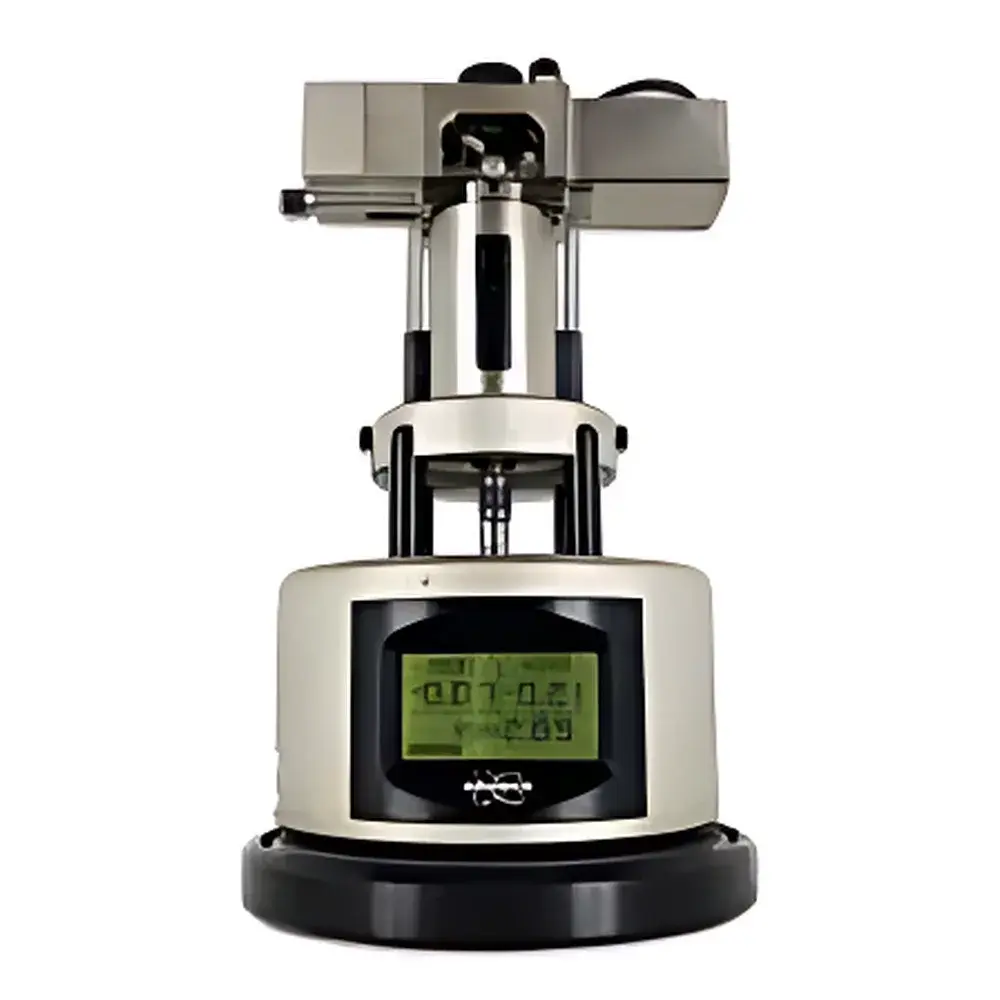
Bruker MultiMode 8 Atomic Force Microscope
| Brand | Bruker |
|---|---|
| Origin | Germany |
| Model | MultiMode 8 |
| Instrument Type | Materials-Focused AFM |
| XY Positioning Noise | ≤0.15 nm |
| Maximum Sample Diameter | ≤15 mm |
| Maximum Sample Thickness | ≤5 mm |
| Sample Stage Travel Range | 180 mm × 180 mm (visible area) |
| Controller | NanoScope® V |
Overview
The Bruker MultiMode 8 Atomic Force Microscope (AFM) is a high-performance, materials-oriented scanning probe microscope engineered for nanoscale topographic and quantitative property mapping under ambient, liquid, or controlled environmental conditions. Based on Bruker’s proven cantilever-based dynamic force sensing architecture, the system operates primarily in PeakForce Tapping® mode—a proprietary force-controlled intermittent-contact technique that decouples tip–sample interaction force from scan parameters, enabling stable, low-noise imaging across soft, fragile, or heterogeneous surfaces. Its rigid mechanical design, combined with the NanoScope® V controller featuring industry-leading bandwidth (>2 MHz analog bandwidth) and ultra-low electronic noise floor (<0.15 nm RMS XY positioning noise), ensures exceptional resolution and measurement reproducibility—critical for peer-reviewed publication and regulatory-compliant materials characterization.
Key Features
- PeakForce QNM (Quantitative Nanomechanical Mapping): Delivers simultaneous, pixel-resolved quantification of elastic modulus, adhesion, deformation, and dissipation—without requiring complex calibration or post-processing assumptions.
- PeakForce TUNA (Tunneling AFM): Enables nanoscale current mapping with picoampere sensitivity and sub-10 nm spatial resolution, supporting quantitative conductivity and local density of states analysis beyond conventional conductive AFM limitations.
- ScanAsyst-HR: A high-speed imaging module that maintains sub-nanometer resolution at scan rates up to 20× faster than conventional tapping-mode AFM, significantly improving throughput for large-area surveys or time-resolved studies.
- Environmental Flexibility: Fully compatible with liquid cells, temperature-controlled stages (−35 °C to +250 °C), and inert-atmosphere enclosures (O₂/H₂O < 1 ppm), enabling correlative measurements under physiologically relevant or industrially stringent conditions.
- NanoScope® V Controller: Integrates real-time signal processing, advanced feedback algorithms, and hardware-accelerated data acquisition—optimized for compliance with GLP/GMP documentation requirements including audit trails and electronic signature support per FDA 21 CFR Part 11.
Sample Compatibility & Compliance
The MultiMode 8 accommodates samples up to 15 mm in diameter and 5 mm in thickness, with a motorized 180 mm × 180 mm visible-stage travel range for precise region-of-interest navigation. Its modular stage interface supports ISO-standard sample holders and custom fixtures for wafer-level or device-integrated metrology. The platform conforms to key international standards for nanoscale measurement traceability—including ISO/IEC 17025 (for accredited labs), ASTM E2539 (standard guide for AFM terminology and practice), and USP (for nanomaterial characterization in pharmaceutical development). All quantitative modes are validated against NIST-traceable reference materials, and raw data files (.spm, .wsx) retain full metadata for third-party verification.
Software & Data Management
Acquisition and analysis are performed using Bruker’s NanoScope Analysis software (v2.0+), which provides automated feature recognition, batch processing pipelines, statistical surface metrology (per ISO 25178), and export-ready reporting templates aligned with journal submission guidelines (e.g., Nature, ACS, RSC). Data integrity is enforced through versioned project files, timestamped acquisition logs, and optional integration with LIMS or ELN systems via secure REST API. All quantitative outputs include uncertainty estimates derived from instrument noise floors, thermal drift compensation, and probe geometry corrections—ensuring metrological rigor required for patent applications or regulatory filings.
Applications
The MultiMode 8 serves as a foundational tool in academic and industrial R&D laboratories across disciplines: polymer nanocomposite phase segregation analysis (ASTM D7904); battery electrode SEI layer morphology and mechanical degradation mapping; semiconductor gate oxide defect inspection; protein–ligand binding force spectroscopy in buffer; ferroelectric domain switching dynamics; and graphene defect density quantification. Its ability to correlate topography with nanomechanical, electrical, and thermal properties—within a single experimental session—makes it indispensable for structure–property relationship studies compliant with DOE, NSF, and Horizon Europe funding mandates.
FAQ
Is the MultiMode 8 compatible with third-party probes?
Yes—it accepts standard 125 µm × 125 µm × 40 µm silicon or silicon nitride cantilevers with reflective coatings, adhering to ISO/TC 201 specifications.
Can PeakForce QNM data be exported for machine learning training?
Yes—raw force–distance curves and parameter maps are exportable in HDF5 and ASCII formats, preserving full metadata for supervised model development.
Does the system support automated tip exchange?
No—tip exchange requires manual alignment; however, Bruker offers the AutoProbe™ accessory kit for semi-automated cantilever loading and coarse alignment.
What level of training and application support is provided?
Bruker delivers on-site installation qualification (IQ), operational qualification (OQ), and user training covering ISO 17025-aligned SOP development, measurement uncertainty estimation, and journal-ready figure generation.
Is remote diagnostics supported?
Yes—the NanoScope V controller includes encrypted remote access via Bruker’s SecureConnect™ protocol, enabling real-time troubleshooting by certified field engineers without compromising lab network security.




