
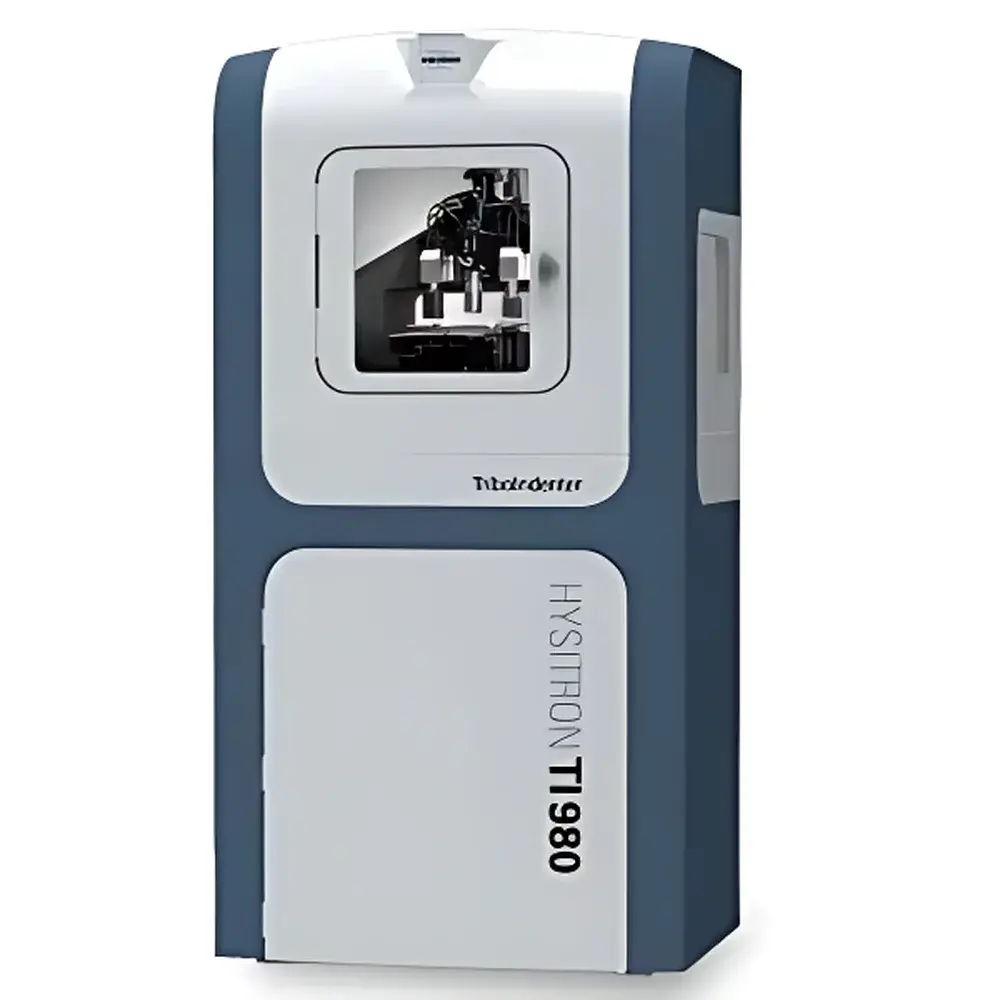
Bruker TI 980 TriboIndenter Nanoindentation and Nanotribology Testing System
| Brand | Bruker |
|---|---|
| Origin | USA |
| Manufacturer Type | Authorized Distributor |
| Origin Category | Imported |
| Model | TI 980 |
| Price Range | USD $260,000 – $390,000 |
Overview
The Bruker TI 980 TriboIndenter is a high-precision, modular nano-mechanical and nanotribological characterization platform engineered for quantitative measurement of mechanical properties at the nanoscale. Based on decades of innovation in contact mechanics and dynamic indentation methodology, the system employs a closed-loop electrostatic actuator architecture with real-time force–displacement feedback control operating at 76.9 kHz (13 µs cycle time), enabling true transient response capture during indentation, scratch, and dynamic modulus mapping experiments. It operates on the fundamental principles of Oliver–Pharr analysis for hardness and reduced elastic modulus extraction, extended to include time-dependent viscoelastic modeling, strain-rate sensitivity quantification, and interfacial shear strength assessment via controlled lateral loading. Designed for research laboratories and industrial R&D centers requiring traceable, GLP-compliant nanomechanical data, the TI 980 delivers sub-nanonewton force resolution (< 50 nN RMS noise) and sub-angstrom displacement sensitivity (< 0.05 nm RMS noise), supporting measurements across six orders of magnitude in load (10 nN – 100 mN) and ten orders in displacement (0.01 nm – 1 mm).
Key Features
- Performech® II high-bandwidth control electronics with 76.9 kHz real-time feedback loop for dynamic mechanical testing and transient event capture
- Multi-sensor architecture supporting interchangeable transducers: high-stiffness piezoresistive sensors for ultra-low-load indentation (down to 10 nN), high-force capacitive sensors for micro-scale testing (up to 100 mN), and dedicated lateral force modules for nanoscratch and friction coefficient mapping
- Integrated high-resolution optical navigation stage with 10×–100× zoom optics and automated surface topography search for rapid region-of-interest localization
- Modular test head design accommodating interchangeable probe geometries: Berkovich, cube-corner, spherical (R = 1–100 µm), flat-punch, and custom AFM-integrated tips
- Environmental isolation enclosure with vibration damping, acoustic shielding, and optional temperature-controlled chamber (–40 °C to 200 °C) for in situ thermomechanical studies
- Universal sample stage with mechanical clamping, magnetic fixation, and vacuum chuck options for substrates ranging from brittle ceramics to soft polymers and biological tissues
Sample Compatibility & Compliance
The TI 980 supports heterogeneous sample classes including thin films (≥5 nm), bulk metals, semiconductors, glasses, polymers, hydrogels, and composite coatings. Its non-destructive, localized probing enables property mapping without macroscopic sample preparation. The system complies with ASTM E2546–22 (Standard Test Method for Instrumented Indentation Testing), ISO 14577–1:2022 (Metallic materials — Instrumented indentation test), and USP (Mechanical Characterization of Pharmaceutical Solids). Audit-trail functionality, electronic signatures, and 21 CFR Part 11–compliant software modules (TriboScan™ 10 and Tribo iQ™) support regulated environments under GMP/GLP frameworks.
Software & Data Management
TriboScan™ 10 provides experiment orchestration with XPM (eXtended Property Mapping) for high-throughput nanoindentation arrays, SPM+ for synchronized in situ scanning probe imaging, and AutoCalibrate for fully automated tip area function validation, thermal drift compensation, and frame stiffness correction. Tribo iQ™ delivers advanced post-processing: depth-sensing creep analysis, Weibull statistics for fracture probability modeling, phase identification via clustering algorithms on multi-parameter datasets (load, displacement, acoustic emission, lateral force), and customizable report generation with embedded metadata per ASTM E2546 Annex A3. All raw data are stored in vendor-neutral HDF5 format with SI-traceable units and version-controlled processing scripts.
Applications
- Thin-film adhesion strength quantification via progressive-load scratch testing with critical load (Lc) determination per ISO 20502
- Spatially resolved elastic modulus and hardness mapping of battery electrode cross-sections (e.g., NMC cathodes, Si anodes) under inert atmosphere
- Time-dependent mechanical behavior of biomedical hydrogels: stress relaxation, creep recovery, and frequency-domain storage/loss modulus via dynamic nanoindentation
- Nanoscale wear track morphology and coefficient of friction evolution in lubricated tribological interfaces
- Interfacial delamination kinetics in multilayer optical coatings subjected to thermal cycling
- High-throughput screening of combinatorial material libraries using automated grid-based indentation arrays
FAQ
What is the minimum measurable force resolution, and how is it verified onsite?
The system achieves ≤50 nN RMS force noise under standard lab conditions. Verification is performed during installation using NIST-traceable calibration standards and documented in the Certificate of Conformance per ISO/IEC 17025 requirements.
Can the TI 980 perform simultaneous nanomechanical testing and in situ SPM imaging?
Yes — the SPM+ module integrates a low-noise AFM head co-aligned with the indenter axis, enabling real-time topographic and mechanical property correlation at sub-10 nm lateral resolution.
Is thermal drift compensation automated during long-duration creep or relaxation tests?
Yes — TriboScan™ 10 implements continuous thermal drift monitoring via reference cantilever deflection and applies real-time displacement offset correction without interrupting test execution.
Does the system support third-party probe integration, such as conductive or heated tips?
Yes — the modular probe interface supports OEM and custom probes with electrical feedthroughs (for nano-electrical-mechanical testing) and integrated heating elements (for temperature-dependent modulus mapping).
How is data integrity ensured in regulated pharmaceutical or aerospace QA/QC workflows?
Tribo iQ™ includes role-based access control, immutable audit logs, electronic signature workflows, and 21 CFR Part 11–compliant electronic records generation — all validated per IQ/OQ protocols supplied with the system.



