
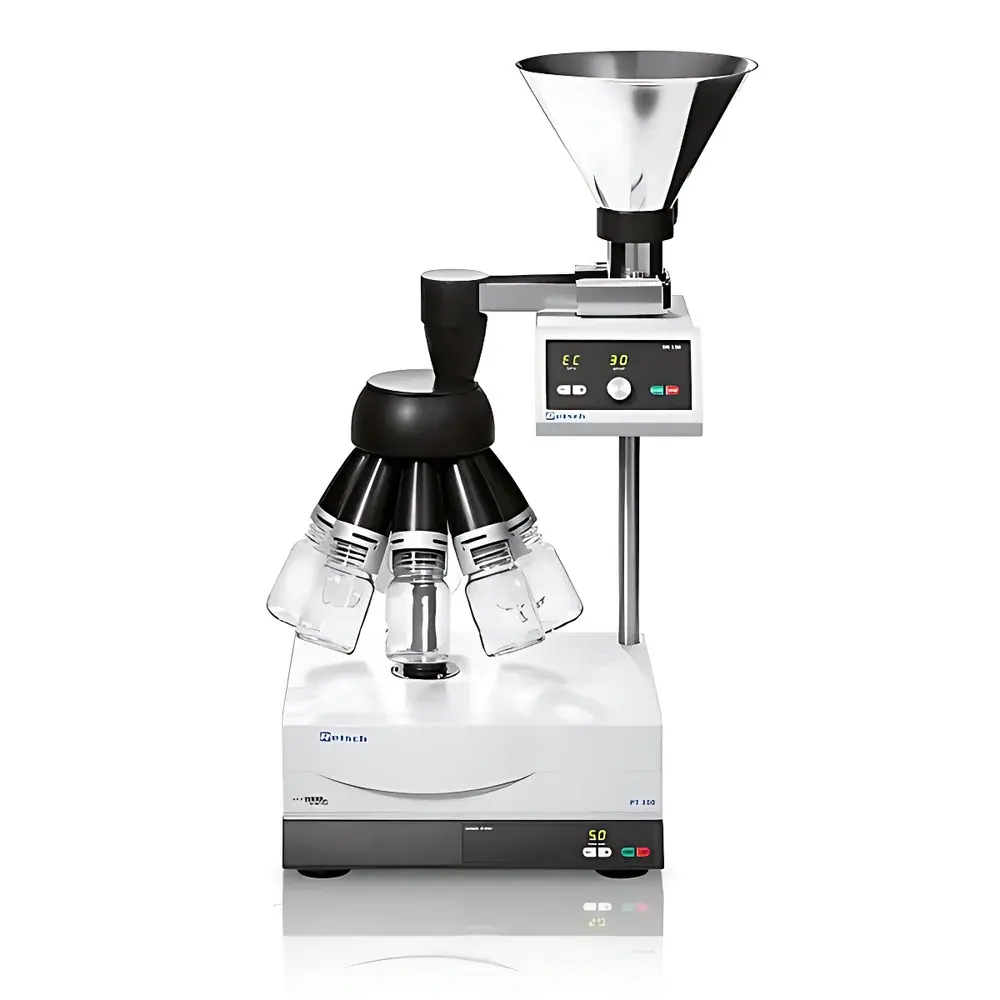
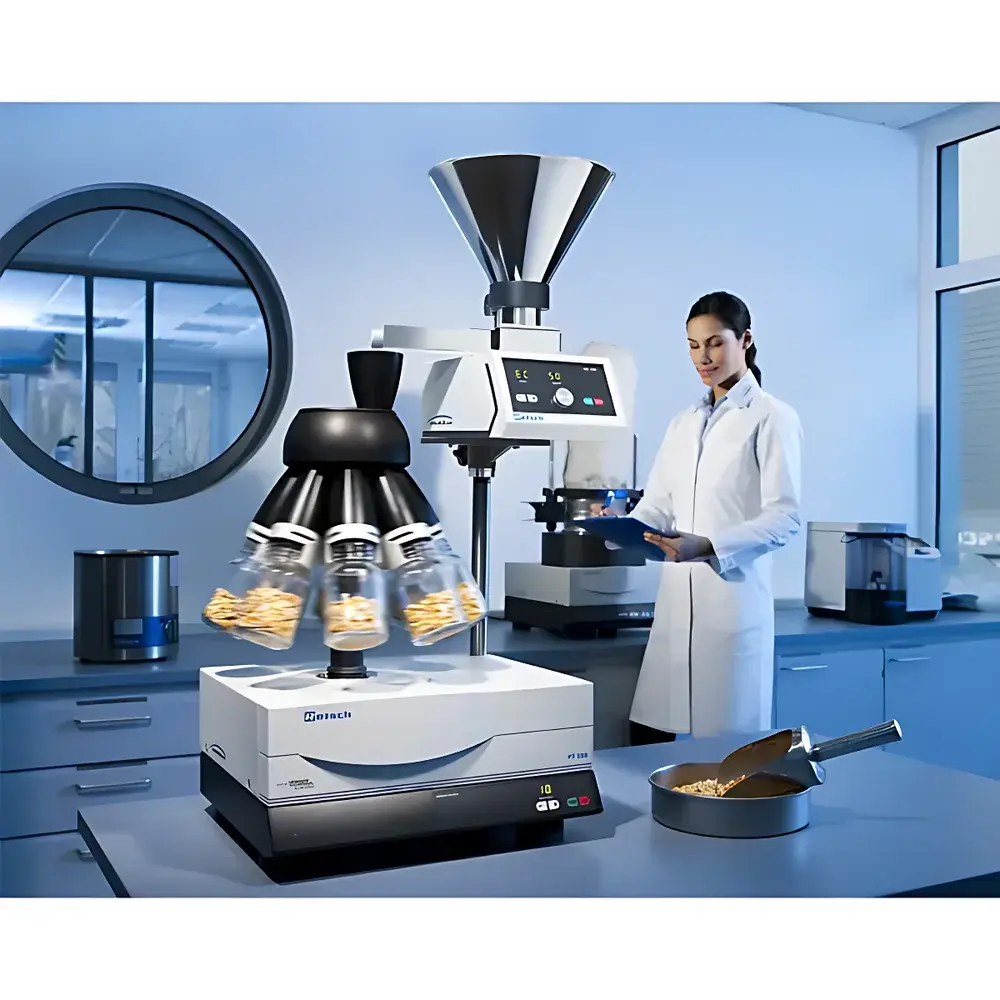
RETSCH PT 100 Rotary Sample Divider
| Brand | RETSCH |
|---|---|
| Origin | Germany |
| Model | PT 100 |
| Sample Capacity | ≤ 5000 mL |
| Feed Particle Size | ≤ 10 mm |
| Number of Subsamples | 6 / 8 / 10 |
| Rotational Speed | 110 min⁻¹ |
| Division Time | Digital setting (1, 3, 5, 10–60 min or continuous) |
| Container Volumes | 30 mL / 100 mL / 250 mL / 500 mL |
| Power Supply | 100–240 V, 50/60 Hz |
| Dimensions (W × H × D) | 580 × 910 × 420 mm (including DR 100 feeder) |
| Net Weight | ~33.5 kg |
| Compliance | CE |
Overview
The RETSCH PT 100 Rotary Sample Divider is a precision-engineered instrument designed for representative sample subdivision of bulk, free-flowing granular and powdered materials in accordance with standardized sampling protocols. Based on the rotary riffling principle—where material is evenly distributed across multiple collection vessels via a rotating, symmetrical divider head—the PT 100 ensures high reproducibility and minimal segregation bias during subsampling. Its operation complies with fundamental principles outlined in ISO 13320 (particle size analysis—sampling considerations), ASTM D7429 (standard practice for sampling of particulate materials), and EN 15051 (soil quality—sampling of soil and waste). The system integrates seamlessly with the optional DR 100 vibratory feeder to enable controlled, uniform feed rate and eliminate operator-induced variability—a critical requirement for GLP-compliant laboratories and quality control environments where traceability and process consistency are mandated.
Key Features
- Modular architecture supporting flexible configuration: standalone operation or integration with DR 100 automated feeder for repeatable mass flow control.
- Digital timer interface with selectable division durations (1, 3, 5, 10–60 minutes) and continuous mode—enabling precise control over total processed mass and subsample number.
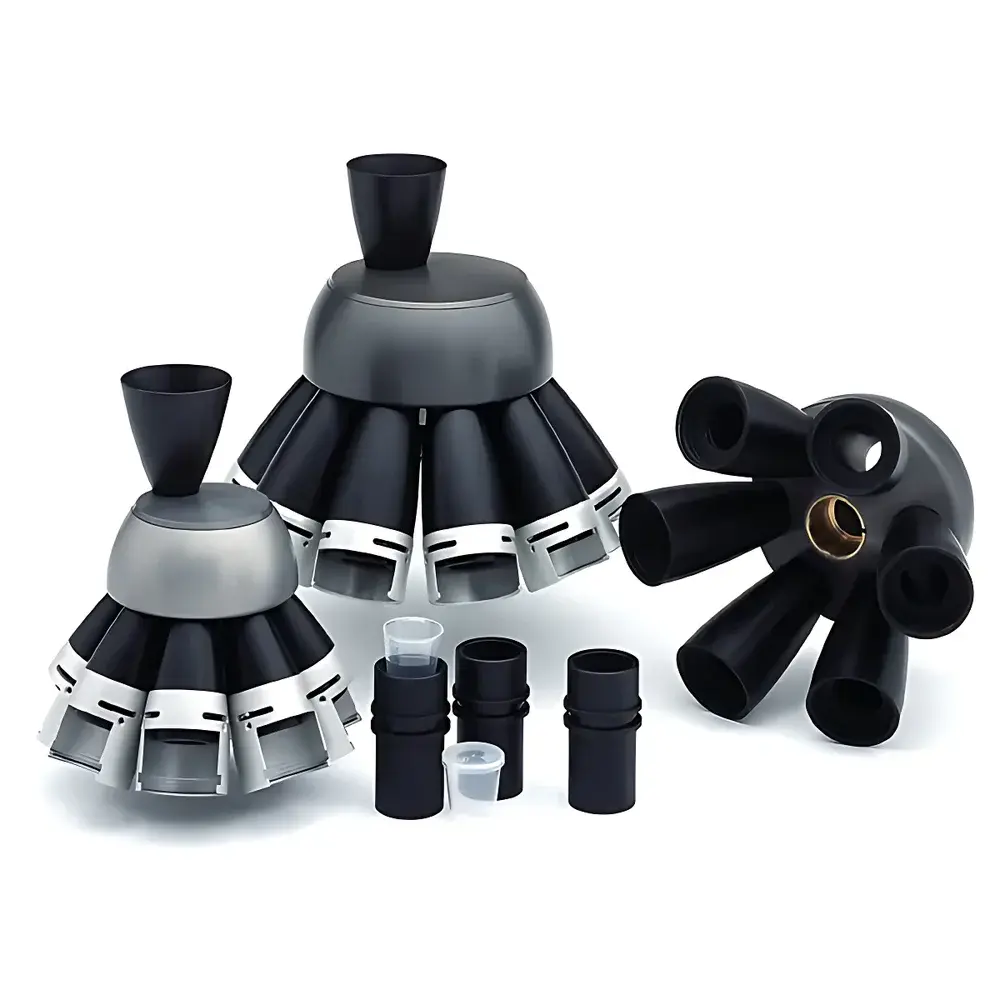
- Three standard subsample configurations: 6-, 8-, or 10-way division, configurable via interchangeable divider heads to match analytical throughput and regulatory reporting requirements.
- Rapid-lock container system enabling tool-free attachment/detachment of sample bottles (30 mL, 100 mL, 250 mL, and 500 mL options), minimizing cross-contamination risk and cleaning downtime.
- Stable 110 rpm rotational speed maintained via brushless DC motor and integrated speed monitoring—ensuring consistent centrifugal distribution across all outlet channels.
- Compact footprint (580 × 910 × 420 mm) and maintenance-free drive train; no lubrication or periodic belt replacement required—optimized for high-usage laboratory and production QC settings.
Sample Compatibility & Compliance
The PT 100 is validated for handling dry, non-cohesive, and moderately cohesive particulates with maximum particle size ≤ 10 mm and batch volume up to 5000 mL. It accommodates heterogeneous matrices common in agricultural feedstocks, pharmaceutical excipients, metallurgical ores, construction aggregates, recycled electronic waste fractions, and ceramic raw materials. All wetted components are constructed from corrosion-resistant stainless steel (AISI 304) and food-grade polymers compliant with EU Regulation (EC) No. 1935/2004. The device bears CE marking per Directive 2014/30/EU (EMC) and 2014/35/EU (LVD), confirming conformity with essential health and safety requirements for electrical equipment within the European Economic Area.
Software & Data Management
While the PT 100 operates as a stand-alone electromechanical instrument without embedded firmware or network connectivity, its operational parameters—including division time, selected subsample count, and start/stop timestamps—are manually recorded in laboratory notebooks or integrated into LIMS workflows via external documentation. For laboratories operating under FDA 21 CFR Part 11 or ISO/IEC 17025, full audit trails require manual entry of run logs with operator ID, sample ID, and calibration verification status (e.g., speed verification using external tachometer). Optional accessories such as calibrated volumetric flasks and certified reference standards support metrological traceability aligned with ISO/IEC 17025 clause 6.4.10.
Applications
- Agriculture: Subdivision of grain, seed, fertilizer, and soil samples prior to nutrient analysis or mycotoxin screening.
- Pharmaceuticals: Representative splitting of active pharmaceutical ingredients (APIs), excipients, and blended powders for content uniformity testing (USP <905>).
- Geology & Metallurgy: Preparation of ore and slag samples for XRF, ICP-OES, or fire assay—reducing heterogeneity-related measurement uncertainty.
- Construction Materials: Homogenization and reduction of cement, sand, and asphalt mixtures for compressive strength and composition testing.
- Environmental Testing: Processing of municipal solid waste, fly ash, and contaminated soils for leaching studies (e.g., TCLP, EN 12457).
- Food & Feed: Regulatory sampling of flour, spices, dairy powders, and pet food for microbiological and nutritional profiling.
FAQ
What sample types are unsuitable for the PT 100?
Materials exhibiting strong cohesion, moisture sensitivity, electrostatic charge, or fibrous morphology (e.g., wet clays, cellulose fibers, or hygroscopic salts) may cause bridging or channeling—compromising division accuracy. Pre-drying or anti-static treatment may be necessary.
Is the PT 100 compatible with GMP/GLP documentation requirements?
Yes—when used with documented procedures, operator training records, and periodic performance verification (e.g., speed calibration, mass balance checks), it supports compliance with Annex 11, USP <1058>, and ISO/IEC 17025 clause 7.7.
Can the PT 100 be validated for use in regulated environments?
Yes—qualification can be performed per IQ/OQ protocols covering mechanical integrity, speed stability, container alignment tolerance, and subsample mass variance (target RSD ≤ 3% across n = 10 replicates).
Does RETSCH provide calibration services for the PT 100?
RETSCH-certified service technicians offer on-site OQ verification, including rotational speed validation with NIST-traceable tachometers and dimensional inspection of divider head symmetry.
What maintenance is required?
None beyond routine visual inspection and cleaning of the divider head, feed chute, and bottle adapters with ethanol or isopropanol; no scheduled lubrication or component replacement is specified in the operating manual.



