
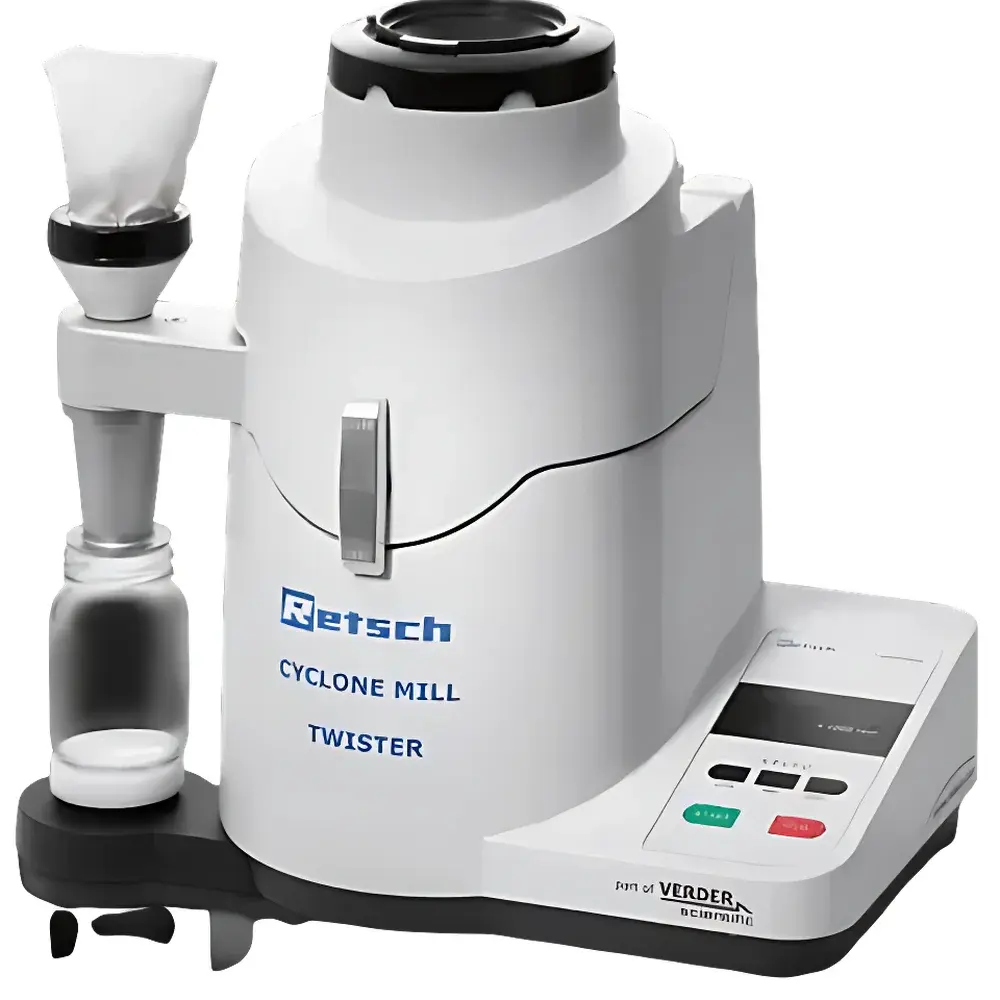
RETSCH TWISTER Cyclone Mill
| Brand | RETSCH |
|---|---|
| Origin | Germany |
| Model | TWISTER |
| Instrument Type | Cyclonic Grinding Mill |
| Sample Type | Soft, friable materials (e.g., grains, seeds, forage, feed) |
| Feed Size | < 10 mm |
| Final Particle Size | < 250 µm |
| Batch Capacity | < 250 mL |
| Motor Power | 900 W |
| Speed Settings | 3 fixed rotational speeds |
| Compliance | Designed for NIR sample preparation per ASTM E1655 and ISO 12099 guidelines |
Overview
The RETSCH TWISTER Cyclone Mill is a precision-engineered laboratory grinding instrument specifically developed for the reproducible preparation of soft, friable biological samples—particularly those destined for near-infrared (NIR) spectroscopic analysis. Unlike conventional impact or rotor mills, the TWISTER operates on a cyclonic grinding principle: a high-speed rotating knife generates controlled air vortices within the grinding chamber, fluidizing the sample and accelerating particles against a fixed ring sieve. This pneumatic comminution mechanism minimizes mechanical heat generation, preserving critical sample integrity—including moisture content, enzymatic activity, and chemical stability—essential for quantitative NIR calibration and validation. Its design adheres to the fundamental requirements of reference method harmonization in agricultural and feed analytics, where particle size distribution uniformity directly influences spectral repeatability and model robustness.
Key Features
- Cyclonic air-assisted grinding: Eliminates frictional heating; maintains sample moisture and biochemical fidelity during comminution.
- Three-step speed control (low/medium/high): Enables optimization for diverse matrix types—from brittle cereal grains to fibrous hay or moist silage—without manual adjustment of grinding time.
- Integrated cyclone separator with 250 mL collection bottle: Ensures complete, rapid transfer of ground material; eliminates residual carryover and enables immediate downstream analysis.
- Fixed-ring stainless-steel sieve: Guarantees consistent particle size distribution (< 250 µm) across batches; eliminates need for NIR model revalidation due to grinding-induced spectral drift.
- Robust 900 W industrial motor with thermal protection: Delivers stable torque under variable load conditions; engineered for extended duty cycles in high-throughput QC laboratories.
- Ergonomic front-access design: Simplifies cleaning—no tools required; all wetted parts are autoclavable or solvent-rinsable to prevent cross-contamination between samples.
Sample Compatibility & Compliance
The TWISTER is validated for soft, low-abrasiveness matrices including whole grains (wheat, corn, barley), oilseeds (soybean, rapeseed), dried forages (alfalfa, timothy), pelleted and mash animal feeds, and botanical powders. It is not intended for hard, fibrous, or high-fat samples requiring cryogenic milling. The instrument conforms to ISO 12099:2017 (“Animal feeding stuffs — General guidelines for sampling and sample preparation”) and supports compliance with ASTM E1655 (standard practices for infrared quantitative analysis). Its closed-loop grinding and separation architecture meets GLP traceability requirements when paired with documented SOPs, and its repeatable output facilitates FDA 21 CFR Part 11–compliant data workflows when integrated with validated LIMS or NIR software platforms.
Software & Data Management
The TWISTER is a standalone mechanical instrument with no embedded firmware or digital interface. However, its operational consistency directly supports digital analytical workflows: standardized grinding parameters (speed setting, batch mass, dwell time) are recorded manually or via lab notebook systems and linked to corresponding NIR spectra in chemometric software (e.g., Unscrambler®, GRAMS/AI®, or OPUS). For regulated environments, users implement audit-trail procedures documenting each grinding event—including operator ID, date/time, sample ID, speed selection, and sieve condition—to satisfy ALCOA+ principles (Attributable, Legible, Contemporaneous, Original, Accurate). Optional accessories include calibrated weight stations and barcode-scanned sample vials to reinforce data integrity.
Applications
- Routine NIR calibration sample preparation in feed mills and grain elevators.
- Reference material homogenization for method validation per AOAC 2020.01 (for moisture, protein, starch, and fiber determination).
- Pre-analytical processing prior to HPLC, GC-MS, or ICP-OES analysis of nutrients and contaminants in agricultural commodities.
- Quality control of incoming raw materials and finished feed products across GMP-compliant manufacturing sites.
- Research-scale comminution in plant breeding programs requiring high-fidelity spectral libraries of genetic variants.
FAQ
Is the TWISTER suitable for grinding oily or high-moisture samples?
No—samples with >15% moisture or >10% oil content may clog the ring sieve or impair cyclonic separation efficiency. Pre-drying to <12% moisture is recommended.
Can the final particle size be adjusted below 250 µm?
Not without modifying the fixed ring sieve—a non-standard procedure that voids calibration validity and compromises NIR model transferability.
How often should the ring sieve be replaced?
Under typical use (≤50 batches/week), replacement is recommended every 6–12 months; visual inspection for wear or deformation should precede each high-stakes calibration run.
Does the TWISTER meet CE or UL safety certification?
Yes—the instrument carries CE marking per EU Machinery Directive 2006/42/EC and complies with EN 61000-6-2/6-4 electromagnetic compatibility standards.
Can it be integrated into automated sample prep lines?
While not natively robotic, the TWISTER’s consistent cycle time and bottle-based collection allow integration with third-party autosamplers using standard gripper interfaces and PLC-triggered start signals.



