
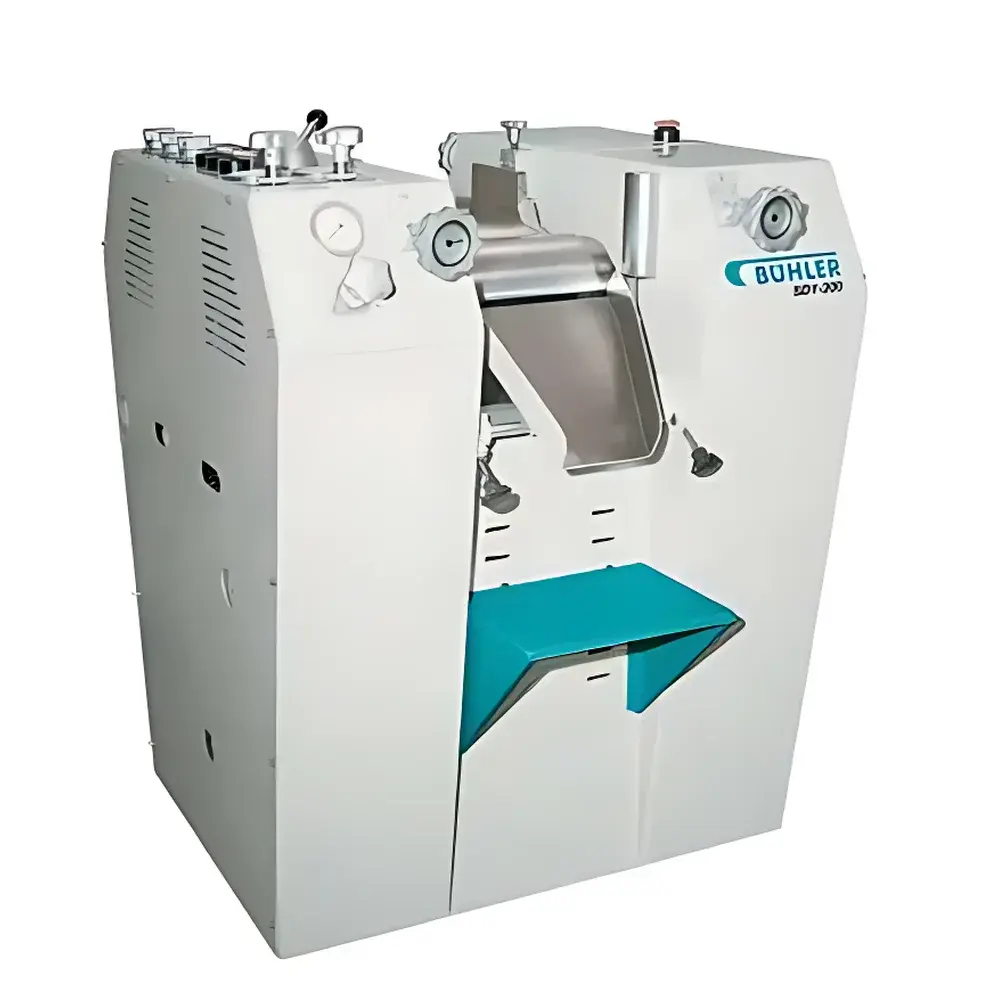
Bühler SDY-200 Laboratory Three-Roll Mill
| Brand | Bühler (Switzerland) |
|---|---|
| Origin | Switzerland |
| Model | SDY-200 |
| Drive Type | Hydraulic |
| Roller Cooling | Independent, Temperature-Controlled Water Circulation |
| Safety Features | Interlocked Safety Guard, Automatic Shutdown (Overload/Feed Jam/Cooling Failure) |
| Roller Adjustment | Mechanical Gap Setting |
| Roller Speed Ratio | Adjustable Differential Speed |
| Compliance | Designed per ISO 12100 for Machinery Safety, GLP-Compatible Operation |
Overview
The Bühler SDY-200 is a precision-engineered, full-hydraulic laboratory three-roll mill designed for dispersion, homogenization, and particle size reduction of high-viscosity pastes, inks, pigments, coatings, ceramics slurries, and pharmaceutical suspensions. Operating on the fundamental principle of controlled shear deformation between three horizontally aligned, counter-rotating rolls—feed roll, apron roll, and finishing roll—the SDY-200 applies calibrated compressive force and differential surface velocity to progressively refine material structure. Unlike belt-driven or pneumatic alternatives, its closed-loop hydraulic pressure system delivers consistent, reproducible nip pressure across the entire roll width—critical for eliminating batch-to-batch variability in dispersion quality. The machine’s architecture supports both R&D-scale formulation development and pilot-scale process validation, serving as a direct technical bridge to industrial-scale Bühler production mills (e.g., SDY-500 and SDY-1000 series), thereby minimizing scale-up risk.
Key Features
- Hydraulic Nip Pressure Control: Dynamic, real-time hydraulic system maintains constant pressure between rolls independent of material viscosity or feed rate—ensuring uniform shear history and eliminating manual recalibration.
- Differential Roll Speed Configuration: Individually driven rolls with adjustable speed ratios (typically 1:3:9) generate high, controllable shear gradients essential for deagglomeration and wetting of nanoparticles and pigment agglomerates.
- Independent Precision Cooling: Each roll integrates a sealed, thermostatically regulated water circuit with flow monitoring; temperature stability ≤ ±0.5°C enables processing of thermally sensitive materials (e.g., polymer dispersions, bioactive suspensions).
- Mechanical Gap Adjustment: Micrometer-actuated, backlash-free gap setting (range: 0–200 µm) allows precise control over residence time and final particle size distribution—particularly effective for low-viscosity or short-flow materials.
- Integrated Safety Architecture: Complies with ISO 12100:2010 (Risk Assessment) and IEC 60204-1 (Electrical Equipment of Machines); features interlocked safety guard, automatic shutdown on motor overload, feed jam detection, and cooling interruption sensing.
- Modular Cleanability: Quick-release roller clamps, smooth stainless-steel surfaces (Ra ≤ 0.8 µm), and zero dead-leg fluid pathways meet GLP-aligned cleaning validation requirements (e.g., residue limits per USP ).
Sample Compatibility & Compliance
The SDY-200 accommodates samples ranging from 50 g to 500 g per batch, supporting Newtonian and non-Newtonian fluids with viscosities from 100 mPa·s to >10⁶ mPa·s. It is routinely deployed in ASTM D2196-compliant ink dispersion studies, ISO 8781-3 pigment grinding validation, and USP extended-release suspension development. Its mechanical design and documentation package support audit readiness for GMP environments (per FDA 21 CFR Part 11 where integrated with compliant data acquisition systems) and GLP study execution under OECD Principles.
Software & Data Management
While the SDY-200 operates via tactile HMI with analog pressure and temperature readouts, it includes standardized 4–20 mA and RS-485 Modbus RTU interfaces for integration into centralized lab automation platforms (e.g., LabVantage, Thermo Fisher SampleManager). Optional digital retrofit kits enable timestamped logging of roll speeds, hydraulic pressure, coolant inlet/outlet temperatures, and runtime—supporting ALCOA+ data integrity principles (Attributable, Legible, Contemporaneous, Original, Accurate, Complete, Consistent, Enduring, Available).
Applications
- Dispersion of carbon black, TiO₂, and organic pigments in solvent- and water-based inks
- Homogenization of battery electrode slurries (NMC, LFP) prior to coating trials
- Refinement of ceramic green tapes and thick-film pastes for additive manufacturing
- Deagglomeration of nanocellulose and exfoliated graphene suspensions
- Processing of ophthalmic suspensions and topical nanogels requiring narrow PSD (D90 < 5 µm)
- Scale-down correlation studies for Bühler industrial mills under QbD frameworks
FAQ
What is the minimum sample volume required for reproducible results?
Typical validated working range is 150–300 g; below 100 g, edge effects and thermal drift may affect repeatability.
Can the SDY-200 be used for heat-sensitive APIs?
Yes—its independent roll cooling permits operation at 10–25°C ambient-equivalent surface temperatures, verified by IR thermography per ISO 13153.
Is the hydraulic system serviceable onsite?
All hydraulic components (pump, accumulator, pressure transducers) are modular and accessible without specialized tools; Bühler-certified technicians provide remote diagnostics and scheduled PM.
Does it comply with FDA 21 CFR Part 11 for electronic records?
The base unit does not include Part 11–compliant software; however, when paired with validated third-party SCADA or ELN systems, full audit trail and e-signature capability can be achieved.
How is roller wear monitored and compensated?
Roll diameter is measured annually using certified micrometers per ISO 1101 GD&T protocol; wear compensation is applied via recalibrated gap offset in the HMI.





