
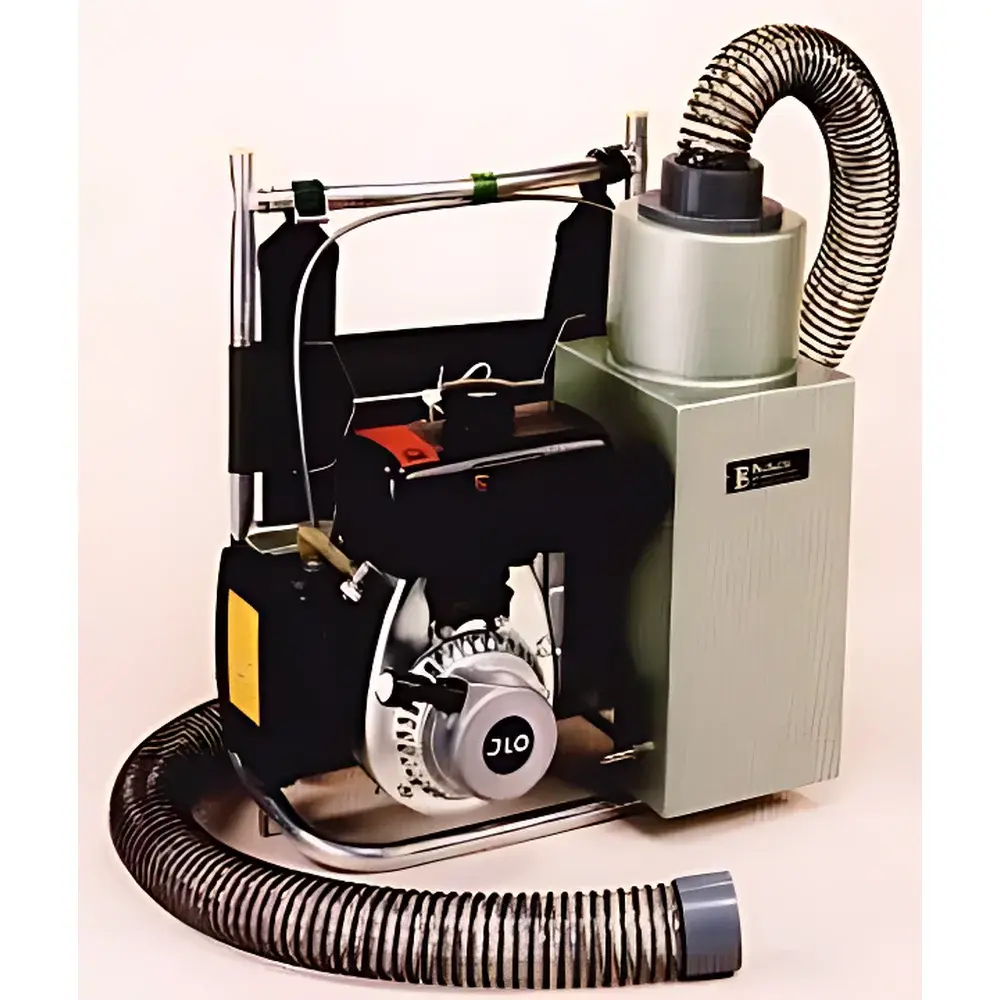
Burkard Univac Portable Insect Vacuum Sampler
| Brand | Burkard |
|---|---|
| Origin | United Kingdom |
| Model | Univac |
| Vacuum Pressure | 180 mmHg |
| Airflow Velocity (at 6 cm diameter inlet) | 300 km/h |
| Dimensions | 38 cm × 25 cm × 50 cm |
| Net Weight | 11.34 kg |
| Fuel Tank Capacity | 1.25 L |
| Power Source | JLO 35 two-stroke gasoline engine (self-powered) |
Overview
The Burkard Univac Portable Insect Vacuum Sampler is an engineered field instrument designed for rapid, non-destructive collection of arthropod specimens from low-canopy vegetation—including agricultural crops, pasturelands, grasslands, and hedgerows. Operating on the principle of high-velocity suction sampling, the Univac employs a mechanically driven vacuum system powered by a proven JLO 35 two-stroke gasoline engine. This self-contained powertrain eliminates dependency on external electricity or battery infrastructure, enabling uninterrupted operation in remote or off-grid field locations. The device generates a static vacuum pressure of up to 180 mmHg and delivers an airflow velocity of approximately 300 km/h at the 6 cm diameter sampling orifice—conditions optimized to dislodge and entrain small- to medium-sized insects (e.g., aphids, thrips, leafhoppers, beetles, spiders, and parasitoid wasps) without mechanical damage. Its robust aluminum-alloy chassis, vibration-damped engine mount, and ergonomic shoulder harness support extended daily use under variable terrain and weather conditions.
Key Features
- Self-powered operation via air-cooled JLO 35 two-stroke gasoline engine—no external power source required
- High-efficiency suction head with 6 cm diameter inlet and flexible 1.8 m polyethylene collection tube for precise targeting of vegetation strata
- Static vacuum capability of 180 mmHg, validated for consistent capture efficiency across diverse microhabitats
- Compact footprint (38 × 25 × 50 cm) and balanced weight distribution (11.34 kg net) enabling single-operator portability and rapid deployment
- Fuel reservoir capacity of 1.25 L supports ≥4 hours of continuous sampling at nominal engine speed (~3,500 rpm)
- Quick-release sample chamber with fine-mesh retention screen (standard 250 µm aperture) for immediate specimen recovery and minimal contamination risk
- Corrosion-resistant housing and sealed ignition system rated for outdoor use in humid, dusty, or light-rain environments
Sample Compatibility & Compliance
The Univac is validated for quantitative sampling of epigeal and foliage-dwelling arthropods in ecological monitoring, integrated pest management (IPM), and regulatory entomological surveys. It complies with standardized methodologies referenced in ISO 11087:2012 (Entomological sampling—Field techniques for arthropod monitoring) and aligns with FAO Plant Protection Operational Guidelines for suction sampling in crop health assessment. Specimen integrity is preserved through controlled airflow dynamics—avoiding thermal stress or shear-induced mortality common in centrifugal or high-turbulence collectors. The unit meets CE marking requirements for portable motorized equipment (2006/42/EC Machinery Directive) and carries UKCA certification for post-Brexit conformity. All plastic components contacting specimens are free of leachable plasticizers and comply with EU Regulation (EC) No 1935/2004 for food-contact materials—ensuring compatibility with subsequent molecular or morphological analysis.
Software & Data Management
As a field-deployed mechanical sampling tool, the Burkard Univac operates without embedded electronics or digital interfaces. However, it integrates seamlessly into modern data workflows via standardized field protocols. Users record metadata—including GPS coordinates, sampling duration, vegetation height, ambient temperature/humidity, and engine runtime—using compatible mobile applications (e.g., CyberTracker, ODK Collect) or laboratory LIMS platforms. Sample vials are barcoded and linked to spatial-temporal records for traceability. For GLP- or GCP-compliant studies, full audit trails—including operator ID, calibration verification logs (per annual service interval), and maintenance history—are maintained per ISO/IEC 17025:2017 requirements. Optional accessories include time-synchronized digital timers and calibrated flow meters for protocol validation.
Applications
- Quantitative monitoring of pest and beneficial insect populations in cereal, legume, and horticultural cropping systems
- Baseline biodiversity assessment in agroecological zoning and habitat restoration projects
- Evaluation of insecticide efficacy and resistance development through pre- and post-application sampling
- Surveillance of invasive species incursions in border regions and protected natural areas
- Training and capacity-building in entomological field methodology for extension services and academic institutions
- Supporting regulatory submissions under EFSA guidance documents on arthropod monitoring for environmental risk assessment
FAQ
Is the Univac suitable for sampling flying insects mid-air?
No—the Univac is specifically engineered for vegetation-based (beating/suction) sampling. It does not replace aerial netting or light-trap methods for volant species.
What maintenance intervals are recommended for the JLO 35 engine?
Burkard recommends engine servicing—including spark plug replacement, carburetor cleaning, and air filter inspection—every 50 operational hours or annually, whichever occurs first.
Can the collection tube be sterilized between samples?
Yes—polyethylene tubing is compatible with 70% ethanol immersion and UV-C irradiation; autoclaving is not advised due to thermal deformation risk.
Does the Univac meet USDA-APHIS import requirements for use in U.S. field trials?
Yes—the device carries valid CITES documentation for non-invasive sampling tools and conforms to USDA-APHIS Technical Bulletin TB-12 guidelines for arthropod surveillance equipment.
Is technical support available outside the UK?
Burkard maintains authorized service partners across North America, Australia, and the EU; spare parts and certified calibration kits are distributed globally through ISO 13485-certified logistics channels.



