
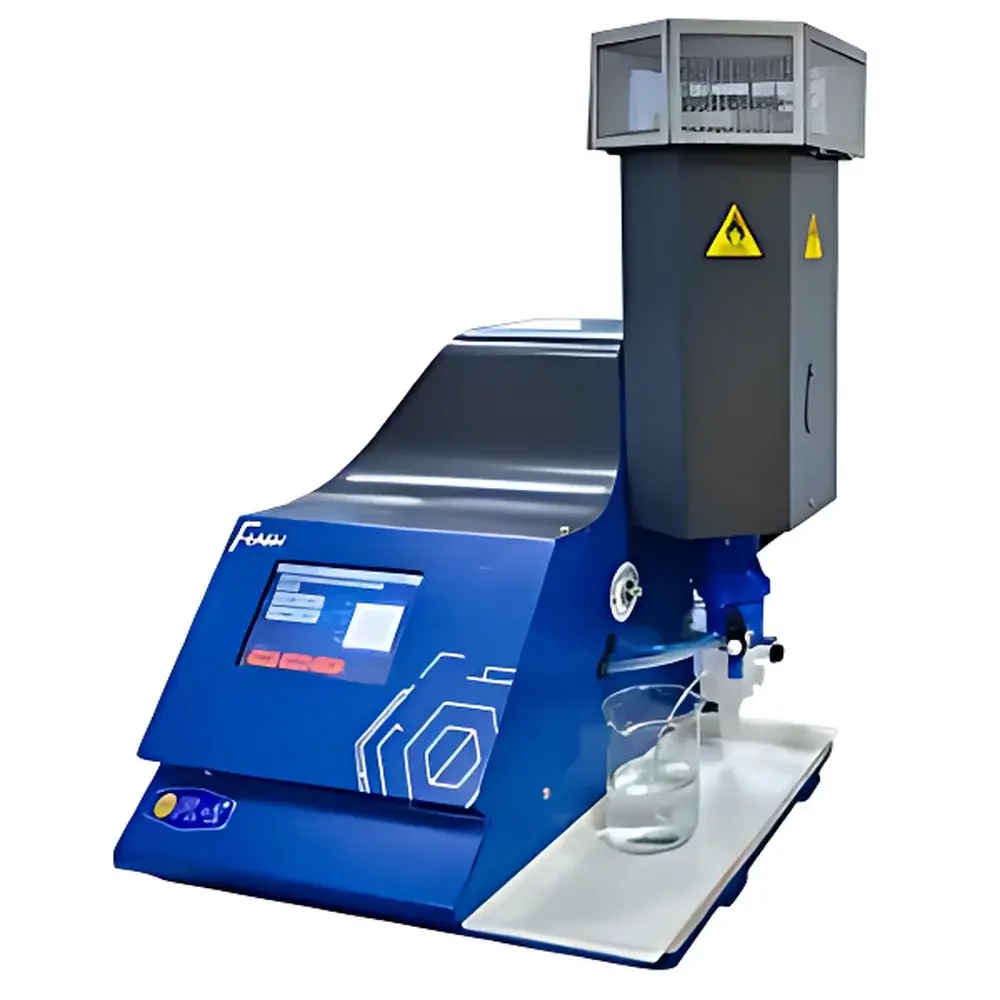
BWB FL Flame Photometer
| Brand | BWB |
|---|---|
| Origin | United Kingdom |
| Model | FL |
| Detection Range | Na: 0.1–1000 ppm |
| K | 0.05–1000 ppm |
| Li | 0.1–1000 ppm |
| Ca | 2.5–1000 ppm |
| Detection Limit | Na/K: 0.02 ppm |
| Li | 0.05 ppm |
| Ca | 1.0 ppm |
| Response Time | <15 s |
| Repeatability | <1% RSD (at ≤100 ppm, n=20 over 10 min) |
| Sample Uptake Rate | 3.0–5.5 mL/min |
| Air Supply | Integrated silent air compressor (switchable to external source) |
| Compliance | CE-marked |
| Data Interfaces | RS232 and USB |
| Calibration Modes | Two-point, multi-point, and multi-ion calibration |
| Display Units | ppm, mg/L, mmol/L, meq/L |
| Safety Features | Flame-out detection, auto-shutdown, power-on self-diagnosis |
Overview
The BWB FL Flame Photometer is a high-precision, benchtop atomic emission spectrometer designed for quantitative analysis of alkali and alkaline earth metals—including sodium (Na), potassium (K), lithium (Li), and calcium (Ca)—in aqueous and digested samples. Based on the fundamental principle of flame atomic emission spectroscopy (FAES), the instrument atomizes and excites sample ions in a stable, stoichiometric air–fuel flame (compatible with propane, butane, LPG, or natural gas). Emitted radiation at element-specific wavelengths is isolated by interference filters and measured via a photomultiplier tube (PMT) or solid-state detector, enabling direct quantification against calibrated standards. Engineered for robustness and long-term stability, the FL model integrates a built-in silent air compressor—eliminating dependency on external compressed air systems—while maintaining ISO/IEC 17025-aligned measurement integrity. Its optical path is optimized for minimal spectral interference and high signal-to-noise ratio, supporting routine analysis in environmental, agricultural, food, pharmaceutical, and industrial quality control laboratories.
Key Features
- Integrated silent air compressor with manual/auto switching to external air supply—ensures consistent nebulization pressure without facility infrastructure dependency.
- Four interchangeable interference filters (Na, K, Li, Ca) enabling sequential or simultaneous multi-element measurement; up to five elements displayed in descending concentration order in READ mode.
- Flexible calibration architecture: two-point linear, multi-point non-linear, and multi-ion calibration modes; full calibration curves stored internally with user-defined naming and timestamping.
- Configurable reporting units (ppm, mg/L, mmol/L, meq/L) and adjustable resolution settings to meet method-specific reporting requirements.
- Real-time flame supervision with automatic flame-out detection and safety-triggered shutdown; comprehensive power-on self-diagnostic routine verifying optical alignment, gas flow, and detector response.
- RS232 and USB interfaces support bidirectional communication with laboratory information management systems (LIMS) and external PCs; FP-PC software enables GLP-compliant data capture, audit trail generation, and electronic signature capability per FDA 21 CFR Part 11 guidelines.
Sample Compatibility & Compliance
The BWB FL accepts clarified, filtered aqueous solutions—including acid-digested soils, plant tissues, biological fluids (e.g., serum, milk), food extracts, cement leachates, and fuel ash digests—within defined viscosity and suspended solids limits (<1 cP, <0.1 µm particulates). It complies with CE marking requirements for electromagnetic compatibility (EMC Directive 2014/30/EU) and low-voltage safety (LVD Directive 2014/35/EU). Method validation aligns with ASTM D1385 (potassium in soil), ISO 11885 (water quality—determination of Na, K, Ca, Mg), and USP (alkali metal content in pharmaceutical excipients). Instrument performance verification follows internal SOPs traceable to NIST SRM 968e (multi-element calibration standard) and is suitable for GLP/GMP-regulated environments requiring documented calibration history, maintenance logs, and user access control.
Software & Data Management
FP-PC software provides full instrument control, real-time graphical display of emission intensity versus time, and interactive calibration curve visualization. Each measurement record stores operator ID, sample ID, date/time stamp, calibration reference, and raw analog output—automatically archived in encrypted binary format with optional XML export. Reports conform to GLP templates: including instrument serial number, software version, environmental conditions (ambient temperature, barometric pressure), and uncertainty estimates derived from repeatability and calibration residual analysis. Data synchronization supports networked storage and role-based access permissions. Maintenance alerts—triggered by runtime counters, filter usage cycles, or pressure deviation thresholds—generate scheduled service notifications to ensure uninterrupted compliance readiness.
Applications
- Soil science: Exchangeable K⁺ and Na⁺ quantification in agronomic testing per ISO 11260 and USDA-NRCS protocols.
- Cement and construction materials: Alkali content (Na₂O + K₂O) assessment per ASTM C150 and EN 197-1 to mitigate alkali–silica reaction (ASR).
- Food & beverage: Ca²⁺ in dairy products (ISO 5725), Na⁺/K⁺ ratios in juices and cereals (AOAC 985.35), and Li⁺ in specialty oils.
- Environmental monitoring: Na⁺ and K⁺ in surface water, wastewater effluents, and brine streams per EPA Method 200.7.
- Clinical & nutritional analysis: Calcium in serum and milk (CLSI C35-A3), electrolyte profiling in plant-based beverages.
- Industrial QA/QC: Sodium contamination in fuels (ASTM D3229), lithium in greases and battery electrolyte precursors.
FAQ
What fuel gases are compatible with the BWB FL Flame Photometer?
Propane, butane, liquefied petroleum gas (LPG), and natural gas are all supported; optimal flame stability is achieved using certified-grade fuel with ≤0.1% sulfur content.
Does the instrument support regulatory compliance for pharmaceutical testing?
Yes—the FP-PC software includes 21 CFR Part 11–compliant audit trails, electronic signatures, and secure data archiving suitable for USP and Ph. Eur. monograph applications.
Can calibration curves be transferred between instruments?
Calibration parameters (slope, intercept, polynomial coefficients) may be exported as ASCII files and imported into other BWB FL units running identical firmware versions.
Is daily recalibration required?
Not necessarily—under stable ambient conditions and consistent sample matrix, calibration validity is typically maintained for 8–12 hours; however, bracketing standards are recommended every 10 samples per ISO/IEC 17025 practice.
What maintenance intervals are recommended for the nebulizer and burner head?
Nebulizer cleaning is advised after every 50 samples or when uptake rate drops >10%; burner head inspection and ultrasonic cleaning should occur weekly or after high-salt matrix use.






