
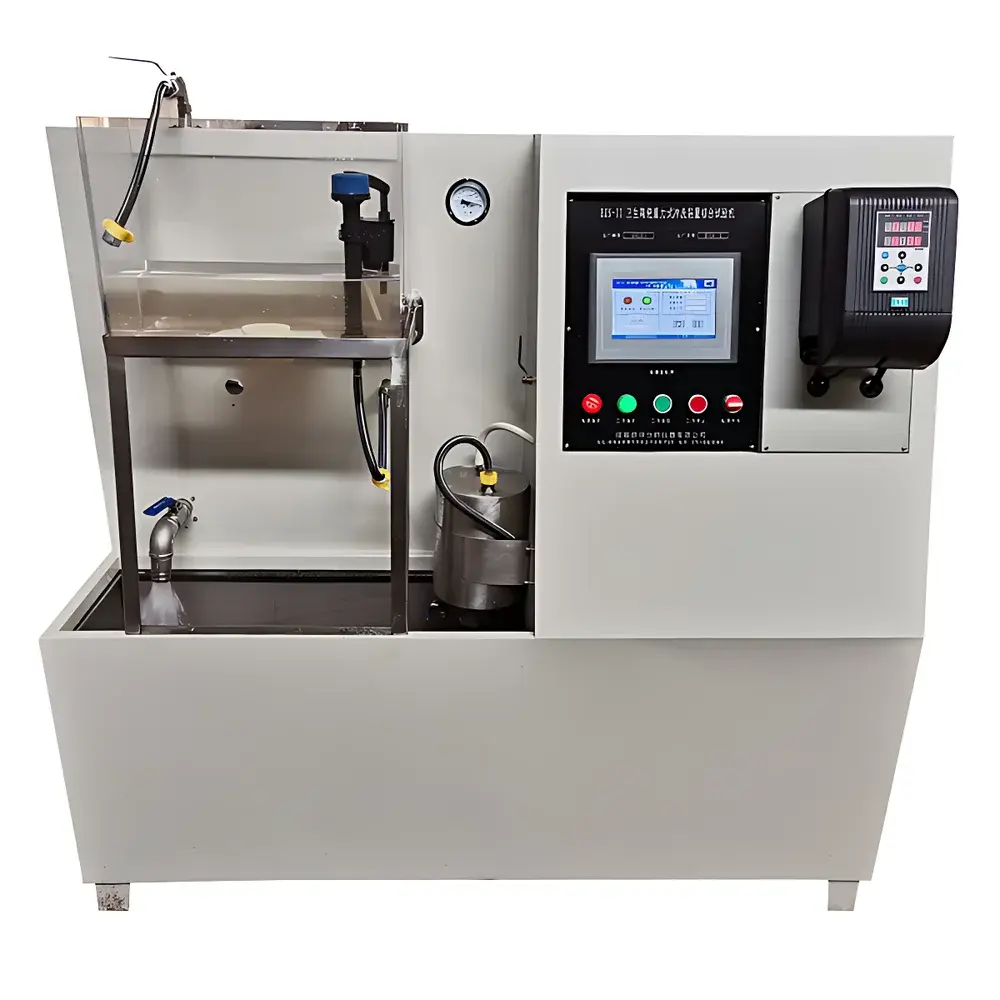
BZS-II Integrated Siphon, Water Hammer, and Flow Testing System for Gravity-Fed Toilet Flush Devices
| Origin | Hunan, China |
|---|---|
| Manufacturer Type | Authorized Distributor |
| Origin Category | Domestic (China) |
| Model | BZS-II |
| Pricing | Upon Request |
| Input Voltage | AC 380 V / 50 Hz (3-phase + N) |
| Pump Pressure Range | 0.03–1.0 MPa |
| Power Consumption | 6 kW |
| Flow Rate Range | 0.05–6 m³/h |
| Test Stations | 3 (Water Hammer |
| Ambient Operating Temperature | Room Temperature (15–30 °C) |
Overview
The BZS-II Integrated Siphon, Water Hammer, and Flow Testing System is a purpose-built laboratory instrument engineered for the standardized performance evaluation of gravity-fed toilet flush mechanisms—specifically siphonic bowl fixtures and associated flush valves used in sanitary ceramic applications. It operates on three core physical principles: (1) dynamic pressure transduction to quantify water hammer surge events during rapid valve closure; (2) volumetric flow rate measurement under controlled hydraulic head conditions; and (3) siphon initiation time, trap seal integrity, and vacuum-assisted drawdown kinetics. Designed to replicate real-world plumbing dynamics—including transient pressure spikes, steady-state flow delivery, and siphonic break/re-establishment—the system supports full compliance verification per international regulatory frameworks governing fixture performance, durability, and water efficiency.
Key Features
- Triple-station modular test architecture enabling concurrent or sequential execution of water hammer, siphon, and flow/seal tests without hardware reconfiguration
- Industrial-grade touch-screen HMI with intuitive workflow navigation, real-time pressure/flow visualization, and automated data logging
- Variable-frequency pump control paired with precision back-pressure regulation via adjustable return valve for stable, repeatable hydraulic loading across 0.03–1.0 MPa
- Integrated vacuum pump module for controlled siphon initiation and sustained negative pressure monitoring during trap seal testing
- Calibrated stainless-steel test tanks with standardized inlet/siphon port geometry aligned to ASSE, EN, and GB dimensional specifications
- Automated cycle timing and manual stopwatch synchronization mode for direct correlation with ASTM/ISO-defined timing protocols
- Rugged mechanical construction with corrosion-resistant components suitable for continuous wet-environment operation in QC laboratories
Sample Compatibility & Compliance
The BZS-II accommodates standard-sized floor-mounted and wall-hung siphonic toilets, dual-flush valves, and gravity-fed flush tanks conforming to nominal outlet diameters of 2”–4” (DN50–DN100). It supports full-cycle validation against key global standards including: GB/T 26730–2011 (China), ASSE 1002–2018 (USA), EN 14142:2018 and EN 14055:2018 (Europe), AS/NZS 172.2:2018 (Australia/NZ), and ASME A112.18.1–2018 (North America). All test procedures are structured to satisfy ISO/IEC 17025 documentation requirements for accredited testing laboratories, including traceable calibration records for pressure transducers and flow meters.
Software & Data Management
The embedded control software provides guided test sequencing with context-sensitive prompts, parameter validation checks, and automatic pass/fail flagging based on user-defined tolerance thresholds. Raw sensor data—including peak water hammer pressure (MPa), siphon initiation time (s), fill/drain duration (s), and volumetric flow (L/min)—are timestamped and exported in CSV format. Audit trails record operator ID, test date/time, configuration settings, and manual inputs (e.g., water height, drain time), supporting GLP-compliant reporting and FDA 21 CFR Part 11 readiness when deployed with external network authentication and electronic signature modules.
Applications
This system serves as a primary verification tool in R&D labs developing low-consumption flush technologies, manufacturing QA departments validating production-line consistency, and third-party certification bodies conducting type-approval testing. Typical use cases include: comparative analysis of siphon tube geometry on trapway evacuation efficiency; quantification of water hammer mitigation efficacy in new valve actuation profiles; verification of seal integrity after repeated thermal cycling; and correlation of measured flow rates with WaterSense or WELS rating thresholds. Its design enables reproducible simulation of worst-case transient events—such as sudden solenoid closure or float-valve jamming—that impact long-term reliability and user experience.
FAQ
What standards does the BZS-II explicitly support?
It is configured to execute test protocols defined in GB/T 26730–2011, ASSE 1002–2018, EN 14142:2018, EN 14055:2018, AS/NZS 172.2:2018, and ASME A112.18.1–2018.
Can the system measure both fill and drain flow independently?
Yes—fill flow is determined by timed volumetric accumulation at a specified water height; drain flow is calculated from discharge duration following pre-filled trapway conditions.
Is calibration documentation provided with the instrument?
Factory calibration certificates for pressure sensors and flow measurement subsystems are supplied; annual recalibration services are available through authorized service partners.
Does the system require external vacuum or compressed air sources?
No—all pneumatic functions—including siphon vacuum generation—are self-contained via the integrated vacuum pump module.
How is data security and traceability ensured?
Each test session logs operator ID, timestamp, configuration parameters, and raw sensor outputs; export files retain metadata for audit trail reconstruction in regulated environments.



