
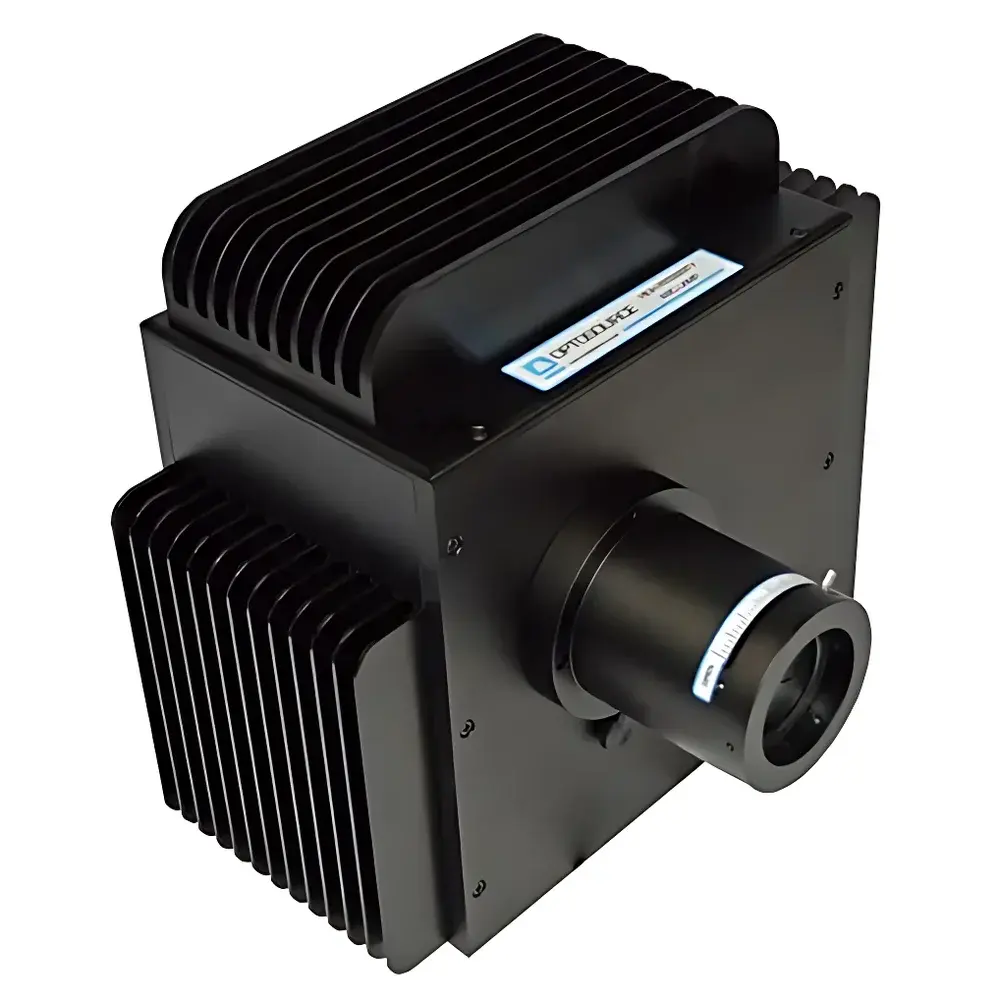
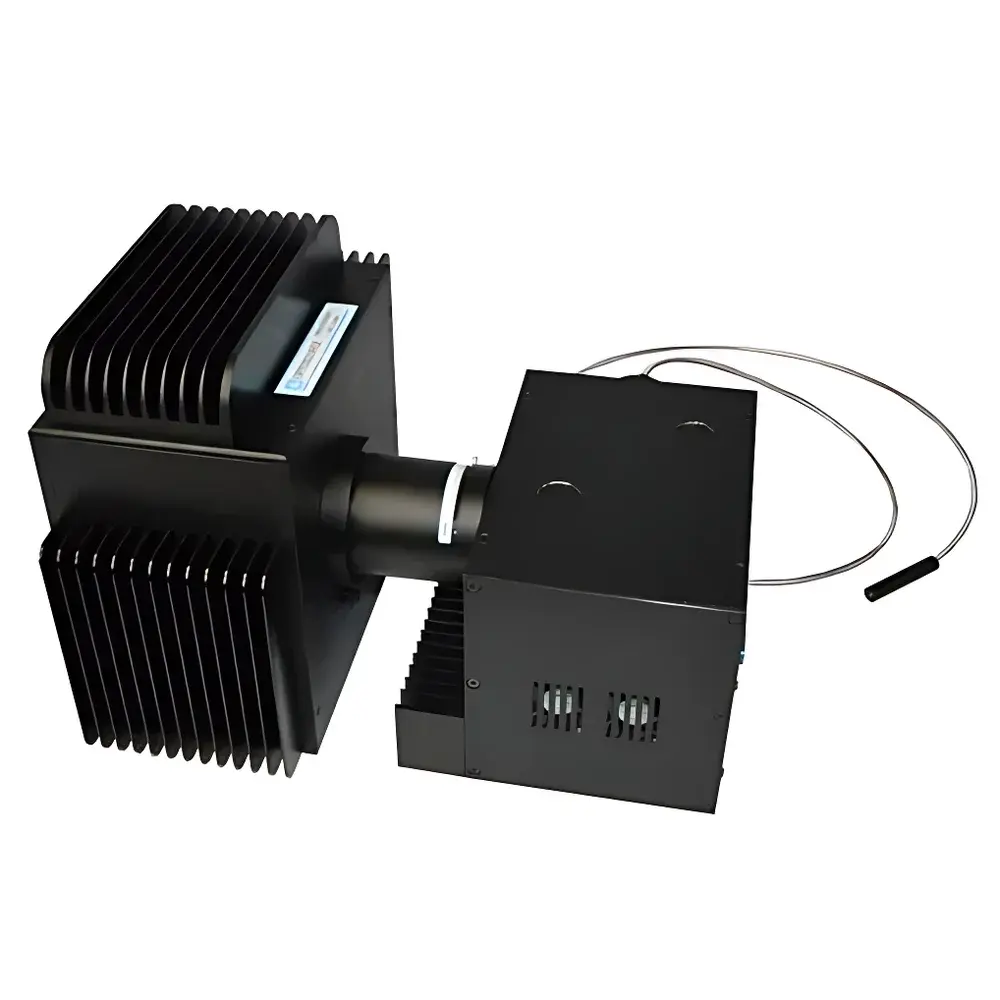
Cairn OptoScan Monochromator
| Brand | Cairn |
|---|---|
| Origin | United Kingdom |
| Model | OptoScan |
| Light Source Type | Xenon Lamp |
| Illumination Mode | Internal Illumination |
| Optical Design | Enhanced Czerny-Turner |
| Grating Options | 1200 lp/mm (UV-Vis), optional 1800/2000 lp/mm holographic gratings |
| Wavelength Range | 300–800 nm |
| Wavelength Accuracy | ±1.5 nm |
| Spectral Resolution | 0.5 nm (FWHM) |
| Bandwidth Range | 0–30 nm |
| Bandwidth Accuracy | ±0.2 nm |
| 200 nm Wavelength Switching Time | <1.5 ms |
| 50 nm Wavelength Switching Time | <1.0 ms |
| Slit-Driven Bandwidth Switching Time | <1.5 ms |
| TTL Digital Shutter Response | <2 ms |
| Dimensions (L×W×H) | 230 × 180 × 180 mm |
Overview
The Cairn OptoScan Monochromator is a high-performance, microprocessor-controlled optical instrument engineered for precision wavelength selection and rapid spectral tuning in advanced fluorescence microscopy, spectroscopic imaging, and time-resolved photobiology applications. Based on an enhanced Czerny-Turner optical configuration with fast F/2 light collection and off-axis parabolic mirrors, the OptoScan minimizes optical aberrations while maximizing throughput and spectral fidelity across the 300–800 nm range. Its core functionality centers on monochromatic light generation via interchangeable diffraction gratings — standard 1200 lines/mm ruled grating for broad UV-Vis coverage, with optional 1800 or 2000 lines/mm holographic gratings available for higher resolution or specialized spectral isolation tasks. Designed for integration with Cairn’s OptoSource 75 W or 150 W xenon arc lamps, the system delivers stable, high-intensity broadband excitation suitable for demanding quantitative imaging protocols requiring sub-millisecond spectral agility.
Key Features
- Sub-millisecond wavelength switching: <1.5 ms for 200 nm jumps; <1.0 ms for 50 nm steps — enabling dynamic spectral scanning synchronized with camera acquisition or electrophysiological recording.
- Independent bandwidth control via motorized input/output slits, with <1.5 ms actuation and ±0.2 nm accuracy over 0–30 nm range.
- Dual control architecture: embedded USB interface for high-level software integration, plus analog voltage input for direct hardware triggering in closed-loop experimental setups.
- Integrated TTL-compatible electronic shutter with <2 ms response time — fully programmable for pulse-width modulation, gated illumination, or dark-frame synchronization.
- Modular mechanical design allows standalone use as a white-light source via fiber-optic or liquid light guide coupling to commercial microscopes (e.g., Nikon Eclipse, Zeiss Axio, Olympus IX series).
- Front-panel keypad and LCD display support autonomous operation; serial-port emulation enables remote control via PC without dedicated drivers.
Sample Compatibility & Compliance
The OptoScan is compatible with a wide range of biological and material science samples requiring spectrally resolved excitation, including live-cell cultures, tissue sections, optogenetic preparations, and thin-film photonic devices. Its internal illumination geometry ensures uniform, collimated beam delivery without external alignment constraints. The system meets CE marking requirements for electromagnetic compatibility (EMC Directive 2014/30/EU) and low-voltage safety (LVD Directive 2014/35/EU). While not classified as medical device hardware, its timing stability and repeatability support GLP-compliant experimental workflows where traceable illumination parameters are required. When operated with calibrated reference lamps and NIST-traceable spectroradiometers, wavelength and irradiance outputs satisfy ISO/IEC 17025 criteria for laboratory measurement uncertainty reporting.
Software & Data Management
Cairn provides a comprehensive software development kit (SDK), including Windows DLL libraries, LabVIEW VIs, MATLAB wrappers, and Python bindings, enabling full programmatic control of wavelength, bandwidth, shutter state, and scan sequences. The bundled OptoScan Control Suite supports both point-and-shoot operation and automated multi-wavelength acquisition protocols, with timestamped metadata logging (wavelength, slit width, shutter status, elapsed time) embedded directly into TIFF or HDF5 image headers. Integration with third-party platforms — such as MetaMorph, Micro-Manager, NIS-Elements, and ScanImage — is validated through native plugin interfaces. All digital control signals comply with TTL logic standards and support hardware-triggered synchronization with frame grabbers, DAQ cards, or patch-clamp amplifiers. Audit trails for parameter changes are maintained in accordance with FDA 21 CFR Part 11 guidelines when used in regulated environments with appropriate validation documentation.
Applications
- Multi-wavelength fluorescence excitation profiling for ratiometric Ca2+, pH, or voltage-sensitive dyes.
- Time-gated photoluminescence spectroscopy of quantum dots, perovskites, and organic semiconductors.
- Optogenetic stimulation with spectrally selective activation of ChR2, C1V1, or ReaChR variants.
- In situ absorption and reflectance measurements in thin-film metrology and catalytic surface studies.
- Calibration-grade light source for spectral responsivity characterization of scientific CMOS and EMCCD detectors.
- Dynamic illumination control in adaptive optics and structured illumination microscopy (SIM) systems.
FAQ
What light sources are compatible with the OptoScan?
The OptoScan is optimized for use with Cairn’s OptoSource 75 W and 150 W xenon arc lamps. It accepts any DC-stabilized, water-cooled short-arc lamp with compatible mechanical and electrical interfaces.
Can the OptoScan be integrated into existing microscope systems?
Yes — it couples directly to standard microscope ports via liquid light guides or multimode optical fibers (SMA905 or FC/PC connectors), supporting seamless integration with major OEM platforms without optical realignment.
Is wavelength calibration traceable to national standards?
Factory calibration uses mercury and neon emission lines; users may perform recalibration using NIST-traceable spectral lamps. Calibration files are stored in non-volatile memory and persist across power cycles.
Does the system support automated sequential wavelength scanning?
Yes — the embedded controller includes step-scan mode with user-defined start/end wavelengths, step size, dwell time, and shutter gating — all executable without host PC connection.
What maintenance is required for long-term operational stability?
No routine optical alignment is needed. Recommended annual verification of wavelength accuracy and slit positioning using certified reference sources; grating cleaning only if contamination is observed under inspection.




