
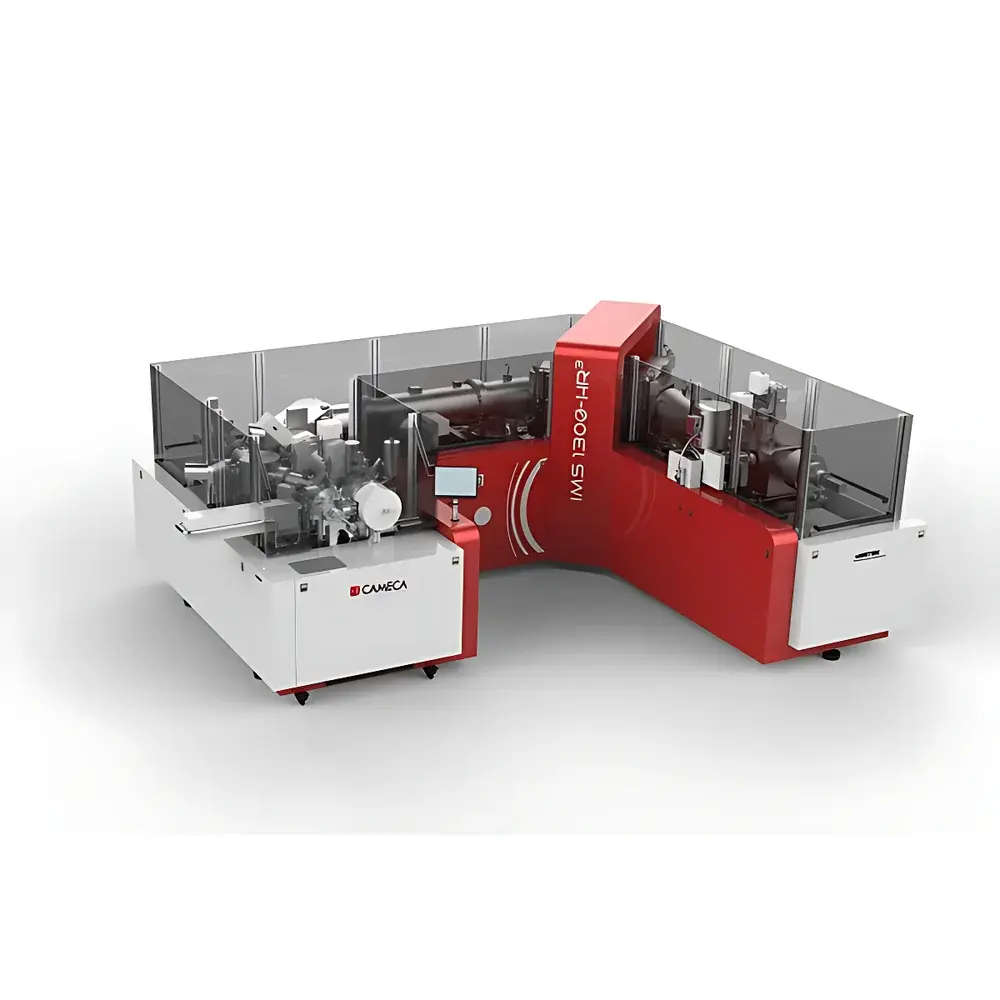
CAMECA IMS 1300-HR3 Large-Geometry High-Resolution Secondary Ion Mass Spectrometer
| Brand | Cameca |
|---|---|
| Origin | France |
| Model | IMS 1300-HR3 |
| Primary Beam Energy | 2–15 keV |
| Mass Range | 1–600 amu |
| Mass Resolution | 40,000 |
| Mass Analyzer Type | Magnetic Sector |
| Detector System | 10¹² Ω Faraday Cup + Multi-Collector Array |
Overview
The CAMECA IMS 1300-HR3 is a next-generation large-geometry secondary ion mass spectrometer (SIMS) engineered for ultra-high-precision in situ isotopic and elemental analysis at micrometer-scale spatial resolution. Operating on the principle of dynamic SIMS, the instrument sputters material from solid samples using a focused primary ion beam (O⁻, Cs⁺, or O₂⁺), generating secondary ions that are extracted, energy-filtered, mass-separated via double-focusing magnetic sector optics, and detected with high transmission efficiency and isotopic fidelity. Its large-geometry optical design—featuring extended ion flight paths and optimized electrostatic/magnetic field configurations—enables simultaneous achievement of high mass resolution (M/ΔM ≥ 40,000 at 10% peak height), high sensitivity (>10⁶ counts per second per ppm for many elements), and sub-10 µm lateral resolution under routine analytical conditions. Designed specifically for demanding applications in Earth sciences, planetary geochemistry, nuclear forensics, and materials science, the IMS 1300-HR3 delivers reproducible, traceable, and metrologically robust data required for peer-reviewed geochronology, stable isotope ratio determination (e.g., δ¹⁸O, δ²⁶Mg, εNd), and ultra-trace element mapping.
Key Features
- Large-geometry magnetic sector mass analyzer enabling concurrent high mass resolution and high transmission efficiency without signal compromise
- Dual primary ion source configuration supporting both positive-mode (Cs⁺) and negative-mode (O⁻/O₂⁺) analysis for comprehensive elemental and isotopic coverage
- RF-driven oxygen plasma primary ion source delivering enhanced beam current stability, reduced energy spread, and improved spatial resolution down to 5–8 µm (depending on matrix and operating mode)
- Automated Z-height sample stage with real-time topography compensation, minimizing defocusing effects and ensuring consistent ion yield across uneven surfaces
- Integrated UV-transmitted light microscope (266 nm illumination) coupled with high-resolution CCD imaging and dedicated navigation software for precise region-of-interest targeting and correlative optical–mass spectral registration
- Multi-collector detection system with 10¹² Ω Faraday cup amplifiers for low-noise measurement of high-abundance isotopes and discrete electron multipliers for trace-level species—fully configurable for simultaneous multi-isotope acquisition
- Enhanced magnetic field stabilization system achieving short-term mass stability better than ±0.1 ppm/hour, critical for long-duration multi-point analyses and inter-laboratory comparability
Sample Compatibility & Compliance
The IMS 1300-HR3 accepts polished thin sections (typically 25–100 µm thick), grain mounts, bulk wafers, and particulate samples mounted on conductive stubs. It accommodates standard 25 mm diameter sample holders compatible with vacuum-compatible geological and metallurgical preparation protocols. The instrument operates under ultra-high vacuum (UHV; base pressure <5×10⁻¹⁰ mbar) and conforms to ISO 14644-1 Class 4 cleanroom requirements for internal chamber integrity. Data acquisition and processing workflows support audit-ready compliance with GLP and GMP frameworks, including full electronic record retention, user-access logging, and version-controlled method templates. While not FDA-cleared as a medical device, its data structure and metadata tagging align with ASTM E1317 (Standard Practice for Calibration of Mass Spectrometers) and ISO/IEC 17025:2017 requirements for testing laboratories performing isotopic reference material characterization.
Software & Data Management
CAMECA’s proprietary NIMBUS™ software suite provides end-to-end control—from automated beam alignment and mass calibration to quantitative isotope ratio calculation and image reconstruction. All acquisition parameters (beam current, dwell time, raster size, mass stepping sequence) are stored as immutable metadata within HDF5-formatted raw data files. The software implements built-in dead-time correction, background subtraction algorithms (including multi-point baseline interpolation), and internal standard normalization routines traceable to NIST SRM standards. Export modules generate FAIR-compliant outputs (netCDF, CSV, TIFF stacks) compatible with third-party platforms such as Iolite, Vizor, and Python-based geochemical libraries (e.g., PyChron, Pint). Remote operation is supported via TLS-encrypted client-server architecture, enabling secure off-site monitoring and collaborative multi-user scheduling without compromising data sovereignty.
Applications
- In situ U–Pb, Pb–Pb, and Sm–Nd geochronology of zircon, monazite, apatite, and baddeleyite with external precision ≤0.2% (2σ) for crystals >10 µm in diameter
- Stable isotope ratio imaging (δ¹⁸O, δ³⁰Si, δ⁴⁴Ca) in biogenic carbonates, silicates, and meteoritic minerals at 10–50 µm scale
- Nuclear safeguards verification via isotopic fingerprinting of uranium particles (²³⁴U/²³⁵U/²³⁸U, ²³⁶U detection limits <10⁶ atoms)
- Trace element distribution mapping (e.g., REE, Hf, Ti) in single mineral domains with detection limits in the low pg/g range
- Planetary sample analysis—including lunar regolith, Martian meteorites, and asteroid return materials—under curation-compliant non-destructive protocols
- Diffusion profiling across grain boundaries and metamorphic reaction rims with sub-micrometer depth resolution
FAQ
What vacuum level does the IMS 1300-HR3 maintain during analysis?
The instrument achieves and sustains a base pressure of <5×10⁻¹⁰ mbar in the sample chamber and <1×10⁻⁹ mbar in the analyzer region using a combination of turbomolecular pumping, cryo-trapping, and differential pumping stages.
Is the IMS 1300-HR3 capable of analyzing insulating samples without charge compensation?
Yes—integrated electron flood gun and low-energy electron flooding (≤10 eV) enable stable analysis of dielectric materials including quartz, feldspar, and glassy phases without observable surface charging artifacts.
How is mass calibration performed, and how frequently is it required?
Mass calibration uses well-characterized oxide and hydride peaks from matrix-specific standards (e.g., SiO₂, Al₂O₃); full calibration is recommended before each analytical session, though automated daily drift correction maintains mass accuracy within ±0.001 amu over 8-hour runs.
Can the IMS 1300-HR3 be integrated into a centralized laboratory information management system (LIMS)?
Yes—NIMBUS supports OPC UA and RESTful API interfaces for bidirectional data exchange with LIMS platforms compliant with ASTM E1497 and ISO/IEC 17025 Annex A.3 specifications.
What maintenance intervals are recommended for the RF oxygen source and magnet power supply?
The RF plasma source requires quarterly inspection of quartz window integrity and electrode alignment; the water-cooled magnet power supply undergoes preventive maintenance every 12 months per CAMECA’s Field Service Bulletin FS-IMS1300-07.





