
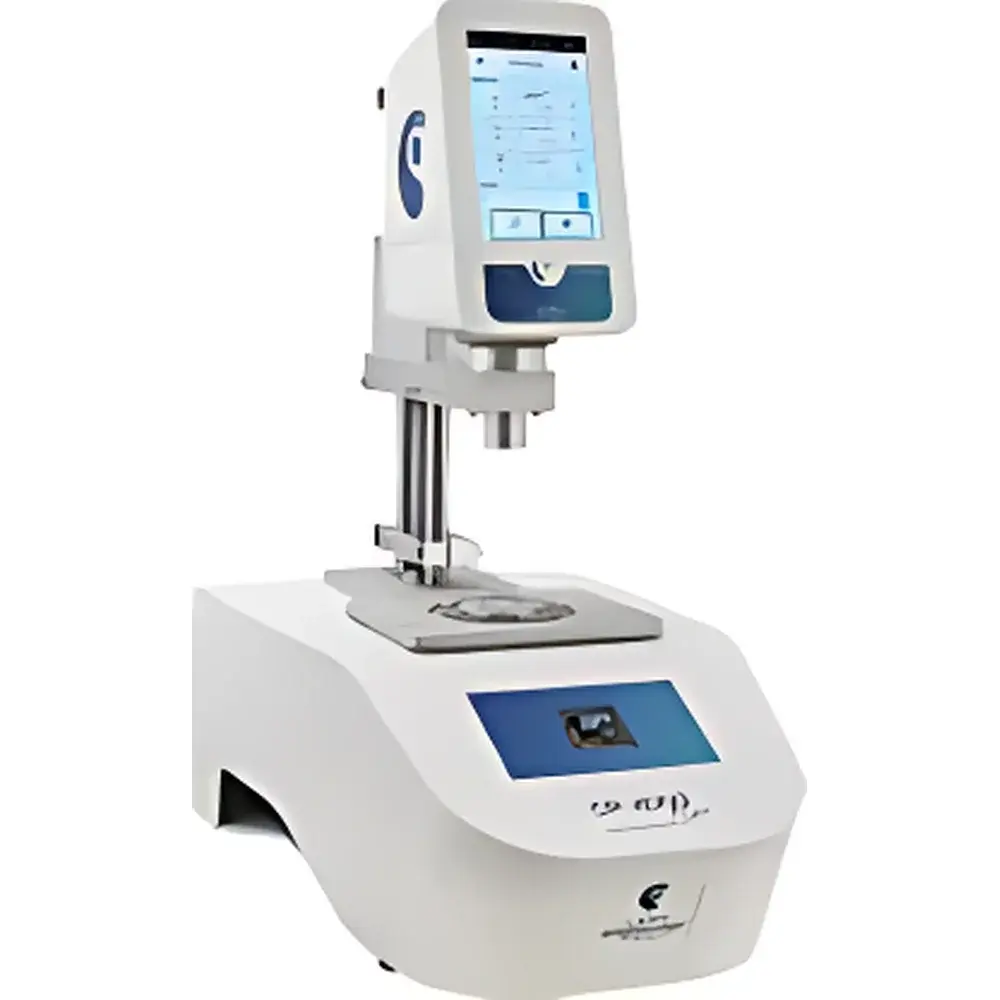
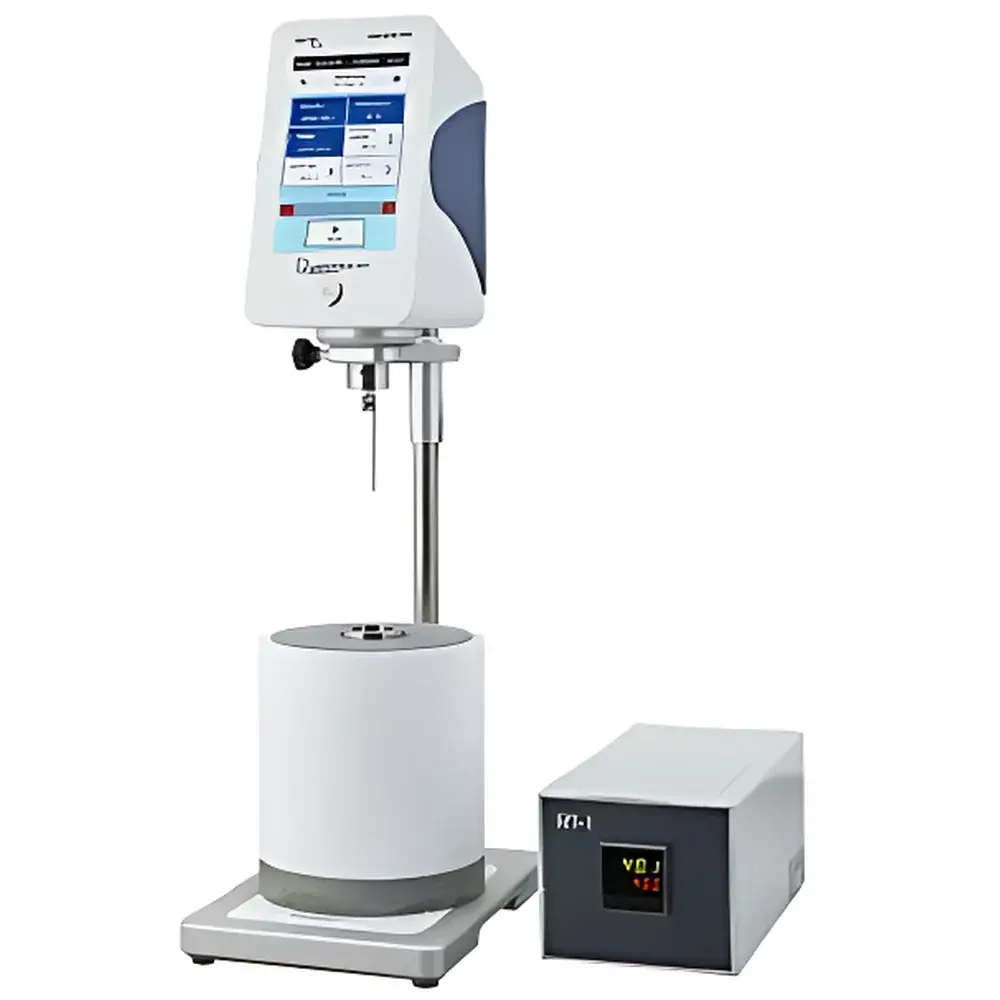
Lamyrheology RM200 CP4000 PLUS Advanced Rotational Rheometer
| Brand | Lamyrheology |
|---|---|
| Origin | France |
| Model | RM200 CP4000 PLUS |
| Temperature Range | −20 °C to 300 °C |
| Rotational Speed | 0.3–1500 rpm |
| Torque Range | 0.05–30 mN·m |
| Viscosity Range | 1–540,000,000 mPa·s (dependent on geometry) |
| Shear Rate Range | up to 20,000 s⁻¹ |
| Accuracy | ±1% of full scale |
| Repeatability | ±0.2% |
| Display | 7″ capacitive touchscreen |
| Interface | RS-232 serial & USB |
| Temperature Sensor | Integrated Pt100 |
| Gap Auto-Adjustment | Yes |
| Compliance | ASTM D2196, ISO 3219, USP <911>, GLP-ready audit trail support |
Overview
The Lamyrheology RM200 CP4000 PLUS is a benchtop rotational rheometer engineered for precision viscoelastic characterization under controlled temperature and shear conditions. Based on Couette flow geometry and torque-sensing principles, it delivers high-fidelity rheological data across a broad dynamic range—spanning from low-shear yield stress evaluation to high-shear processing simulation (up to 20,000 s⁻¹). Unlike conventional viscosity meters, this instrument operates as a true rheometer: it quantifies both viscous and elastic responses through controlled stress or strain protocols—including steady-state flow sweeps, oscillatory amplitude/frequency sweeps, and time-dependent thixotropy recovery tests. Its integrated Pt100 sensor and active thermal control enable accurate temperature regulation from −20 °C to 300 °C, supporting applications in thermosensitive formulations such as pharmaceutical gels, polymer melts, and edible emulsions. The absence of mechanical springs in the motor drive ensures long-term torque stability and eliminates hysteresis—a critical requirement for GMP-compliant QC laboratories.
Key Features
- Self-contained operation: Full rheological analysis—including real-time curve plotting, parameter fitting (Newtonian, Bingham, Casson, Ostwald–de Waele), and thixotropic index calculation—performed directly on the 7″ capacitive touchscreen without external PC dependency.
- Motorized vertical positioning system: Enables rapid, repeatable gap setting and geometry exchange (cone-plate, parallel-plate, concentric cylinder) with sub-micron reproducibility—critical for inter-laboratory method transfer.
- Spring-free electromagnetic drive: Delivers linear torque response across the full 0.05–30 mN·m range, eliminating mechanical drift and enabling reliable low-torque measurements (<0.1 mN·m) essential for dilute polymer solutions and biological fluids.
- Automated gap calibration: Onboard algorithm compensates for thermal expansion and geometry misalignment, ensuring consistent measurement conditions across temperature ramps.
- Multi-language UI & operator-level access control: Supports English, French, Spanish, and Russian interfaces; four-digit PIN authentication restricts parameter modification and preserves SOP integrity per user profile.
- Dual communication interface: RS-232 and USB ports support legacy LIMS integration and secure data export in CSV/Excel formats with timestamped metadata (temperature, shear rate, torque, viscosity).
Sample Compatibility & Compliance
The RM200 CP4000 PLUS accommodates diverse sample classes via interchangeable measuring systems: standard cone-and-plate (e.g., 40 mm Ø, 2° angle), parallel-plate (25–50 mm Ø), and coaxial cylinder (DIN/ISO geometries). It handles suspensions, pastes, gels, melts, and shear-thinning liquids with minimal wall-slip artifacts—enabled by surface texturing options and solvent trap accessories. Regulatory alignment includes full traceability per ISO/IEC 17025, compliance with ASTM D2196 (paints and coatings), ISO 3219 (polymer solutions), and USP (rheology of semisolid dosage forms). Audit trail functionality meets FDA 21 CFR Part 11 requirements for electronic records, with immutable timestamps, user attribution, and change history logging.
Software & Data Management
Embedded firmware supports real-time visualization of viscosity vs. shear rate, storage of up to 500 test profiles locally, and automated regression modeling (power-law, Herschel–Bulkley, etc.). Exported datasets include raw torque/time/temperature arrays and derived parameters (yield stress τ₀, consistency index K, flow index n, thixotropic area). Optional PC-based LamyrheoSoft v4.2 extends capabilities to multi-step ramp sequences, frequency sweep analysis (G′/G″), and batch reporting compliant with GLP documentation standards—including PDF certificate generation with digital signature fields.
Applications
This rheometer serves as a primary tool in formulation development and quality control across regulated and industrial sectors: monitoring gelation kinetics in topical pharmaceuticals; validating shear-thinning behavior of inkjet inks; assessing yield stress in toothpaste and cosmetic creams; characterizing thermal degradation onset in thermoplastics; evaluating structural recovery in drilling muds; and benchmarking dispersion stability in pigment-loaded coatings. Its wide shear rate coverage allows direct correlation between lab-scale measurements and production-line pumping/shearing conditions.
FAQ
Does the RM200 CP4000 PLUS support oscillatory rheology?
Yes—it performs controlled-strain and controlled-stress oscillatory tests (amplitude sweeps, frequency sweeps, time sweeps) to determine storage modulus (G′), loss modulus (G″), and complex viscosity (η*).
Can I use non-standard geometries, such as serrated plates or vane spindles?
Yes—custom geometries are supported via manual calibration routines and geometry-specific correction factors stored in the instrument’s configuration library.
Is temperature calibration traceable to national standards?
The integrated Pt100 sensor is factory-calibrated against NIST-traceable reference baths; users may perform field verification using certified thermostats per ISO 17025 procedures.
How is data integrity maintained during power interruption?
All active measurements are auto-saved to non-volatile memory every 2 seconds; interrupted tests resume from last valid data point upon reboot.
What maintenance intervals are recommended for routine operation?
Annual torque sensor verification and geometry alignment check are advised; no lubrication or mechanical adjustment is required due to the spring-free drive architecture.



