
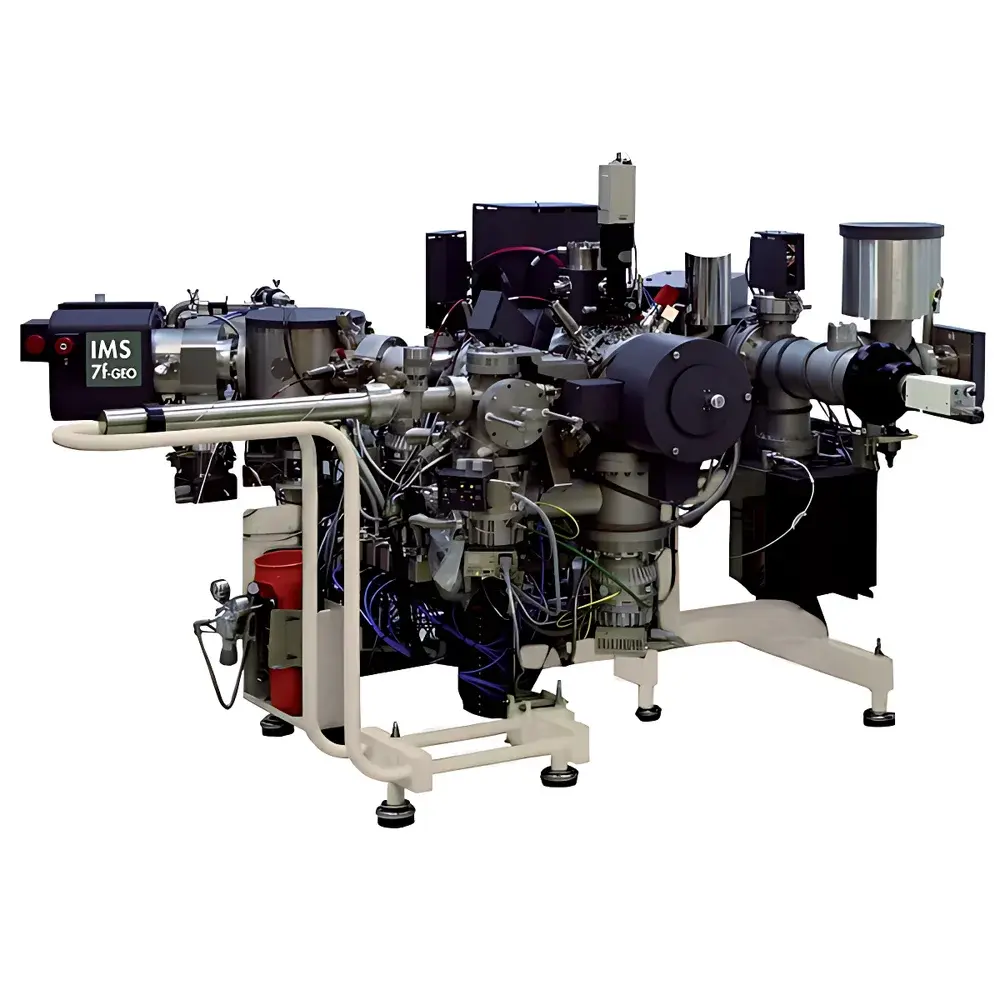
CAMECA IMS 7f-GEO Secondary Ion Mass Spectrometer
| Brand | Cameca |
|---|---|
| Origin | France |
| Model | IMS 7f-GEO |
| Instrument Type | Magnetic Sector Mass Spectrometer |
| Primary Beam Energy | 1–23 keV |
| Mass Range | 1–360 Da |
| Mass Resolution (M/ΔM) | <20,000 |
Overview
The CAMECA IMS 7f-GEO is a compact, high-throughput magnetic sector secondary ion mass spectrometer engineered specifically for high-precision isotopic and elemental analysis of geological materials. Operating on the principle of dynamic secondary ion mass spectrometry (SIMS), the instrument sputters sample surfaces using a focused primary ion beam (O−, Cs+, or O2+), generating secondary ions that are extracted, energy-filtered, mass-separated via double-focusing magnetic sector optics, and detected with sub-permil precision. Designed as a single-collector platform optimized for Earth science laboratories, the IMS 7f-GEO delivers exceptional reproducibility in stable isotope ratio measurements—particularly for oxygen (18O/16O), sulfur (34S/32S), carbon (13C/12C), and silicon (30Si/28Si)—while maintaining robust performance for trace element quantification (e.g., REEs, U-Th-Pb systematics) and microscale heterogeneity mapping.
Key Features
- Optimized magnetic sector architecture delivering high mass resolution (M/ΔM < 20,000) with excellent transmission efficiency across the full mass range (1–360 Da)
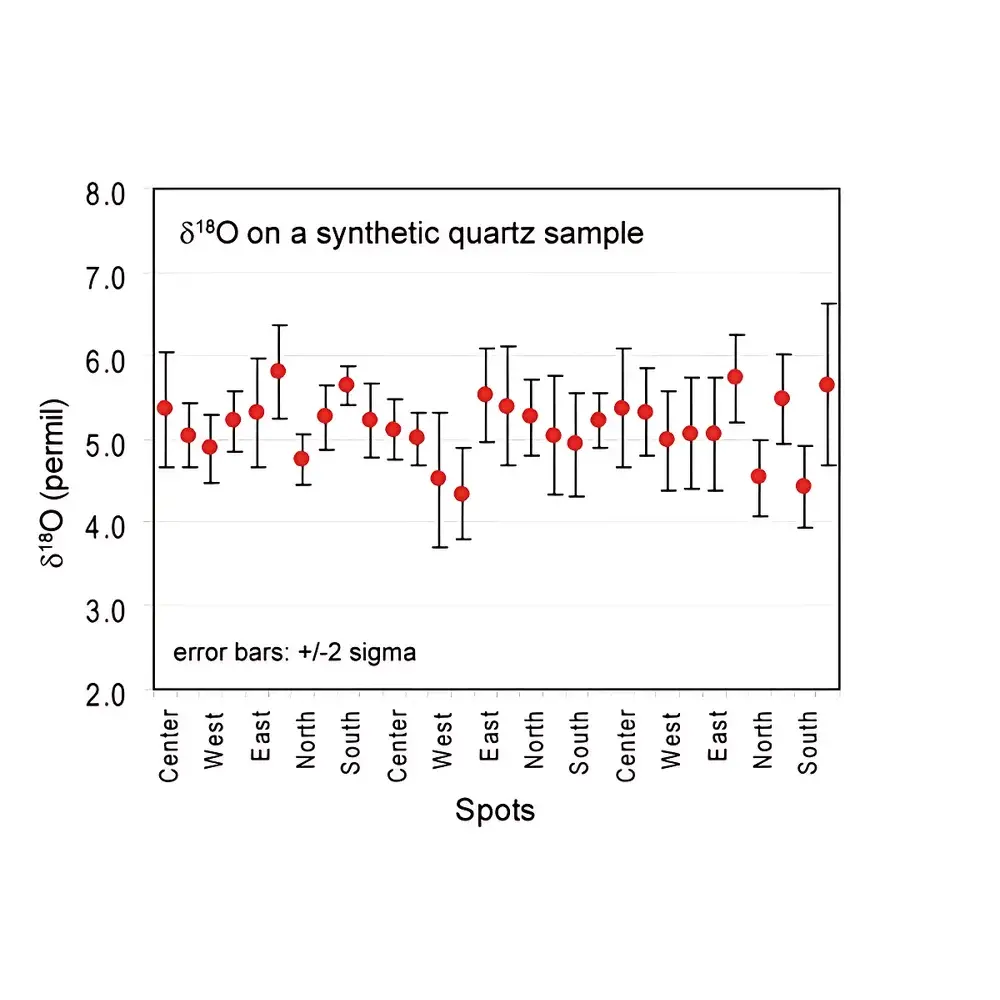
- Dual Faraday cup detector system enabling quasi-dual-reception operation without mechanical repositioning—critical for achieving <0.3‰ (1σ) external precision on stable isotope ratios
- Fast mass peak switching capability (<0.3 seconds at high resolution), minimizing dead time between isotope cycles and maximizing duty cycle
- Primary ion source offering selectable beam energies from 1 to 23 keV, supporting both high-sensitivity trace analysis (low keV) and high-depth-resolution depth profiling (high keV)
- Integrated electron flood gun for charge compensation on insulating geological samples (e.g., zircon, quartz, feldspar, glass)
- Robust vacuum architecture with differential pumping stages ensuring ultra-high vacuum (<1×10⁻⁹ mbar) in the analyzer region for low background and high signal stability
Sample Compatibility & Compliance
The IMS 7f-GEO accommodates standard 25 mm diameter polished thin sections, grain mounts, and pressed powder pellets—compatible with routine petrographic preparation protocols. Its high spatial resolution (5–10 µm lateral resolution under optimal conditions) supports in situ analysis of mineral domains, melt inclusions, and metamorphic reaction rims. The system complies with analytical requirements defined in ASTM D7259 (standard guide for SIMS analysis of geological materials), ISO/IEC 17025:2017 (general competence requirements for testing laboratories), and supports GLP-compliant data acquisition through audit-trail-enabled software logging. All calibration procedures follow community-accepted reference material protocols (e.g., NIST SRM 610/612, USGS GSE-1G, MPI-DING glasses).
Software & Data Management
Data acquisition and reduction are performed using CAMECA’s proprietary *MultiMode* software suite, which provides real-time monitoring of beam current, secondary ion intensities, and mass spectra. The software supports automated multi-cycle acquisition sequences, internal standard normalization (e.g., using 29Si or 31P), and offline correction for instrumental mass fractionation using certified reference materials. Raw data files (.dat) are stored in vendor-neutral ASCII format, facilitating integration with third-party processing tools (e.g., Iolite, VizualAge). Full audit trails—including operator ID, timestamp, parameter history, and calibration logs—are maintained in accordance with FDA 21 CFR Part 11 requirements for regulated environments.
Applications
- High-precision stable isotope geochemistry: δ18O, δ34S, δ13C, δ7Li, δ11B, δ26Mg
- In situ U–Pb, Pb–Pb, and Lu–Hf geochronology in zircon, monazite, apatite, and baddeleyite
- Trace element mapping and quantification in silicates, oxides, and sulfides at sub-ppm detection limits
- Environmental forensics: isotopic fingerprinting of heavy metals (e.g., Pb, Sr, Nd) in soils, sediments, and aerosols
- Materials science applications: dopant profiling in semiconductors, oxide interface chemistry, and nuclear fuel characterization
FAQ
What is the typical spatial resolution achievable with the IMS 7f-GEO?
Typical lateral resolution ranges from 5 to 10 µm depending on primary ion species, beam energy, and sample conductivity—optimized for single-grain analysis in zircon and quartz.
Does the IMS 7f-GEO support depth profiling?
Yes; with variable primary beam energy (1–23 keV) and raster control, it enables controlled sputter depth profiling for layered geological materials and synthetic thin films.
How is mass fractionation corrected during data reduction?
Mass-dependent instrumental fractionation is corrected using matrix-matched reference materials measured under identical analytical conditions, following exponential or linear law models implemented in MultiMode.
Is remote operation supported?
The system supports secure remote access for instrument monitoring and method setup via encrypted network protocols, though final acquisition requires local supervision per safety and quality assurance protocols.
What maintenance intervals are recommended for the ion source and detector?
CAMECA recommends quarterly inspection of the Cs+/O− ion source and biannual calibration of Faraday cup gains; detector lifetime exceeds 5 years under standard geological usage profiles.



