
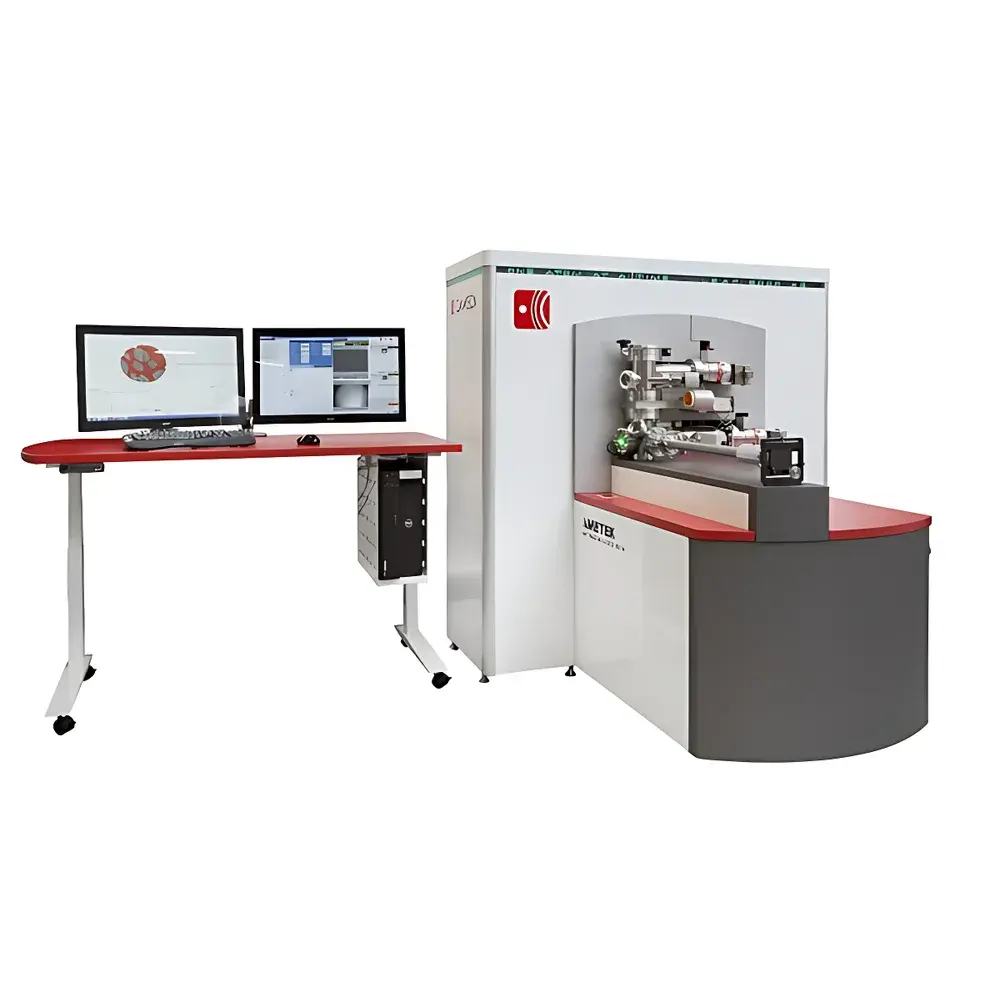
CAMECA LEAP 5000 3D Atom Probe Tomography System
| Brand | Cameca |
|---|---|
| Origin | USA |
| Manufacturer Type | Authorized Distributor |
| Origin Category | Imported |
| Model | LEAP 5000 |
| Price Range | USD 6.2–6.9 million (FOB) |
| Acceleration Voltage | Up to 20 kV |
| Magnification | Field-ion imaging resolution < 0.3 nm, atomic-scale 3D reconstruction |
| Detection Efficiency | > 37% (pulse mode), > 60% (laser mode) |
| Mass Resolution (m/Δm) | > 1,000 at 100 Da |
| Spatial Resolution | ≤ 0.3 nm lateral, ≤ 0.2 nm depth (in optimal conditions) |
| Data Acquisition Rate | Up to 1 million atoms/hour |
Overview
The CAMECA LEAP 5000 is a state-of-the-art 3D atom probe tomography (APT) system engineered for quantitative, sub-nanometer three-dimensional compositional mapping of solid-state materials. Operating on the principle of field evaporation—where atoms are sequentially ionized from a needle-shaped specimen under ultra-high vacuum (UHV, <2×10⁻¹¹ mbar) and high electric field (≥20 V/nm)—the LEAP 5000 captures time-of-flight mass spectrometry (TOF-MS) data synchronized with position-sensitive detection. Each detected ion is assigned precise (x, y, t) coordinates, enabling full 3D reconstruction with near-atomic spatial fidelity and isotopic mass identification. Unlike conventional TEM or SEM-based techniques, APT delivers true atomic-scale chemistry without beam-induced damage or diffraction-limited resolution constraints. The LEAP 5000 platform supports three core configurations—LEAP 5000 R (resistive heating), LEAP 5000 XR (extended range, optimized for low-conductivity materials), and LEAP 5000 XS (ultra-high sensitivity, enhanced laser pulse control)—each calibrated for specific material classes including metallic alloys, semiconductors, oxides, and nuclear fuels.
Key Features
- High-efficiency detector architecture with multi-hit capability and sub-nanosecond timing resolution for accurate mass assignment and isotope ratio quantification.
- Integrated UV laser pulsing (355 nm, pulse width adjustable from 0.5–10 ps) and voltage-pulsing modes, enabling controlled evaporation across conductive and semi-insulating specimens.
- Advanced specimen cooling stage (40–300 K) with active vibration damping and thermal drift compensation algorithms for stable acquisition over multi-hour runs.
- Automated tip preparation workflow via FIB-SEM integration (compatible with Thermo Fisher Helios & Zeiss CrossBeam platforms), including in-situ lift-out, annular milling, and apex sharpening.
- Modular UHV chamber design with differential pumping stages, cryo-shrouded sample stage, and real-time pressure monitoring to maintain <2×10⁻¹¹ mbar during analysis.
- Proprietary AP Suite™ software suite (v7.0+) supporting automated reconstruction, compositional clustering (e.g., maximum separation, isoconcentration surfaces), and statistical confidence interval modeling per element.
Sample Compatibility & Compliance
The LEAP 5000 accommodates specimens prepared as sharp tips (~50–100 nm radius) from bulk metals, intermetallics, ceramics, thin-film stacks, and irradiated nuclear materials. It complies with ASTM E3082-17 (Standard Guide for Atom Probe Tomography) and ISO/IEC 17025:2017 requirements for analytical laboratory competence. Data integrity meets FDA 21 CFR Part 11 criteria through audit-trail logging, electronic signature support, and role-based access control within AP Suite™. All hardware subsystems—including TOF mass spectrometer, delay-line detector, and laser control electronics—are traceably calibrated against NIST-certified standards. System validation reports include mass calibration stability (±0.005 Da over 24 h), spatial resolution verification using Ni-Al multilayer standards, and detection efficiency certification per IUPAC guidelines.
Software & Data Management
AP Suite™ provides end-to-end workflow management—from raw ion event ingestion (binary .aps files) to reconstructed volume visualization (.vtp, .obj export), composition profiling, and statistical uncertainty propagation. The software implements ISO/IEC 17025-aligned data handling protocols: automatic metadata embedding (evaporation parameters, temperature, laser energy), checksum validation for file integrity, and encrypted local storage with optional SFTP synchronization to institutional HPC clusters. Batch processing pipelines support reproducible quantification across datasets using standardized reconstruction parameters (e.g., dmax/dmin ratio, background subtraction models). Export formats include CSV (atom-by-atom lists), HDF5 (for machine learning training sets), and VTK (for ParaView/Avizo interoperability). Audit logs record every user action, parameter change, and reconstruction revision—fully compliant with GLP/GMP documentation requirements.
Applications
- Quantifying solute segregation at grain boundaries and dislocation cores in high-strength aluminum and nickel-based superalloys.
- Mapping dopant distribution and interface intermixing in SiGe/Si heterostructures and GaN power devices.
- Characterizing helium bubble nucleation and oxide phase evolution in neutron-irradiated stainless steels and zirconium cladding.
- Validating predictive thermodynamic models (e.g., CALPHAD) by direct measurement of nanoscale phase compositions in multi-principal element alloys (MPEAs).
- Correlating atomic-scale precipitate chemistry with mechanical property degradation in aging aerospace components.
FAQ
What is the typical specimen preparation time for LEAP analysis?
Specimen preparation via FIB-SEM typically requires 4–8 hours per tip, depending on material hardness and required tip geometry. Automated scripting (e.g., using AutoScript 4) reduces manual intervention and improves reproducibility.
Can the LEAP 5000 analyze insulating materials?
Yes—the LEAP 5000 XR configuration incorporates resistive heating and low-repetition-rate UV laser pulsing to enable field evaporation of wide-bandgap oxides, nitrides, and glasses without charging artifacts.
How is mass calibration performed and validated?
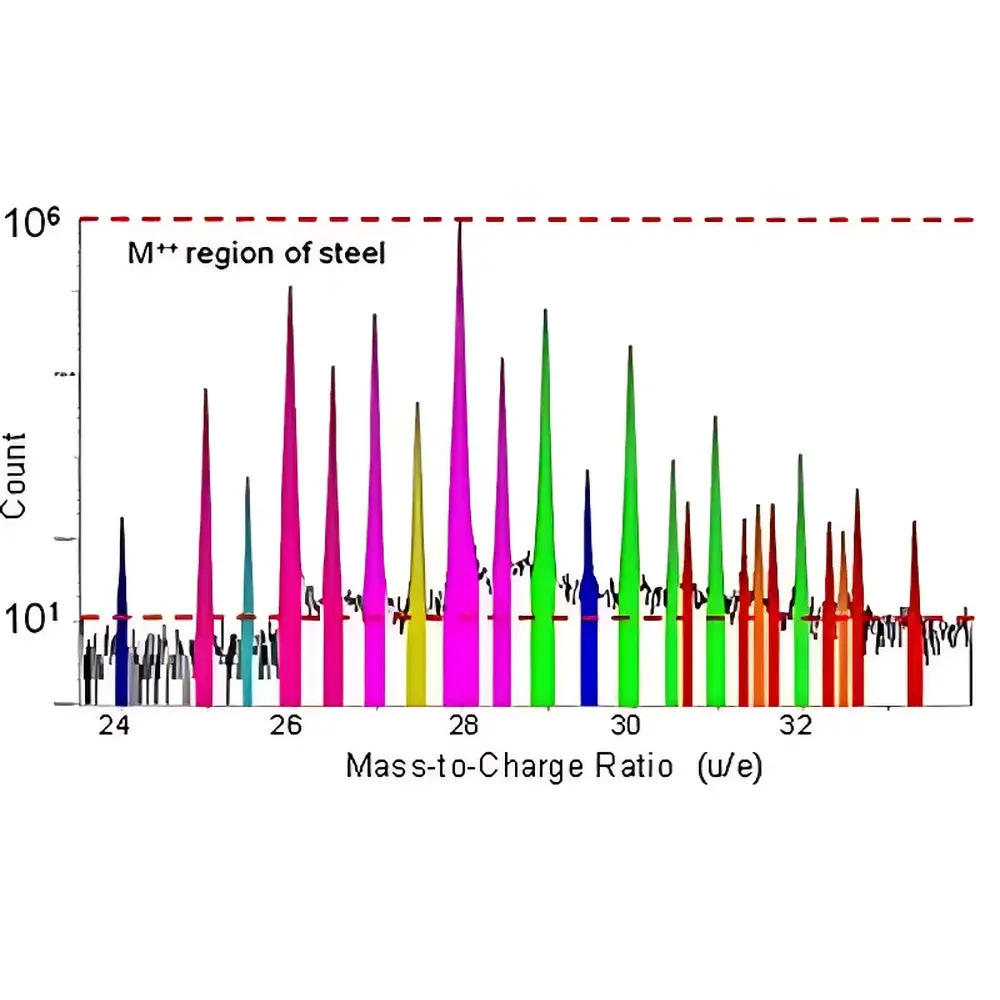
Mass calibration uses known elemental peaks (e.g., ⁵²Cr⁺, ⁵⁶Fe⁺, ⁶³Cu⁺) acquired during daily system checks; calibration curves are stored with uncertainty estimates and automatically applied during reconstruction.
Is remote operation supported?
Full remote operation—including acquisition control, real-time event monitoring, and reconstruction—is enabled via secure TLS-encrypted client-server architecture, compatible with institutional VPN and MFA policies.
What data security measures are implemented?
All data resides on encrypted local SSDs; network transfers use AES-256 encryption; AP Suite™ enforces password complexity, session timeout, and granular permission tiers aligned with NIST SP 800-53 Rev. 5 controls.





