
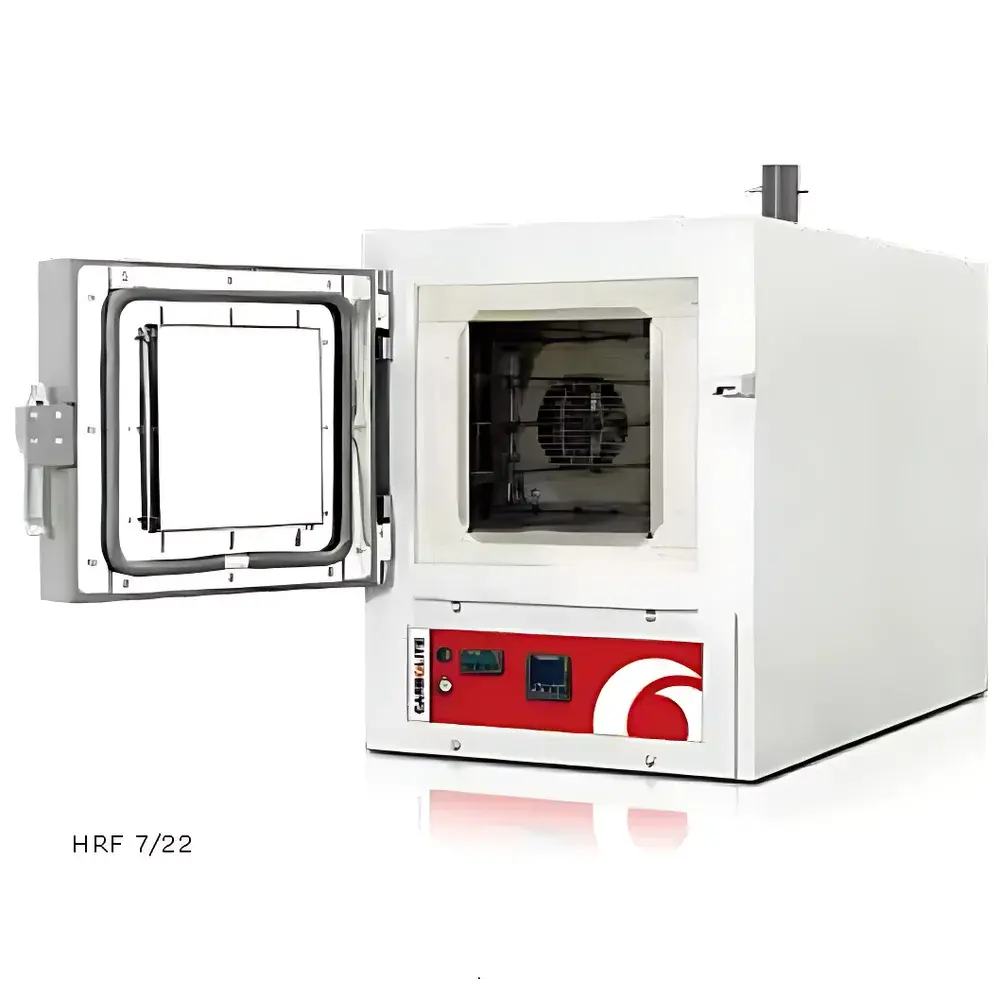
Carbolite Gero HRF Series Air-Circulating Muffle Furnace
| Brand | Carbolite Gero |
|---|---|
| Origin | United Kingdom |
| Model | HRF 7/22/301 |
| Max Operating Temperature | 750 °C |
| Temperature Uniformity | ±1 °C |
| External Dimensions | 590 × 450 × 870 mm |
| Internal Chamber Dimensions | 220 × 200 × 495 mm |
| Chamber Material | Stainless Steel (AISI 304) |
| Heating Method | Forced-Air Convection |
| Insulation | Low-thermal-mass ceramic fiber + firebrick composite |
| Controller | PID301 Single-Stage Programmable Controller |
| Safety | Independent Over-Temperature Protection (DIN 12880 Compliant) |
Overview
The Carbolite Gero HRF Series is a precision-engineered air-circulating muffle furnace designed for consistent, repeatable high-temperature thermal processing in research laboratories, quality control environments, and industrial R&D settings. Utilizing forced-air convection—where a robust internal fan circulates heated air uniformly across the chamber—the HRF achieves exceptional temperature homogeneity (±1 °C) at its maximum operating temperature of 750 °C. Unlike static-heating ovens, this active airflow system minimizes thermal gradients, ensuring uniform heat transfer to samples regardless of placement within the stainless steel (AISI 304) chamber. The furnace employs a dual-layer insulation architecture: an inner lining of low-thermal-mass ceramic fiber for rapid thermal response and energy efficiency, backed by structural firebrick for long-term thermal stability and mechanical integrity. Its muffle design fully isolates the heating elements—mounted vertically on both side walls—from the process chamber, eliminating contamination risk from element outgassing and enabling clean, oxidation-controlled atmospheres essential for ashing, calcination, and pre-treatment of analytical samples.
Key Features
- Forced-air convection system with tangential fan and optimized baffle geometry for laminar, uniform airflow throughout the chamber
- Stainless steel (AISI 304) interior chamber with seamless welded corners and polished finish for corrosion resistance and easy cleaning
- PID301 single-segment programmable controller with intuitive rotary encoder interface, real-time temperature display, and manual override capability
- Independent over-temperature protection circuit compliant with DIN 12880, featuring a separate thermocouple and cut-off relay for fail-safe operation
- Low thermal mass insulation assembly reducing warm-up time by up to 35% compared to traditional brick-only furnaces while maintaining Class 3 thermal efficiency per EN 60519
- Robust structural frame with reinforced door hinge mechanism and high-temperature silicone gasket for long-term sealing integrity
Sample Compatibility & Compliance
The HRF series accommodates standard crucibles (including alumina, platinum, and quartz), ceramic boats, and metal sample holders within its 22 L usable chamber volume (model HRF 7/22/301). It supports routine applications requiring precise thermal profiles under ambient air—such as loss-on-ignition (LOI) testing per ASTM D7348, ash content determination per ISO 1171, and thermal pre-conditioning of catalysts prior to BET surface area analysis. The furnace meets CE marking requirements under the EU Machinery Directive 2006/42/EC and Electromagnetic Compatibility Directive 2014/30/EU. Its construction and safety architecture align with IEC 61010-1 for laboratory electrical equipment, and optional data logging configurations support GLP-compliant audit trails when integrated with validated software platforms.
Software & Data Management
While the base PID301 controller operates standalone, the HRF platform is engineered for digital integration. Optional RS232, RS485, or Ethernet interfaces enable connection to laboratory information management systems (LIMS) or SCADA networks. When paired with Carbolite Gero’s optional MultiLog software (v3.2+), users gain multi-furnace monitoring, real-time graphing, automated CSV export, and electronic signature–enabled report generation compliant with FDA 21 CFR Part 11 requirements. All logged temperature data include timestamped metadata (setpoint, actual, ramp rate, dwell time), supporting traceability in regulated environments such as pharmaceutical QC labs operating under GMP Annex 15.
Applications
- Thermal gravimetric analysis (TGA) sample preparation and residue stabilization
- Ashing of biological, environmental, and food matrices prior to elemental analysis (ICP-OES/MS)
- Calcination of metal oxide precursors in materials science synthesis workflows
- Heat treatment of ceramics and refractory test specimens per ISO 506
- Drying and conditioning of hygroscopic standards in metrology laboratories
- Pre-baking of electrodes and battery component substrates in electrochemical R&D
FAQ
Is the HRF furnace suitable for inert or reducing atmospheres?
No—the standard HRF model is configured for ambient air operation only. For controlled-atmosphere applications, Carbolite Gero offers the HTF or TCF series with gas inlet/outlet ports and optional atmosphere controllers.
Can the PID301 controller be upgraded to multi-segment programming?
Yes—retrofitting with the optional PID501 controller (field-installable) enables up to 16 programmable segments, ramp/soak profiles, and event-triggered outputs.
What maintenance is required for long-term accuracy?
Annual verification using a calibrated reference thermometer (e.g., PRT Class A per IEC 60751) is recommended; fan filter replacement every 12 months in high-dust environments ensures sustained airflow performance.
Does the furnace comply with energy efficiency standards?
Yes—it meets EU Ecodesign Directive (EU) 2019/2022 requirements for laboratory ovens, achieving <1.8 kWh/kL·°C energy consumption index at 750 °C steady state.



