
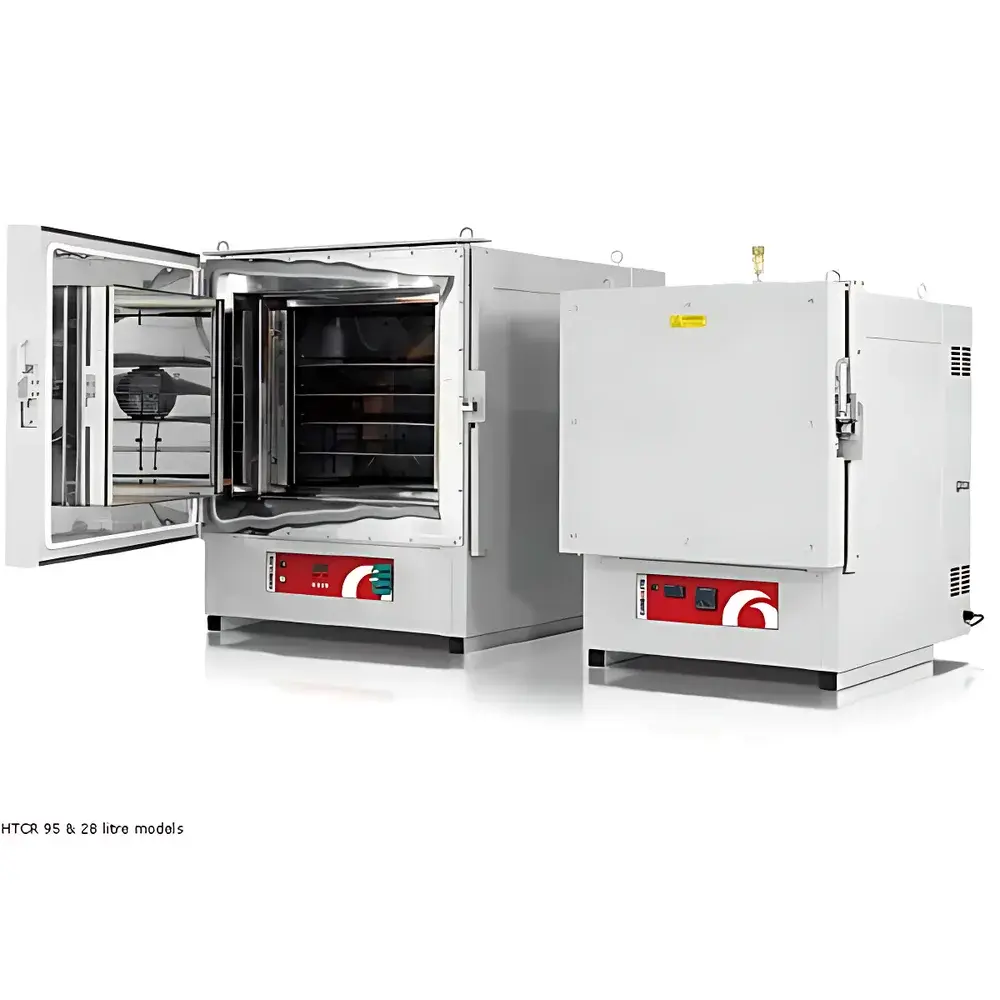
Carbolite Gero HTCR Series High-Temperature Cleanroom Drying Oven
| Brand | Carbolite Gero |
|---|---|
| Origin | United Kingdom |
| Model | HTCR (95 L & 28 L variants) |
| Temperature Range | 400°C, 500°C, 600°C |
| Temperature Uniformity | ±0.5°C |
| External Dimensions | 880 × 675 × 885 mm |
| Internal Chamber Dimensions | 305 × 305 × 305 mm |
| Chamber Material | Polished Stainless Steel (AISI 304) |
| Heating Method | Forced Air Circulation with Low-Thermal-Mass Insulation |
| Compliance Options | ISO 14644-1 Class 5 Cleanroom Configuration Available |
| Controller | PID301 Single-Stage Programmable Controller |
| Safety Features | Independent Over-Temperature Protection, Silicone Door Seal with Particle-Resistant Compression Design |
| Enclosure Finish | White Epoxy-Coated Steel Exterior |
| Fan System | Brushless DC Motor with Sealed Bearing Assembly |
| Insulation | Dual-Layer Ceramic Fiber Blanket with Hermetic Sealing to Prevent Fiber Shedding |
Overview
The Carbolite Gero HTCR Series is a high-precision, high-temperature drying oven engineered for laboratories and production environments requiring strict thermal stability, particle control, and process repeatability. Designed in accordance with ISO 14644-1 cleanroom principles—optionally certified to Class 5—the HTCR integrates forced-air convection heating with ultra-low particulate emission architecture. Its measurement principle relies on precise proportional-integral-derivative (PID) temperature regulation coupled with spatially distributed thermocouple feedback, ensuring uniform thermal distribution across the entire chamber volume. The oven operates within three standard maximum temperature classes: 400°C, 500°C, and 600°C—each validated per IEC 60068-3-5 for thermal stability and recovery performance. Unlike conventional ovens, the HTCR employs a dual-layer insulation system composed of low-thermal-mass ceramic fiber blankets, fully sealed to eliminate fiber shedding—a critical requirement for semiconductor processing, pharmaceutical residual solvent removal, and advanced material sintering where airborne particulates compromise sample integrity.
Key Features
- Polished stainless steel (AISI 304) internal chamber with seamless welded corners and electropolished finish—resistant to oxidation, corrosion, and cleaning agent degradation
- Brushless DC circulation fan with sealed bearings and zero-lubricant operation—ensures continuous, vibration-free airflow without maintenance intervals or particulate generation
- PID301 digital controller with LED display and single-segment ramp/soak programming—supports manual setpoint adjustment and real-time deviation monitoring
- Particle-inhibiting silicone door gasket with compression-seal geometry—tested per ISO 14644-3 for leak rate <0.01 m³/h at 100 Pa differential pressure
- Dual-wall construction with outer epoxy-coated steel enclosure—maintains external surface temperature below 45°C at maximum operating temperature (per EN 61000-3-2)
- Independent over-temperature cut-off circuit with dedicated thermocouple input—meets SIL-2 functional safety requirements for unattended operation
- Perforated stainless steel crucible support tray included as standard—compatible with ASTM E112 grain-size analysis sample holders and USP polymer validation protocols
Sample Compatibility & Compliance
The HTCR accommodates a broad range of sample formats including crucibles, Petri dishes, quartz boats, and custom fixtures up to 305 mm × 305 mm × 305 mm internal volume. Its chamber design complies with ISO 14644-1:2015 for airborne particle concentration limits when configured with optional HEPA-filtered air intake and recirculation bypass. For regulated industries, the oven supports GLP/GMP documentation workflows via optional data logging modules compliant with FDA 21 CFR Part 11 (electronic signatures, audit trail, user access control). Temperature validation reports—including IQ/OQ/PQ templates—are available upon request and align with ASTM E220, ISO/IEC 17025, and EU Annex 15 guidelines. The stainless steel chamber is compatible with IPA, ethanol, hydrogen peroxide vapor (HPV), and dry heat sterilization cycles up to 250°C for pre-use decontamination.
Software & Data Management
While the base HTCR model features standalone PID301 control, optional communication interfaces enable integration into centralized laboratory informatics systems. RS232, RS485, and Ethernet ports support Modbus RTU/TCP protocols for bidirectional parameter exchange and alarm forwarding. The optional multi-segment programmable controller (HTCR-PRO variant) provides up to 16 ramp/soak segments, real-time data logging at 1-second intervals, and CSV export functionality. All logged data include timestamp, setpoint, measured chamber temperature, fan status, and over-temperature event flags—structured to meet ALCOA+ (Attributable, Legible, Contemporaneous, Original, Accurate, Complete, Consistent, Enduring, Available) data integrity standards. Remote access is restricted via role-based authentication and TLS 1.2 encryption when connected via enterprise networks.
Applications
- Thermal gravimetric analysis (TGA) sample conditioning prior to mass loss measurement
- Drying of high-purity ceramics, battery cathode precursors, and MOF synthesis intermediates under inert or low-humidity conditions
- Residual solvent removal from pharmaceutical APIs per ICH Q5C and USP
- Pre-baking of optical substrates and MEMS wafers to minimize outgassing during vacuum deposition
- Accelerated aging studies of polymer encapsulants per ASTM D3045 and ISO 11357-3
- Calibration reference oven for thermocouple wire annealing and fixed-point cell stabilization
FAQ
What cleanroom classifications are supported by the HTCR series?
The HTCR can be factory-configured to meet ISO 14644-1 Class 5 (formerly Class 100) requirements, including HEPA-filtered supply air, unidirectional flow optimization, and particle-count validation reports.
Is the chamber suitable for use with aggressive solvents or corrosive atmospheres?
The AISI 304 stainless steel chamber resists mild organic solvents and aqueous solutions; for halogenated or acidic vapors, optional AISI 316L lining or quartz-lined variants are available.
Can the oven be validated for GMP compliance?
Yes—Carbolite Gero provides IQ/OQ documentation packages, third-party calibration certificates traceable to NPL (UK), and optional PQ support for user-defined process protocols.
What is the typical temperature recovery time after door opening?
At 500°C, the HTCR achieves 90% temperature recovery within ≤4.2 minutes (per IEC 60068-3-5, 30-second door open test), verified using calibrated Class 1 platinum resistance thermometers.
Are replacement parts and service support available globally?
Carbolite Gero maintains authorized service centers across EMEA, North America, and APAC, with spare parts inventory held for minimum 10-year post-manufacture support.
Related Products



