
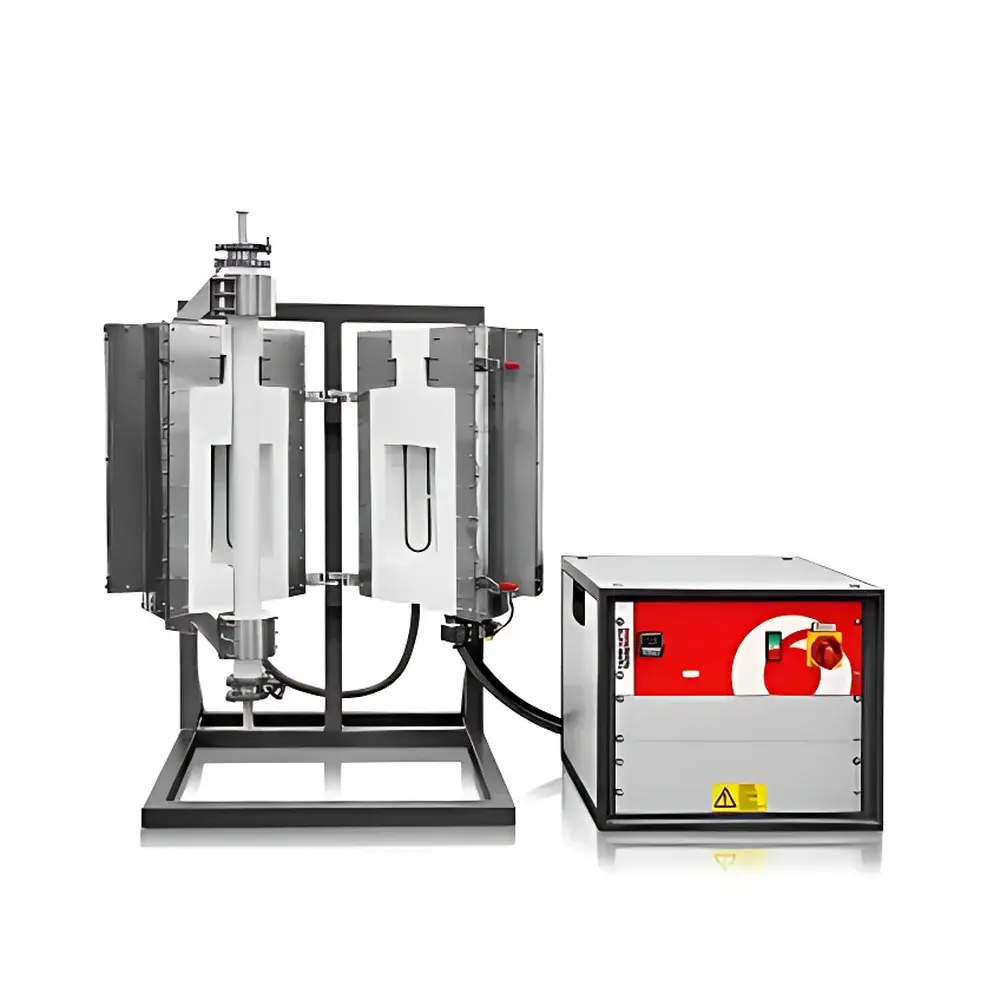
Carbolite Gero HTRF-A Split-Type High-Temperature Tube Furnace (1700 °C)
| Brand | Carbolite Gero |
|---|---|
| Origin | Germany |
| Model | HTRF-A |
| Instrument Type | Split-Type Tube Furnace |
| Max Operating Temperature | 1700 °C |
| Heating Element | Molybdenum Disilicide (MoSi₂) |
| Configuration | Vertical Split-Body Design |
| Heating Zone Lengths | 120 / 250 / 500 / 700 mm |
| Max Tube OD | 100 mm |
| Controller | EPC3016P1 Programmable Digital Controller |
| Thermocouple Type | Type B (Platinum/Rhodium) |
| Insulation | Low-Heat-Capacity Ceramic Fiber |
| Safety | Interlocked Power Cut-off on Door Opening |
| Communication Interface | Ethernet (optional, specified at order) |
| Cable Length (Furnace to Console) | 6 m |
| Atmosphere Compatibility | Inert, Reducing, Vacuum (with optional vacuum package) |
Overview
The Carbolite Gero HTRF-A is a vertically oriented, split-body high-temperature tube furnace engineered for precise thermal processing under controlled atmospheres—up to 1700 °C. Its defining structural feature is the hinged, two-part furnace body that opens laterally, enabling rapid insertion and retrieval of reaction tubes—even those fitted with flanged end caps or complex gas manifolds. This design eliminates the need for axial tube loading, significantly reducing mechanical stress on fragile quartz or ceramic work tubes and minimizing thermal shock during sample handling. The furnace operates on the principle of resistive heating via vertically suspended molybdenum disilicide (MoSi₂) elements embedded within low-thermal-mass ceramic fiber insulation. Heat distribution is optimized through symmetrical element placement and integrated radiation shielding plugs, ensuring axial temperature uniformity ±5 °C over the central 60% of the designated hot zone. A calibrated Type B thermocouple is fixed at the geometric center of the heating zone, providing direct measurement of process temperature without reliance on extrapolated wall readings.
Key Features
- Split-body architecture with mechanical safety interlock: automatic power cutoff upon hinge opening ensures operator protection per EN 61000-6-4 and IEC 61000-6-2 standards.
- Vertically mounted MoSi₂ heating elements—resistant to oxidation in air up to 1800 °C—mounted in tension to minimize sagging and thermal drift over extended operation cycles.
- Ceramic fiber insulation with <1.2 g/cm³ density and <0.12 W/m·K thermal conductivity at 1000 °C, enabling rapid ramp rates and low standby energy consumption.
- EPC3016P1 programmable controller with 16-segment ramp-soak profiles, real-time deviation alarm, and configurable overtemperature cut-off (OTC) setpoint independent of main setpoint.
- Standard 6-meter shielded cable between furnace and control cabinet supports flexible integration into glovebox lines or automated material synthesis platforms.
- Optional Ethernet interface (IEEE 802.3, TCP/IP stack) enables remote monitoring, SCADA integration, and audit-trail-compliant data logging aligned with FDA 21 CFR Part 11 requirements when paired with validated software.
Sample Compatibility & Compliance
The HTRF-A accommodates cylindrical work tubes up to 100 mm outer diameter and supports standard lengths corresponding to heating zones of 120, 250, 500, or 700 mm. Compatible tube materials include high-purity fused silica, alumina (99.8%), silicon carbide, and recrystallized alumina—each selected per ASTM C20, ISO 2738, or DIN EN 623 specifications. For vacuum or reactive gas applications, optional flange kits conform to ISO-KF 40/50 or CF-63 standards. The furnace meets CE marking requirements under the EU Machinery Directive 2006/42/EC and Electromagnetic Compatibility Directive 2014/30/EU. When equipped with the optional oxygen probe and mass flow controllers, it satisfies ASTM E2913-13 for inert atmosphere qualification in metal injection molding (MIM) debinding and sintering workflows.
Software & Data Management
While the EPC3016P1 offers standalone operation with local display and keypad, full data governance is achieved via Carbolite Gero’s optional ThermaLink™ software suite. This Windows-based application provides time-stamped temperature logging at user-defined intervals (1–60 s), digital signature authentication for profile uploads, and export to CSV or PDF formats compliant with GLP documentation protocols. Audit trails record all parameter changes—including setpoint modifications, OTC adjustments, and manual overrides—with operator ID and timestamp. For regulated environments, the system supports electronic signatures per Annex 11 and integrates with LIMS via OPC UA or Modbus TCP when deployed with the Ethernet option.
Applications
The HTRF-A serves as a core thermal platform across advanced materials R&D and industrial process validation. Typical use cases include: controlled-atmosphere annealing of transition metal oxides for battery cathode precursors; pyrolytic decomposition of polymer-derived ceramics; sublimation purification of III–V semiconductor compounds (e.g., GaSe, InSb); solid-state synthesis of MAX phases under argon; vacuum-assisted degassing of optical glass preforms; carbothermic reduction of rare-earth oxides; and cyclic thermal testing of aerospace-grade superalloys per AMS 2750E pyrometry requirements. Its rapid cooldown capability (via forced convection through rear-mounted ventilation slots) also supports quenching studies and thermal cycling fatigue evaluation.
FAQ
What tube materials are certified for use at 1700 °C in the HTRF-A?
High-purity recrystallized alumina (Al₂O₃) and silicon carbide (SiC) tubes are qualified for continuous operation at 1700 °C. Fused silica is limited to ≤1200 °C.
Can the furnace be integrated into a vacuum system?
Yes—optional vacuum packages include dual-stage rotary vane pumps (base pressure 1×10⁻² mbar) or turbomolecular pump systems (base pressure <1×10⁻⁶ mbar), both with ISO-KF or CF flange interfaces.
Is the controller compliant with FDA 21 CFR Part 11?
The EPC3016P1 alone is not Part 11-compliant; however, ThermaLink™ software with enabled audit trail, electronic signatures, and role-based access control meets all technical and procedural requirements when validated per site-specific SOPs.
What is the typical temperature uniformity across the 500-mm heating zone?
At 1600 °C, axial uniformity is ±4 °C over 300 mm (60% of zone length); radial uniformity is ±3 °C at mid-height, measured per ASTM E220 calibration methodology.
Does the furnace support inert gas purging during heating cycles?
Yes—standard gas inlet/outlet ports accept 6-mm OD stainless steel tubing; optional mass flow controllers and oxygen analyzers enable dynamic atmosphere control with <10 ppm O₂ residual in argon or nitrogen streams.



