
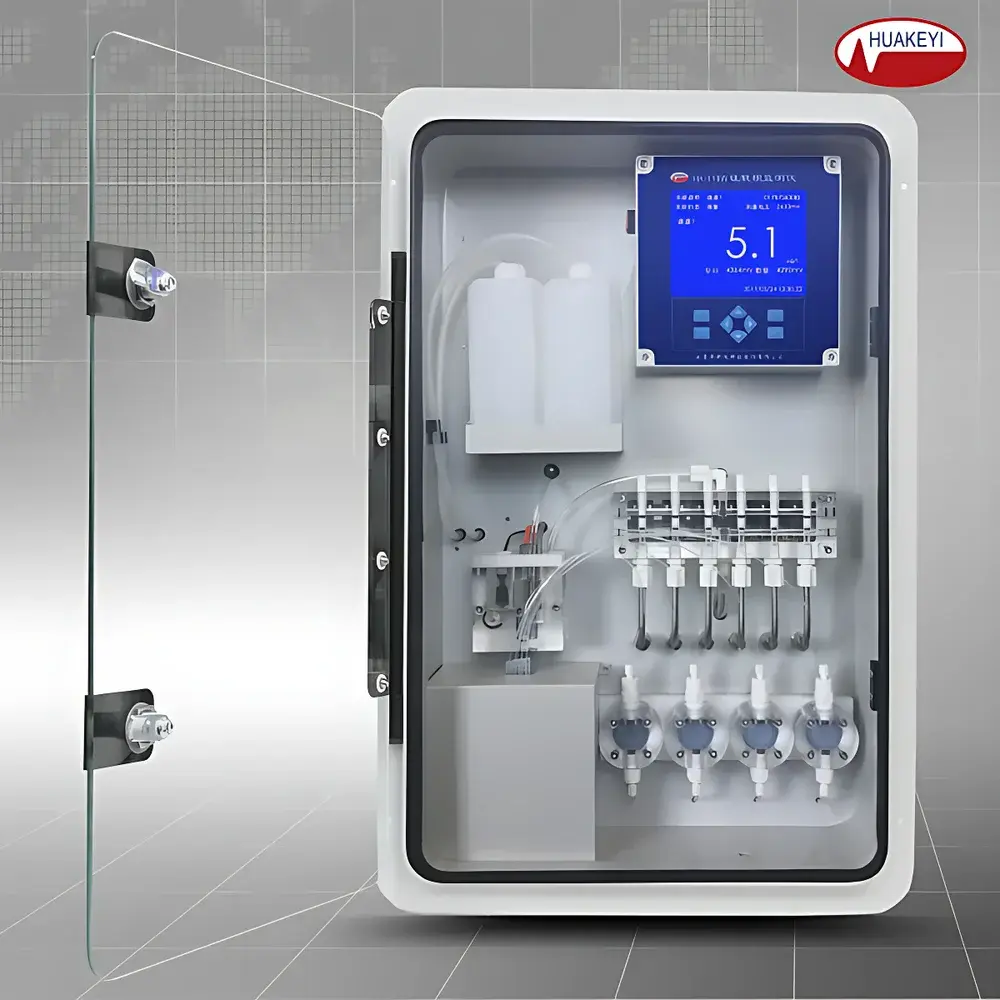
Huake Instrument HK-118W Online Silica Analyzer
| Brand | Huake Instrument |
|---|---|
| Origin | Beijing, China |
| Model | HK-118W |
| Type | Online Analyzer |
| Measurement Principle | Molybdenum Blue Spectrophotometry (810 nm LED光源) |
| Range | 0–200 μg/L or 0–2000 μg/L (selectable) |
| Accuracy | ±2% FS |
| Repeatability | ≤1% |
| Measurement Cycle | 10–60 min (programmable) |
| Sample Flow Rate | 150–300 mL/min |
| Sample Temp. | 5–50 °C |
| Sample Pressure | 14–140 kPa |
| Particle Limit | ≤5 µm (no colloids) |
| Photometric Stability | Baseline drift eliminated via patented blank compensation |
| Temperature Control | Sample, optical path & reagent maintained at up to 50 °C |
| Output | 4–20 mA (isolated), RS485 standard, HART/Profibus optional |
| Data Storage | High-capacity internal logging with trend curve recall |
| Power | AC 220 V ±10%, 50 Hz, max. 240 W |
| Dimensions | 450 × 690 × 225 mm (W×H×D) |
| Weight | 23 kg (dry) |
Overview
The Huake Instrument HK-118W Online Silica Analyzer is a dedicated photometric analyzer engineered for continuous, low-level silicon dioxide (SiO₂) monitoring in ultrapure water streams—particularly in power generation, petrochemical, and semiconductor-grade water systems. It operates on the internationally standardized molybdenum blue spectrophotometric method (ASTM D859, ISO 15303), where soluble silicate reacts with molybdate under acidic conditions to form a heteropoly acid, which is subsequently reduced to yield an intense blue chromophore measurable at 810 nm. The instrument employs a high-stability, temperature-controlled optical path and integrated fluidic architecture to ensure long-term baseline integrity and minimal reagent consumption. Designed for deployment at critical process points—including condensate polishing unit (CPU) effluent, mixed-bed demineralizer outlet, and steam-cycle sampling lines—the HK-118W delivers trace-level silica quantification with metrological rigor suitable for compliance with IAPWS-RP-18 (International Association for the Properties of Water and Steam) and EPRI guidelines for boiler feedwater purity.
Key Features
- Patented dual-compensation methodology: simultaneous correction for both reagent blank contribution and system background silica, eliminating systematic offset without manual recalibration.
- Integrated thermostatic control: independent temperature regulation of sample stream, optical cell, and reagent reservoirs (up to 50 °C), mitigating thermal-induced signal drift across ambient fluctuations (5–45 °C operating range).
- Modular multi-channel capability: programmable 1–6 channel sequential analysis; each channel configurable with independent measurement interval (10–60 min) and auto-scheduling to optimize reagent usage and analytical throughput.
- Industrial-grade fluid handling: diaphragm metering pumps with acid/alkali-resistant chemically inert wetted materials (e.g., PTFE, FFKM), delivering ≤1% volumetric accuracy over extended operation without maintenance intervention.
- Self-diagnostic architecture: real-time hardware status reporting for solenoid valves, pump actuation, sensor response, and circuit integrity—displayed via intuitive icon-based alerts on the 5.7-inch 320×240 graphical LCD.
- Secure data governance: internal non-volatile memory stores ≥12 months of timestamped measurements (including raw absorbance, compensated concentration, and diagnostic logs); USB port enables encrypted export compliant with laboratory data integrity requirements.
Sample Compatibility & Compliance
The HK-118W accepts pressurized liquid samples meeting strict particulate and chemical criteria: suspended solids ≤5 µm (colloidal silica excluded), flow rate 150–300 mL/min, inlet pressure 14–140 kPa, and temperature 5–50 °C. Its design conforms to IEC 61000-6-2 (immunity) and IEC 61000-6-4 (emissions) for industrial electromagnetic environments. While not certified to UL/CE for hazardous locations, it meets IP54 ingress protection when installed per manufacturer mounting instructions (panel-mounted aluminum chassis). For regulated environments, the instrument supports audit-ready operation: all calibration events, parameter changes, and alarm triggers are time-stamped and logged; optional RS485 Modbus RTU or HART 7.5 communication enables integration into DCS/SCADA systems supporting FDA 21 CFR Part 11-compliant electronic records when paired with validated host software.
Software & Data Management
The embedded firmware provides full local configuration via bilingual (English/Chinese) menu navigation and supports remote parameter access through ASCII protocol over RS485. Calibration workflows include single-point, multi-point (up to 5 standards), and dynamic blank referencing—all traceable to NIST-traceable silica standards. All measurement data are stored with millisecond-resolution timestamps and associated metadata (e.g., channel ID, temperature setpoints, pump cycle count). USB exports generate CSV files compatible with LIMS platforms and statistical process control (SPC) tools. Firmware updates are performed via signed binary upload, preserving configuration integrity. No cloud connectivity or external telemetry is implemented—data sovereignty remains fully on-site per ISO/IEC 27001-aligned operational policy.
Applications
- Power plant chemistry monitoring: real-time silica surveillance in turbine condensate, HP/LP heater drains, and superheated steam sampling systems to prevent quartz deposition on turbine blades.
- Petrochemical desalination units: verification of silica removal efficiency in RO pretreatment and ion exchange trains prior to high-pressure boiler feed.
- Pharmaceutical WFI (Water for Injection) loop validation: trending of silica breakthrough during polishing column exhaustion per USP and Annex 1 expectations.
- Microelectronics UPW distribution networks: detection of sub-ppb silica excursions that may impact wafer cleaning efficacy and gate oxide integrity.
- Research-scale demineralization studies: quantitative assessment of novel adsorbent media performance under controlled hydrodynamic and thermal conditions.
FAQ
What is the recommended calibration frequency for routine operation?
Calibration is advised every 7 days for continuous operation in critical steam cycles; however, the built-in blank compensation and thermal stabilization allow extended intervals (up to 30 days) in stable, low-silica environments—subject to internal QA review per ISO/IEC 17025.
Can the HK-118W operate unattended for extended periods?
Yes—reagent consumption is ≤3 L per reagent per 30 days (four reagents total), and the system includes low-reagent level alarms with visual/relay outputs. Optional reagent thermostatic cabinet prevents crystallization or degradation in ambient temperatures below 15 °C.
Is third-party software required for data retrieval or reporting?
No—USB export delivers self-contained CSV files. However, for enterprise integration, the RS485 interface supports standard Modbus RTU register mapping; HART or Profibus DP-V1 modules enable direct connection to Emerson DeltaV, Siemens PCS7, or Honeywell Experion DCS platforms.
How does the instrument handle interference from phosphate or other heteropoly-forming anions?
The method uses optimized acidification and masking agents (e.g., oxalic acid) to suppress phosphomolybdate formation. Validation per ASTM D859 confirms <±5% cross-sensitivity for phosphate up to 500 µg/L when sample pH is controlled within specification.
What maintenance tasks require user intervention beyond reagent replacement?
Annual verification of photometric zero (using deionized water blank) and optical cell cleaning with dilute nitric acid (≤5%) is recommended. Pump tubing and filter cartridges are rated for ≥12 months service life under nominal flow conditions.
Related Products







