
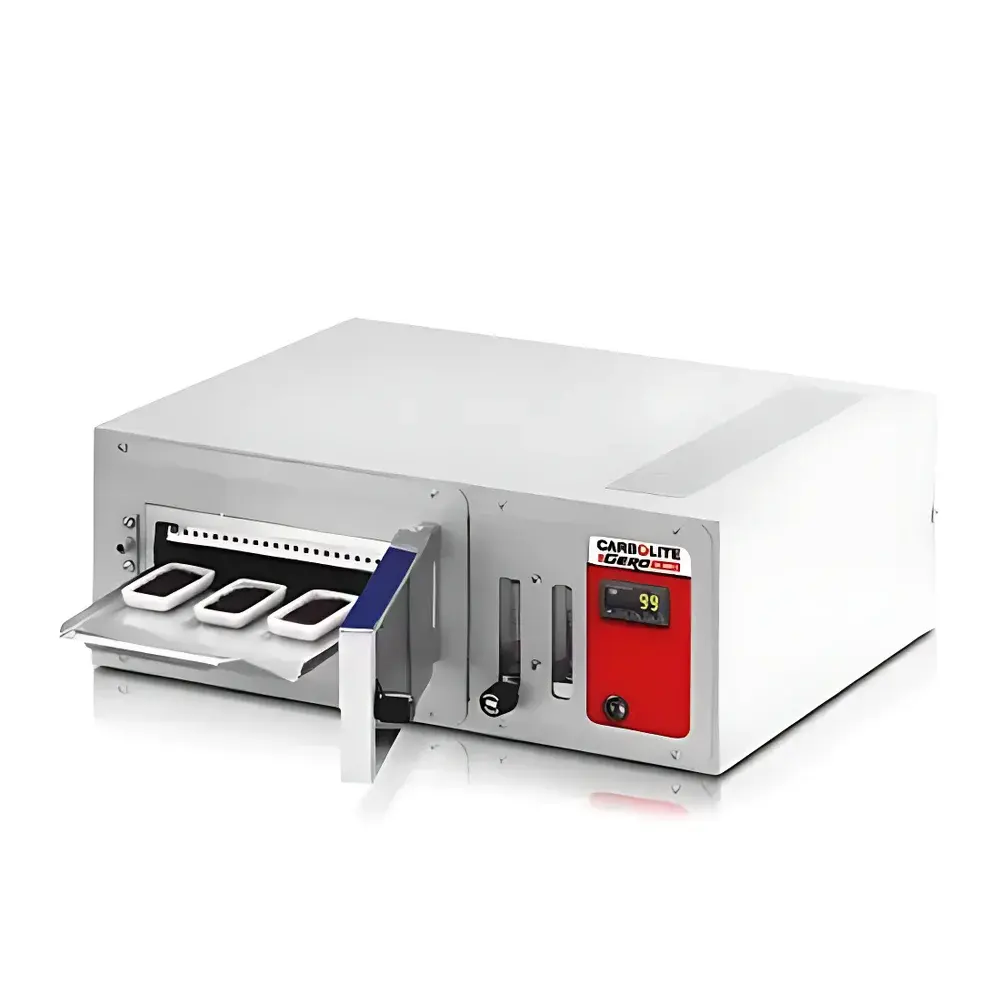
Carbolite Gero MFS Small-Capacity Drying Oven for Coal Moisture Analysis
| Brand | Carbolite Gero |
|---|---|
| Origin | Germany |
| Model | MFS |
| Instrument Type | Precision Drying Oven |
| Max Temperature | 210 °C |
| Chamber Dimensions (W × H × D) | 25 × 195 × 290 mm (depth reduced by 22 mm for thermocouple insertion) |
| External Dimensions (H × W × D) | 185 × 490 × 450 mm |
| Chamber Volume | 1.4 L |
| Temperature Uniformity | ±5.0 °C @ 210 °C |
| Temperature Stability | ±0.5 °C |
| Heating Power | 500 W |
| Atmosphere Options | Nitrogen or Air |
| Compliance | BS ISO 687:2010, BS ISO 11722:2013, BS 1016-104.2:1991 (MFS/1 ISO) |
| Chamber Material | Corrosion- and oxidation-resistant anodized aluminum |
| Door | Side-hinged, gas-tight, single-hand operable |
| Gas Flow Control | Integrated preheated flowmeter with adjustable flow rate |
| Optional Accessories | Welded steel nitrogen-purged desiccator, crucibles with lids, voltage variants |
Overview
The Carbolite Gero MFS Small-Capacity Drying Oven is a purpose-engineered thermal system designed specifically for standardized moisture determination in coal and other hygroscopic solid fuels. It operates on the gravimetric principle: a precisely weighed sample is heated under controlled inert (nitrogen) or ambient (air) atmosphere to drive off physically bound water, and the mass loss—measured after reaching constant weight—is reported as moisture content. Unlike general-purpose ovens, the MFS features a compact, highly insulated chamber (1.4 L internal volume) that minimizes free air space—critical for compliance with international standards requiring minimal convection interference during drying. Its aluminum chamber is anodized to resist oxidation and corrosion from repeated thermal cycling and residual volatiles, ensuring long-term dimensional stability and consistent thermal performance. The oven employs a PID-controlled 132-series temperature regulator delivering ±0.5 °C stability and ±5.0 °C uniformity across the working zone at maximum operating temperature (210 °C), meeting stringent repeatability requirements for accredited laboratory testing.
Key Features
- Compact, low-volume chamber (25 × 195 × 290 mm, net 1.4 L) engineered to satisfy standard-specified minimum free-space criteria for coal moisture analysis
- Corrosion-resistant anodized aluminum interior with optimized thermal mass for rapid stabilization and uniform heat distribution
- Gas-tight, side-hinged door with ergonomic single-hand operation—designed for frequent loading/unloading of crucibles without compromising chamber integrity
- Integrated preheated gas flow path: inlet gas passes through a dedicated preheat zone before entering the chamber, eliminating cold-spot condensation and ensuring consistent drying kinetics
- Dual-standard configuration support: MFS/1 ISO variant certified for nitrogen-purged operation per BS ISO 687:2010 and BS ISO 11722:2013; MFS/1 ASTM variant configured for regulated air flow per ASTM D3173-11
- Front-panel mounted flowmeter with calibrated scale for real-time monitoring of gas throughput and verification of chamber seal integrity
- Overtemperature protection circuit independent of main controller—compliant with IEC 61000-6-2 and EN 60519-2 safety directives
Sample Compatibility & Compliance
The MFS is validated exclusively for solid particulate samples conforming to standardized coal preparation protocols (e.g., BS EN 15148, ASTM D2013). It accommodates standard porcelain or alumina crucibles (typically 30–50 mL capacity) with fitted lids, enabling direct transfer to the optional welded-steel nitrogen desiccator—eliminating exposure to ambient humidity during cooling. Regulatory alignment includes full traceability to reference methods: BS 1016-104.2:1991 (determination of total moisture in coal), BS ISO 687:2010 (coal and coke—determination of moisture in the general analysis test sample), and BS ISO 11722:2013 (solid mineral fuels—determination of moisture in the air-dried basis). For laboratories operating under GLP or ISO/IEC 17025 frameworks, the oven supports audit-ready documentation via its stable thermal profile, calibrated flow control, and mechanical overtemperature safeguard—no software-based validation required.
Software & Data Management
The MFS operates as a stand-alone, microprocessor-controlled instrument with no embedded software or digital data logging. Temperature setpoint, ramp rate (if applicable), and dwell time are manually configured via the front-panel PID controller (Type 132). All operational parameters—including gas flow rate, chamber temperature, and elapsed time—are recorded manually by the analyst in accordance with standard test method reporting requirements (e.g., ASTM D3173 Section 9, BS ISO 11722 Clause 8). This architecture eliminates regulatory complexity associated with computerized systems: no 21 CFR Part 11 compliance burden, no electronic audit trail validation, and no cybersecurity maintenance obligations. Calibration certificates for the integrated PT100 sensor and flowmeter are supplied with each unit and remain valid for 12 months under normal use conditions.
Applications
- Gravimetric moisture determination in bituminous, sub-bituminous, lignite, and anthracite coals per ISO, ASTM, and BS methodologies
- Pre-drying step prior to proximate analysis (ash, volatile matter, fixed carbon) where moisture removal must precede high-temperature treatment
- Controlled dehydration of biomass feedstocks and solid recovered fuels (SRF) under standardized atmospheric conditions
- Stabilization drying of reference materials used in interlaboratory proficiency testing schemes
- Low-temperature conditioning of ceramic precursors and catalyst supports where oxygen exclusion is required
FAQ
What standards does the MFS comply with for coal moisture testing?
The MFS/1 ISO configuration complies with BS ISO 687:2010, BS ISO 11722:2013, and BS 1016-104.2:1991. The MFS/1 ASTM variant meets ASTM D3173-11 requirements.
Is nitrogen purging mandatory for all tests?
No—nitrogen is required only for the ISO-compliant method to prevent oxidative mass gain; ASTM D3173 permits conditioned air flow, and the MFS supports both configurations.
Can the oven be used for applications beyond coal moisture analysis?
It is not validated for non-standardized applications. Its chamber geometry, gas handling, and thermal profile are optimized solely for gravimetric moisture determination in solid fuels per cited standards.
What maintenance is required to sustain calibration accuracy?
Annual recalibration of the PT100 sensor and flowmeter is recommended. Chamber cleanliness—particularly removal of coal dust residue from crucible handling—is essential to preserve thermal uniformity and avoid sensor drift.
Is the optional nitrogen desiccator included by default?
No—the welded-steel nitrogen desiccator is a factory-order option and must be specified at time of purchase. It is not compatible with air-only operation.



