Infrared and Raman Spectral Library Database

| Origin | Japan |
|---|---|
| Manufacturer Type | Authorized Distributor |
| Import Status | Imported |
| Pricing | Upon Request |
| Instrument Category | Spectral Software & Reference Database |
Ask about pricing, availability and specifications.
Overview
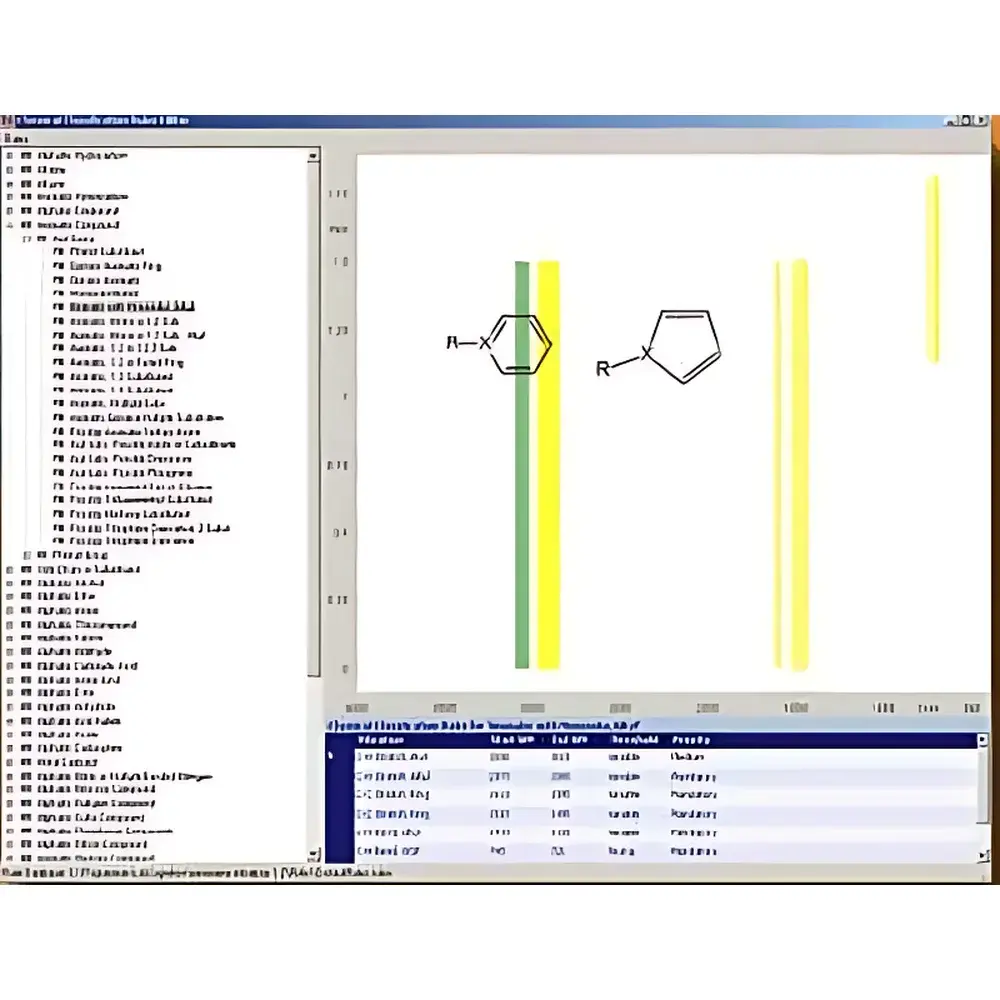
The Infrared and Raman Spectral Library Database is a comprehensive, vendor-neutral digital reference resource engineered for rigorous spectral identification and qualitative analysis in FTIR and dispersive Raman spectroscopy workflows. Unlike instrument-specific proprietary libraries, this database is built on open spectral metadata standards and supports native import of common spectral file formats—including ASTM E1421-22 compliant JCAMP-DX (.jdx), ASCII-based .spc, .csv, and Bruker OPUS-compatible binary structures—enabling seamless integration across major IR/Raman platforms (e.g., Thermo Nicolet, PerkinElmer Spectrum, Shimadzu IRTracer, Horiba LabRAM). The core architecture employs chemometric indexing based on peak position (cm⁻¹), intensity normalization, and second-derivative preprocessing to ensure high-fidelity spectral matching under variable acquisition conditions. It serves as both a validated reference repository and a customizable knowledge base for laboratories operating under ISO/IEC 17025, USP , and ASTM E2893-23 compliance frameworks.
Key Features
- Fully format-agnostic spectral ingestion: Accepts raw, processed, and baseline-corrected spectra from all major FTIR and Raman instrumentation vendors.
- User-definable library structure: Supports hierarchical organization by chemical class (e.g., polymers, pharmaceuticals, contaminants), functional group, CAS registry number, or custom metadata tags.
- Embedded spectral search engine: Implements correlation coefficient (Pearson and Spearman), Euclidean distance, and weighted similarity algorithms with adjustable tolerance thresholds for wavenumber shift (±2 cm⁻¹ default) and intensity scaling.
- Batch processing capability: Enables automated library validation, spectral outlier detection, and cross-instrument reproducibility assessment using internal reference standards (e.g., polystyrene film, silicon wafer).
- Export-ready reporting: Generates audit-compliant PDF reports with embedded spectral overlays, match scores, confidence intervals, and traceable metadata (date/time stamp, operator ID, instrument serial number).
- Secure local deployment: Installed on Windows/Linux workstations or network-attached storage (NAS); no cloud dependency or external telemetry—fully aligned with GLP/GMP data integrity requirements (21 CFR Part 11 ready with optional electronic signature module).
Sample Compatibility & Compliance
The database accommodates spectra acquired from solid (KBr pellet, ATR crystal), liquid (cell transmission), and gas-phase samples across standard mid-IR (4000–400 cm⁻¹), far-IR (400–50 cm⁻¹), and Raman (200–4000 cm⁻¹) ranges. All included reference spectra are sourced from peer-reviewed literature, NIST SRD-115 (IR), and the Horiba Raman Spectral Database v3.2, with full provenance documentation. Each entry conforms to IUPAC-recommended spectral annotation conventions, including explicit labeling of sample preparation method, instrument model, resolution (≤4 cm⁻¹), and signal-to-noise ratio (≥100:1). The system supports ISO 17025 clause 7.7 (result reporting) and ASTM E1655-22 (standard practices for infrared quantitative analysis) validation protocols.
Software & Data Management
Delivered as a standalone Windows application (64-bit, compatible with Windows 10/11 LTSC), the software includes integrated SQLite-based relational database management with ACID transaction support. Users may perform version-controlled library backups, define role-based access permissions (administrator, analyst, reviewer), and generate immutable audit trails for all spectral additions, edits, or deletions. Optional integration with LIMS via ODBC or RESTful API enables bidirectional synchronization of sample IDs, batch numbers, and analytical results. Data retention policies align with FDA 21 CFR Part 11 Subpart B §11.10(a) for electronic records and §11.300 for electronic signatures when configured with PKI authentication.
Applications
- Pharmaceutical QC: Identification of active pharmaceutical ingredients (APIs), excipients, and degradation products per USP and EP 2.2.48.
- Materials science: Polymer identification, additive screening, and counterfeit material detection in composites and coatings.
- Forensic analysis: Rapid comparison of unknown trace evidence (e.g., paints, adhesives, fibers) against curated casework libraries.
- Environmental monitoring: Detection of microplastics, PFAS compounds, and industrial contaminants in soil/water extracts.
- Academic research: Development of machine learning training sets for spectral classification models (e.g., CNN, PLS-DA) with ground-truth labeled data.
FAQ
Is this library compatible with older FTIR instruments running legacy operating systems?
Yes—spectral import is format-driven, not OS-dependent; spectra saved in JCAMP-DX v5.01 or ASCII text can be loaded regardless of original acquisition software version.
Can spectral matches be exported for regulatory submission?
Absolutely—the software generates PDF reports containing full spectral overlays, match metrics, instrument calibration logs, and digital signatures meeting FDA eCTD and EU Annex 11 requirements.
Does the database include isotopically labeled compound spectra?
No—this release contains only naturally abundant isotopic distributions; custom isotopic libraries require separate licensing and validation per ISO/IEC 17025 clause 7.2.2.
How frequently is the reference content updated?
Annual major releases coincide with NIST SRD updates and IUPAC nomenclature revisions; minor patches (e.g., typo corrections, metadata enhancements) are issued quarterly via secure download portal.
Is remote multi-user access supported?
Yes—when deployed on a Windows Server environment with SQL Server backend, concurrent access for up to 25 licensed users is fully supported with session isolation and conflict resolution logic.