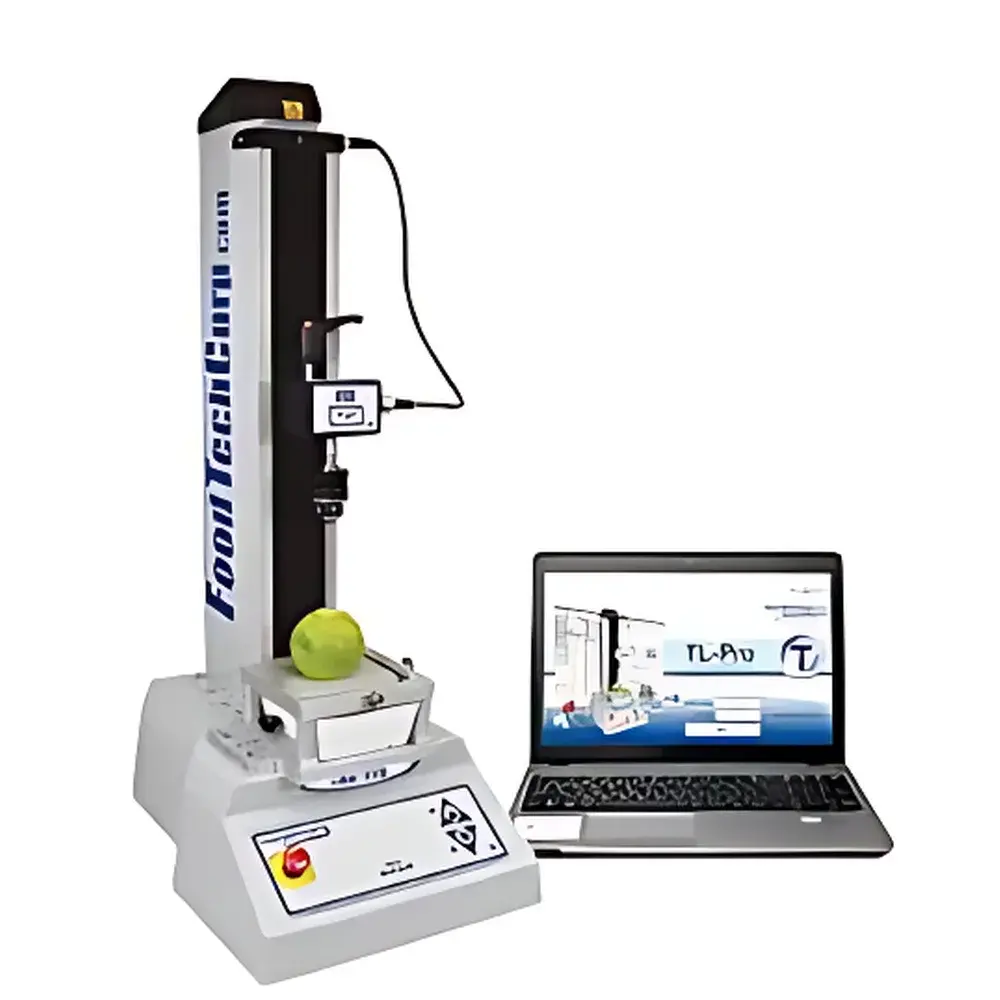
FTC TMS-PRO Texture Analyzer
| Brand | FTC |
|---|---|
| Origin | USA |
| Model | TMS-PRO |
| Type | Research-Grade Universal Texture Analyzer |
| Compliance | ASTM F3102, ISO 11357-3 (for thermoplastic food analogs), USP <1141> (for mechanical property assessment of semi-solids) |
| Force Range Options | 5 N, 50 N, 500 N, 1 kN (interchangeable load cells) |
| Displacement Resolution | 0.1 µm |
| Data Acquisition Rate | Up to 1,000 Hz |
| Probe Mounting | Standard 1/4"-20 UNC thread interface |
| Software Platform | Texture Pro CT v3.x (FDA 21 CFR Part 11 compliant with audit trail, electronic signatures, and user role management) |
Overview
The FTC TMS-PRO Texture Analyzer is a research-grade universal mechanical testing system engineered for precise, repeatable quantification of textural and rheomechanical properties in soft solids and semi-solid materials—primarily within the food science domain. Operating on the principle of controlled uniaxial compression, tension, penetration, extrusion, and cyclic deformation, the TMS-PRO applies calibrated mechanical force via motor-driven crosshead movement while simultaneously recording high-fidelity force–displacement–time data. Its modular architecture enables method standardization across diverse sample geometries and physical states—from viscoelastic gels and doughs to fibrous meats and brittle confections—making it a foundational instrument for fundamental food physics research, product development, and QC/QA laboratories operating under GLP or GMP frameworks.
Key Features
- Modular force measurement system with interchangeable precision load cells (5 N to 1 kN), each factory-calibrated to NIST-traceable standards and validated per ASTM E4 and ISO 7500-1.
- Programmable crosshead speed range from 0.01 mm/s to 1,000 mm/s, supporting both quasi-static and dynamic mechanical profiling—including strain-rate-dependent modulus evaluation.
- Standardized probe interchangeability via 1/4″-20 UNC mounting; compatible with over 80 FDA-registered probe geometries (e.g., P/2, P/36, TA-10, HDP/BS, A/SPR) for standardized texture profile analysis (TPA), puncture, shear, and tensile testing.
- Real-time data acquisition at up to 1,000 Hz, enabling capture of transient failure events (e.g., fracture onset in crisp snacks or yield point in cheese) without aliasing.
- Integrated environmental enclosure options (temperature-controlled chamber: –20 °C to +80 °C) for thermomechanical characterization aligned with ISO 11357-3 protocols.
- Rigid, low-resonance frame design with optical encoder-based position feedback ensures sub-micron displacement repeatability (±0.1 µm) across extended test sequences.
Sample Compatibility & Compliance
The TMS-PRO accommodates heterogeneous food matrices—including hydrated doughs, cooked meats, fresh fruits, hydrocolloid gels, extruded cereals, and aerated confections—without requiring sample homogenization or solvent extraction. Its compliance extends beyond basic mechanical testing: methods are directly translatable to ASTM F3102 (instrumental texture evaluation of foods), ISO 11357-3 (dynamic mechanical analysis of thermoplastics used as food analogs), and USP (mechanical characterization of semi-solid dosage forms). All hardware and software components meet IEC 61000-6-3 EMC requirements and UL 61010-1 safety standards. The system supports full 21 CFR Part 11 compliance through optional audit-trail-enabled firmware and role-based access control in Texture Pro CT software.
Software & Data Management
Texture Pro CT v3.x provides an ISO/IEC 17025-aligned analytical environment with pre-validated test templates (e.g., TPA, Kramer Shear, Warner-Bratzler, Uniaxial Compression), automated parameter extraction (hardness, cohesiveness, springiness, chewiness, adhesiveness, resilience), and statistical batch comparison tools. Raw force–displacement curves are exportable in ASCII, CSV, and HDF5 formats for third-party analysis (MATLAB, Python SciPy, JMP). All user actions—including method edits, result approvals, and calibration logs—are timestamped and cryptographically signed in immutable audit trails. Data integrity is preserved via automatic checksum validation and encrypted local storage with optional network backup to NAS or LIMS-integrated repositories.
Applications
The TMS-PRO delivers quantitative texture metrics critical to food formulation, process optimization, and shelf-life prediction. In bakery R&D, it quantifies dough resistance-to-extension and crumb compressibility to correlate with baking performance and staling kinetics. For meat analogs and processed meats, it measures shear force (Warner-Bratzler), binding strength, and fiber alignment—parameters directly linked to sensory tenderness scores. In confectionery, it tracks time-dependent modulus evolution during gelation and drying cycles (e.g., gelatin-based jellies), replacing subjective sensory panels with objective, reproducible hardness–time profiles. Additional validated applications include fruit firmness grading (ISO 11348), cereal crispness quantification (ASTM F3102 Annex A2), and edible film tensile strength assessment per ASTM D882.
FAQ
What standards does the TMS-PRO support for regulatory submissions?
It natively supports method templates aligned with ASTM F3102, ISO 11357-3, USP , and AOAC 985.25—enabling direct use in FDA GRAS dossiers and EFSA scientific opinions.
Can the system be integrated into an existing LIMS or ERP platform?
Yes—via secure RESTful API and ODBC-compliant database connectors, enabling automated result ingestion into LabVantage, Thermo Fisher SampleManager, or SAP QM modules.
Is training provided for method development and validation?
FTC offers on-site IQ/OQ/PQ protocol execution, GAMP 5-aligned validation documentation packages, and hands-on workshops covering ICH Q5E-compliant comparability studies for texture-critical products.
How is probe calibration verified between runs?
Each probe includes a serialized calibration certificate traceable to NIST SRM 2241; daily verification is performed using FTC-certified reference springs (±0.5% accuracy) following ASTM E2554 guidelines.
Does the system support temperature-controlled testing?
Yes—optional Peltier-cooled or heated environmental chambers maintain ±0.3 °C stability across –20 °C to +80 °C, enabling Arrhenius-based shelf-life modeling per ISO 11348-2.