
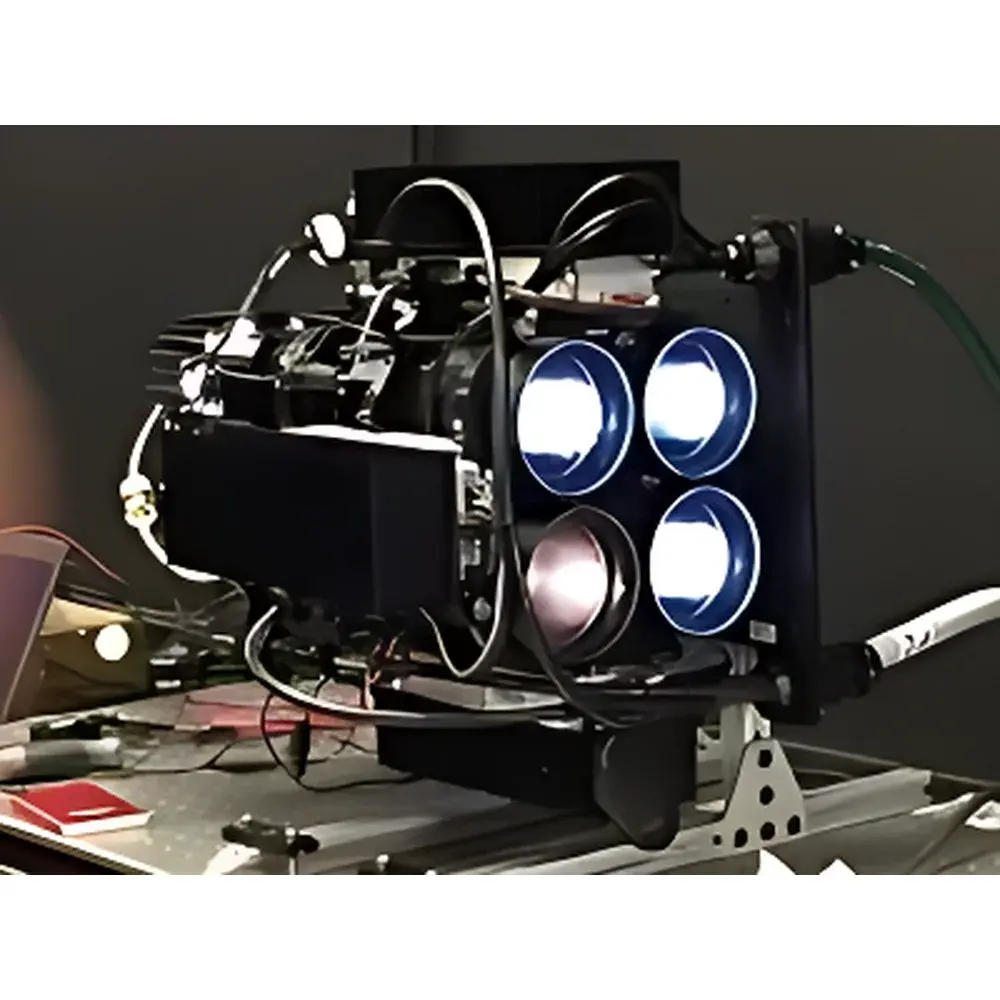
CCS Collimated Solar Simulator by Labsphere
| Brand | Labsphere |
|---|---|
| Origin | USA |
| Model | CCS |
| Operating Mode | Steady-State |
| Spectral Range | 350–2400 nm |
| Correlated Color Temperature | 5250 K |
| Beam Divergence | <3° |
| Illuminated Area Diameter at 3 m | 20 cm |
| Irradiance Uniformity | ≥98% |
| Typical Irradiance at 3 m | ~1000 W/m² (AM1.5G equivalent) |
| Control Interface | Software-Driven Digital Control System |
| Light Source Technology | Multi-Lamp Plasma-Based Architecture |
| Compliance | Designed to meet ASTM E927-23, IEC 60904-9 Ed. 3, ISO 9276-2 for spectral match and spatial uniformity requirements |
Overview
The CCS Collimated Solar Simulator by Labsphere is a high-precision, steady-state solar simulation system engineered for applications demanding spectrally accurate, spatially uniform, and highly collimated illumination. Unlike conventional diffuse or point-source solar simulators, the CCS employs a proprietary multi-lamp plasma-based optical architecture to generate a near-collimated beam with divergence under 3°, enabling reproducible irradiance delivery over extended working distances. Its spectral output spans 350–2400 nm—covering UV-A, visible, and near-infrared regions—with a correlated color temperature of 5250 K, closely matching extraterrestrial solar irradiance (AM0) and terrestrial reference spectra (AM1.5G). The system achieves ≥98% irradiance uniformity across a 20 cm diameter target plane at a 3-meter working distance—a configuration validated per IEC 60904-9 Ed. 3 Class AAA requirements for spatial uniformity. This performance makes the CCS suitable for calibration-critical tasks including photovoltaic device characterization, bidirectional reflectance distribution function (BRDF) measurement, and accelerated material aging studies under controlled solar-spectrum exposure.
Key Features
- Steady-state operation with zero temporal fluctuation—ideal for long-duration stability testing and real-time spectral monitoring.
- Collimated beam geometry (<3° divergence) ensures minimal angular spread, supporting precise angular response characterization of optical surfaces and solar receivers.
- Software-controlled digital regulation of total irradiance output, enabling stepwise or continuous adjustment from sub-1-sun to >2-sun levels without mechanical filter changes.
- Plasma-based light source architecture delivers superior radiometric stability (<±0.5% over 8 hours), eliminating the thermal drift and filament degradation inherent in tungsten-halogen systems.
- Compact, lightweight mechanical design facilitates integration into optical tables, environmental chambers, and automated test platforms.
- Factory-calibrated spectral irradiance data traceable to NIST standards; supplied with full spectral power distribution (SPD) report and uniformity mapping documentation.
Sample Compatibility & Compliance
The CCS accommodates samples up to 20 cm in diameter at the designated 3 m working plane, with optional beam expansion optics available for larger fields. It supports non-contact optical characterization of flat and curved substrates—including PV cells, anti-reflective coatings, aerospace composites, and architectural glazing—without introducing thermal loading artifacts common in focused-source systems. The simulator conforms to key international photovoltaic and optical testing standards: spectral match classification per IEC 60904-9 Ed. 3 (Class A for spectral match), spatial uniformity (Class A), and temporal stability (Class A). It also supports compliance workflows aligned with ASTM E927-23 (Standard Specification for Solar Simulation for Photovoltaic Testing) and ISO 9276-2 (Representation of particle size distributions). Full audit trails, calibration certificates, and GLP-compliant documentation packages are available upon request.
Software & Data Management
Control and monitoring are executed via Labsphere’s proprietary CCS Control Suite—a Windows-based application supporting USB 2.0 and Ethernet interfaces. The software provides real-time irradiance readout (W/m²), spectral weighting selection (e.g., AM1.5G, AM0), and programmable ramp profiles for stress-testing protocols. All operational parameters—including lamp runtime, thermal status, and output history—are logged with timestamped metadata. Export formats include CSV, XML, and HDF5, ensuring compatibility with MATLAB, Python (NumPy/Pandas), and LIMS environments. For regulated laboratories, optional 21 CFR Part 11-compliant user access control, electronic signatures, and immutable audit logs are available as add-on modules.
Applications
- Photovoltaic device certification and performance mapping (I-V curve tracing, quantum efficiency analysis).
- Optical property metrology: BRDF, BSDF, and total hemispherical reflectance/transmittance measurements per ASTM E2027 and ISO/CIE 11664-3.
- Accelerated weathering and photochemical degradation testing of polymers, paints, and encapsulants per ISO 4892-2 and ASTM G155.
- Calibration of radiometers, spectroradiometers, and satellite Earth observation sensors against solar reference standards.
- Thermal management validation of concentrated solar power (CSP) receiver materials under realistic incident angle conditions.
FAQ
What is the spectral match classification of the CCS system?
The CCS meets IEC 60904-9 Ed. 3 Class A requirements for spectral match across the 350–2400 nm range when configured with standard plasma lamp modules.
Can the CCS be integrated into an automated test chamber?
Yes—the system supports TTL-triggered start/stop commands and RS-232/Ethernet remote control, enabling synchronization with environmental controllers, motion stages, and data acquisition hardware.
Is NIST-traceable calibration included with purchase?
Each unit ships with a factory spectral irradiance calibration certificate traceable to NIST Standard Reference Material (SRM) 2065A, valid for 12 months from date of shipment.
What maintenance is required for long-term stability?
Lamp modules are rated for 2,000 hours of operation; routine cleaning of collimating optics and annual recalibration are recommended to maintain Class A performance.
Does the CCS support custom spectral filtering?
Yes—Labsphere offers optional bandpass, cut-on/cut-off, and neutral density filters mounted in motorized filter wheels, enabling application-specific spectral tailoring (e.g., UV-only or NIR-enhanced irradiation).






