
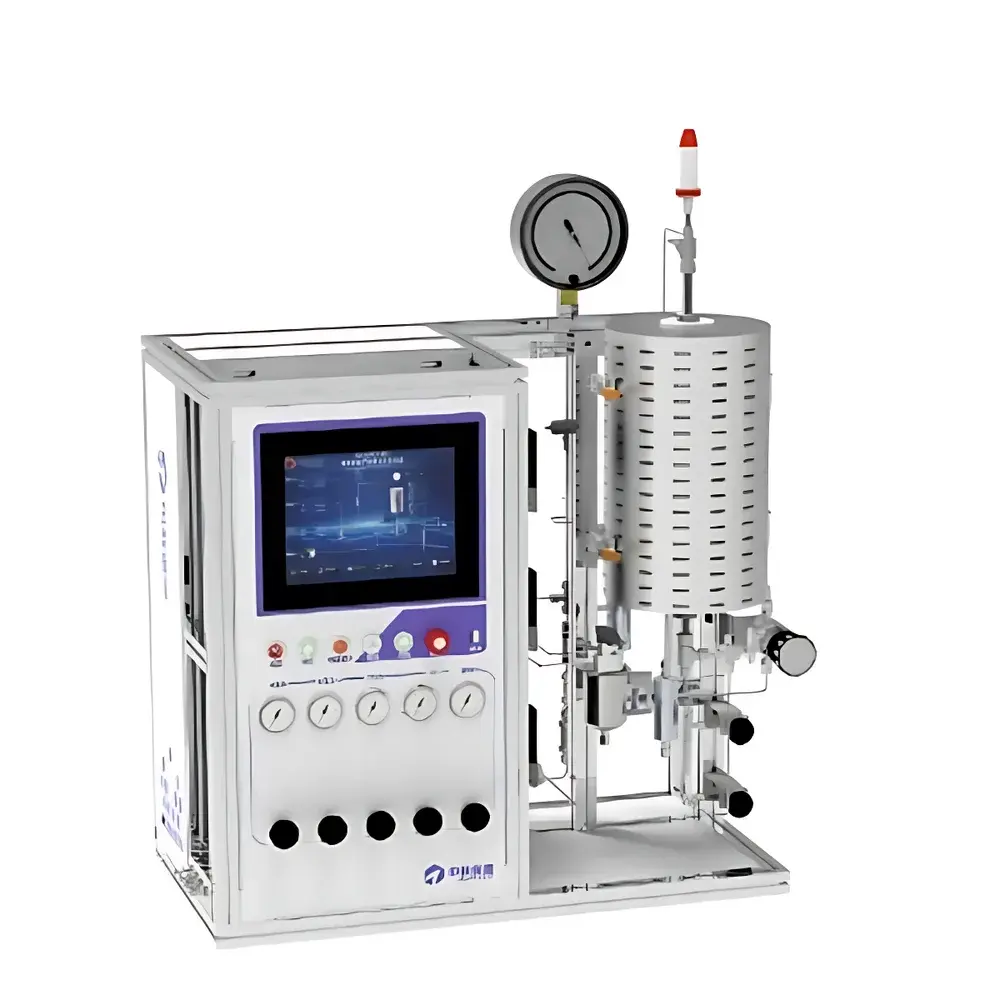
CEL-GPPCT-P Miniature Plasma-Catalytic Reaction System by CEAULIGHT
| Brand | CEAULIGHT |
|---|---|
| Origin | Beijing, China |
| Manufacturer Type | Original Equipment Manufacturer (OEM) |
| Product Category | Domestic Scientific Instrument |
| Model | CEL-GPPCT-P |
| Pricing | Available Upon Request |
| Operating Temperature Range | 0–600 °C |
| System Pressure | Ambient (Atmospheric) |
| Feed Configuration | 3 Gas Inlets + 1 Liquid Inlet |
| Reactor Material | High-Purity Quartz (Optional: High-Purity Alumina) |
| Discharge Gap | 2 mm |
| Discharge Zone Length | 25 mm |
Overview
The CEL-GPPCT-P Miniature Plasma-Catalytic Reaction System is an integrated benchtop platform engineered for fundamental and applied research in non-thermal plasma-assisted heterogeneous catalysis. It operates on the principle of synergistic coupling between low-temperature plasma discharge (predominantly glow-type regime) and thermally activated surface reactions within a catalytically active zone. Unlike conventional thermal reactors, this system enables precise spatiotemporal control over electron energy distribution, reactive species generation (e.g., O•, OH•, N₂⁺, metastable N₂(A³Σᵤ⁺)), and catalyst surface temperature—facilitating mechanistic studies of plasma-catalyst interfacial processes under well-defined, reproducible conditions. Designed for laboratory-scale screening and kinetic investigation, it supports continuous-flow operation with real-time process monitoring capability and accommodates both powder and monolithic catalyst configurations.
Key Features
- Benchtop footprint (W × D × H: ~450 × 380 × 320 mm) with fully integrated plasma generator, programmable heating furnace, multi-channel gas/liquid delivery manifold, and touch-enabled human-machine interface (HMI).
- Glow-mode plasma discharge achieved via controlled AC/DC hybrid excitation at 2 mm electrode gap and 25 mm uniform discharge zone—ensuring spatial homogeneity of electron density and reduced localized arcing risk.
- Dual-field operability: independent or simultaneous activation of resistive heating (0–600 °C, ±1 °C stability) and plasma excitation, enabling direct comparison of thermal-only, plasma-only, and plasma-thermal co-activation pathways.
- Electrically isolated high-voltage electrode assembly with reinforced insulation and shielded HV cabling compliant with IEC 61000-4-5 surge immunity standards.
- Modular reactor design: interchangeable high-purity quartz tubular reactors (standard ID 10–25 mm); optional high-purity alumina variants available for elevated-temperature or corrosive feedstock compatibility.
- Customization-ready architecture: scalable plasma power supply (1–5 kV, 10–50 kHz), reactor geometry (length, diameter, wall thickness), and catalyst bed configuration (fixed-bed, fluidized micro-bed) per user-specified experimental requirements.
Sample Compatibility & Compliance
The CEL-GPPCT-P accommodates solid catalysts (powders, pellets, coated monoliths) and gaseous/liquid reactants—including CO₂, CH₄, NH₃, H₂O, VOCs (e.g., toluene, formaldehyde), and N₂. Its atmospheric-pressure operation eliminates the need for vacuum infrastructure while maintaining compatibility with standard GC/TCD/FID, FTIR, and mass spectrometry sampling interfaces. The system conforms to CE marking requirements for electromagnetic compatibility (EMC Directive 2014/30/EU) and low-voltage safety (LVD Directive 2014/35/EU). All electrical components meet IP20 enclosure rating; quartz reactor assemblies comply with ISO 3585 (borosilicate glass) specifications. For GLP-compliant environments, optional audit-trail logging and user-access-level authentication modules are available upon request.
Software & Data Management
The embedded Linux-based control firmware provides synchronized acquisition of temperature profiles, gas flow rates (mass flow controllers calibrated to ±1% FS), plasma voltage/current waveforms, and real-time power dissipation metrics. Data export is supported in CSV and HDF5 formats for post-processing in MATLAB, Python (NumPy/Pandas), or OriginLab. Optional integration with LabVIEW™ or OPC UA protocols enables centralized lab automation. All parameter setpoints, run logs, and alarm histories are timestamped and stored locally with SHA-256 checksum integrity verification—supporting traceability requirements aligned with FDA 21 CFR Part 11 Annex 11 principles where electronic records are employed.
Applications
- CO₂ hydrogenation to CO, CH₄, or C₂₊ hydrocarbons under mild conditions (≤200 °C, ambient pressure).
- Low-temperature oxidative decomposition of volatile organic compounds (VOCs) in air streams.
- Plasma-enhanced dry/wet reforming of methane for syngas production.
- Catalytic ammonia synthesis (N₂ + H₂ → NH₃) and reverse reaction (NH₃ decomposition to H₂) under sub-ambient equilibrium constraints.
- Structure–activity relationship studies of plasma-modified catalyst surfaces using in situ/operando characterization coupling ports.
- Reaction mechanism elucidation via time-resolved optical emission spectroscopy (OES) integration.
FAQ
What plasma discharge mode does the CEL-GPPCT-P generate?
It primarily sustains a stable, spatially uniform glow discharge under controlled voltage-frequency parameters—distinct from filamentary or spark modes—optimized for catalytic surface interaction rather than bulk gas heating.
Can the system operate under vacuum or elevated pressure?
Standard configuration is rated for ambient-pressure operation only. Vacuum or pressurized variants require custom engineering of the reactor sealing, feedthroughs, and safety interlocks—and must be specified at order stage.
Is catalyst pretreatment (e.g., in situ reduction) supported?
Yes. The integrated furnace allows programmed temperature ramps (up to 10 °C/min) under inert or reducing atmospheres prior to plasma initiation, enabling controlled catalyst activation sequences.
What analytical interfaces are provided for downstream detection?
Standard 1/8″ Swagelok® ports accommodate heated transfer lines to GC, FTIR, or QMS systems; optional integrated quadrupole mass spectrometer (QMS) interface kit available.
Does the system support remote monitoring or networked operation?
Local Ethernet port enables SSH access and HTTP-based status dashboard; full remote control requires deployment of optional secure VPN gateway module compliant with institutional IT policies.



