
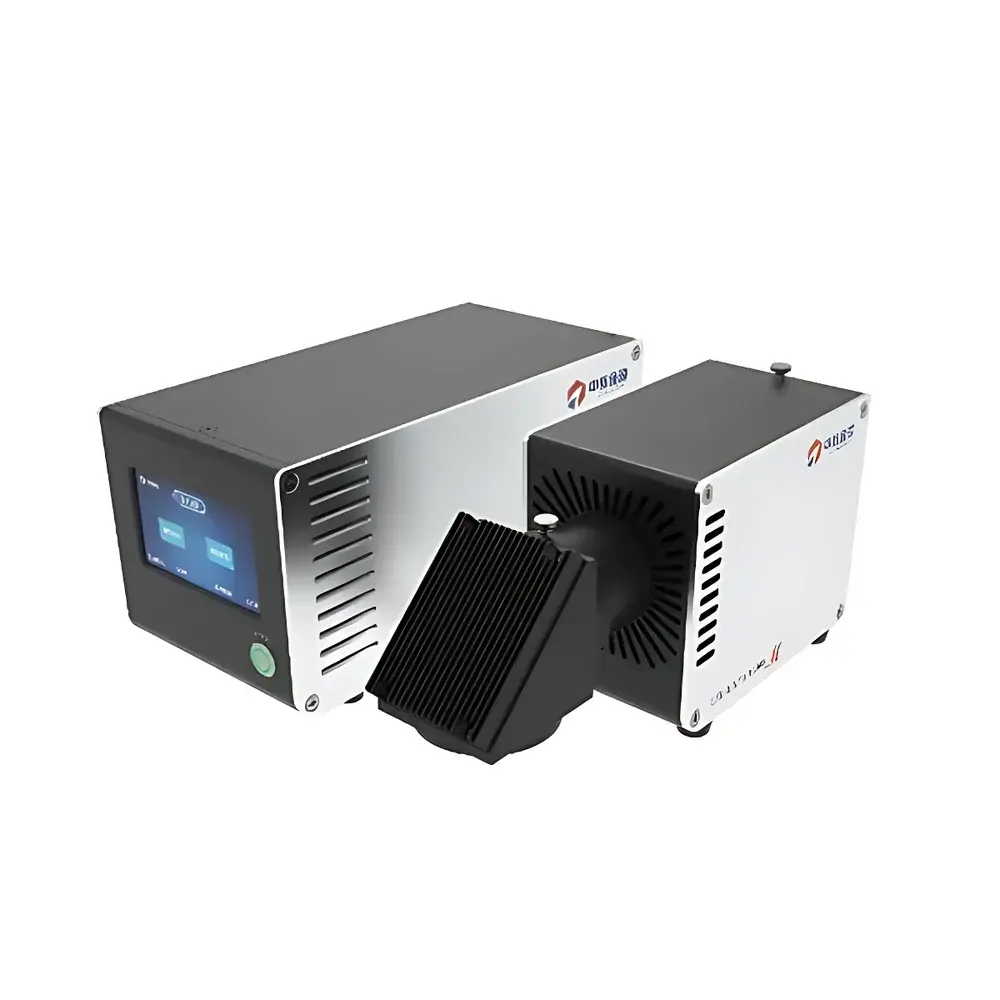
CEL-HXF(UV)300-M Xenon Light Source for Photocatalytic Research
| Brand | CEA-Light (Zhongjiaojinyuan) |
|---|---|
| Origin | Beijing, China |
| Manufacturer Type | OEM Manufacturer |
| Product Category | Domestic |
| Model | CEL-HXF(UV)300-M |
| Light Source Type | Short-Arc Xenon Lamp |
| Irradiation Mode | External Illumination |
| Input Power | 300 W (adjustable 180–320 W) |
| Optical Output Power Density | ≤20 Sun (1 Sun = 100 mW/cm² AM1.5G) |
| Operating Current | 14–21 A |
| Total Radiant Output Power | 50 W |
| UV Output Power (CEL-HXUV300-M variant) | 6.6 W (200–400 nm) |
| UV Output Power (CEL-HXF300-M variant) | 2.6 W (300–400 nm) |
| Visible Output | 5000 lm (CEL-HXF300-M), 4500 lm (CEL-HXUV300-M) |
| IR Output Power | 28.8 W (CEL-HXF300-M), 26.8 W (CEL-HXUV300-M) |
| Correlated Color Temperature | 5600 K (CEL-HXF300-M), 5050 K (CEL-HXUV300-M) |
| Lamp Window Diameter | 25.4 mm |
| Rated Lamp Life | ≥1000 h (under recommended ambient conditions) |
| Spectral Range | 300–2500 nm (CEL-HXF300-M), 200–2500 nm (CEL-HXUV300-M) |
| Light Collection | Ellipsoidal Reflective Collector |
| Beam Diameter at Target | ≥60 mm |
| Beam Divergence | Average 5° |
| Rotation Capability | Full 360° axial rotation of output beam |
| Cooling Method | Forced-air ducted thermal management |
| Safety Protection | Over-temperature cutoff |
| Control Interface | 4.3″ TFT color touch screen with programmable intensity cycling (up to 10 segments) |
| Communication Protocol | RS-485 for external system integration |
| Recommended Ambient Temperature | 20–30 °C |
| Recommended Relative Humidity | <45 % RH |
Overview
The CEL-HXF(UV)300-M is a high-stability, air-cooled short-arc xenon lamp light source engineered specifically for quantitative photocatalytic and photochemical research. It operates on the principle of broadband continuum emission generated by a high-pressure DC-excited xenon plasma, delivering spectrally stable irradiance across the ultraviolet, visible, and near-infrared regions (200–2500 nm). Unlike pulsed or LED-based systems, this source provides continuous-wave (CW) illumination with high spatial uniformity and temporal stability—critical for kinetic studies in hydrogen evolution, CO₂ photoreduction, advanced oxidation processes, and standardized light aging protocols. Its ellipsoidal reflective collector ensures efficient photon collection (>75% geometric coupling efficiency) and collimated beam delivery, enabling reproducible irradiance distribution over sample areas ≥60 mm in diameter. The system is calibrated traceably to NIST-traceable reference detectors and conforms to ISO 9001 manufacturing standards.
Key Features
- Modular lamp housing design permitting tool-free xenon lamp replacement—reducing downtime and minimizing alignment drift;
- Integrated 4.3-inch capacitive touch interface supporting multi-segment light intensity programming (up to 10 time-defined steps) for simulating diurnal cycles or reaction-stage-specific irradiance profiles;
- Ducted forced-air cooling architecture with real-time thermal monitoring, maintaining junction temperature within ±2 °C tolerance during extended operation (≥8 h);
- Over-temperature safety interlock that automatically de-energizes the lamp circuit when internal chassis temperature exceeds 65 °C;
- 360° rotational output arm with precision angular indexing (±0.5° resolution), facilitating oblique-angle irradiation and multi-directional sample exposure;
- RS-485 serial interface compliant with Modbus RTU protocol, enabling synchronization with environmental chambers, gas flow controllers, or data acquisition systems in GLP-compliant laboratories.
Sample Compatibility & Compliance
The CEL-HXF(UV)300-M supports standard quartz cuvettes (10 mm path length), custom reactor cells (up to Ø80 mm), and flat-panel photocatalyst substrates mounted on thermally stabilized stages. Its spectral output meets ASTM G154 Class I irradiance requirements for UV-A/UV-B accelerated weathering testing and aligns with ISO 11341 for simulated solar radiation exposure. When used with certified bandpass filters (e.g., UG11 + BG39 for UV-C isolation or Schott KG5 for IR rejection), it satisfies wavelength-specific validation criteria outlined in ISO/IEC 17025-accredited photoreactor calibration procedures. The unit is CE-marked per EN 61000-6-3 (EMC) and EN 61000-6-4 (immunity), and its electrical safety complies with IEC 61010-1 for laboratory equipment.
Software & Data Management
While the device operates autonomously via its embedded controller, optional PC software (CEA-Light Control Suite v3.2) provides full remote configuration, real-time irradiance logging (sample rate: 1 Hz), and CSV export compatible with MATLAB, OriginLab, and Python pandas workflows. Audit trails record all parameter changes—including lamp runtime, thermal events, and user-initiated intensity sequences—supporting 21 CFR Part 11 compliance when deployed in regulated QA/QC environments. Firmware updates are delivered via USB mass storage mode with SHA-256 signature verification.
Applications
- Quantitative photocatalytic H₂ generation under simulated AM1.5G illumination;
- Kinetic modeling of TiO₂-mediated degradation of organic pollutants (e.g., methylene blue, phenol) under controlled UV–vis flux;
- Photoelectrochemical cell characterization requiring stable spectral irradiance and low temporal noise (<0.5% RMS over 1 h);
- Accelerated photostability assessment of pharmaceutical compounds per ICH Q1B guidelines;
- Calibration of radiometric sensors and spectroradiometers in metrology labs;
- Light-driven polymerization studies where narrowband filtering enables selective bond cleavage or initiation.
FAQ
What is the recommended recalibration interval for irradiance measurements?
Annual recalibration against a NIST-traceable thermopile detector is advised; field verification using a calibrated photodiode sensor should be performed before each experimental campaign.
Can the system operate continuously for >12 hours?
Yes—provided ambient temperature remains within 20–30 °C and relative humidity stays below 45 % RH; continuous operation beyond 1000 h total lamp life is not recommended due to progressive electrode erosion and spectral shift.
Is ozone generation a concern during UV-rich operation?
Negligible—ozone production is suppressed by the fused silica lamp envelope and absence of direct 185 nm emission; no external ventilation is required for standard lab use.
How is beam uniformity quantified and validated?
Beam homogeneity is measured per ISO 9241-307 using a CCD-based imaging radiometer; typical flatness across the 60 mm working area is ±3.2 % (peak-to-valley) at 1 Sun equivalent irradiance.
Does the unit support TTL or analog modulation inputs?
No—intensity control is exclusively via internal program sequencing or RS-485 command set; external analog modulation requires third-party current drivers interfaced to the lamp power supply terminals.





