
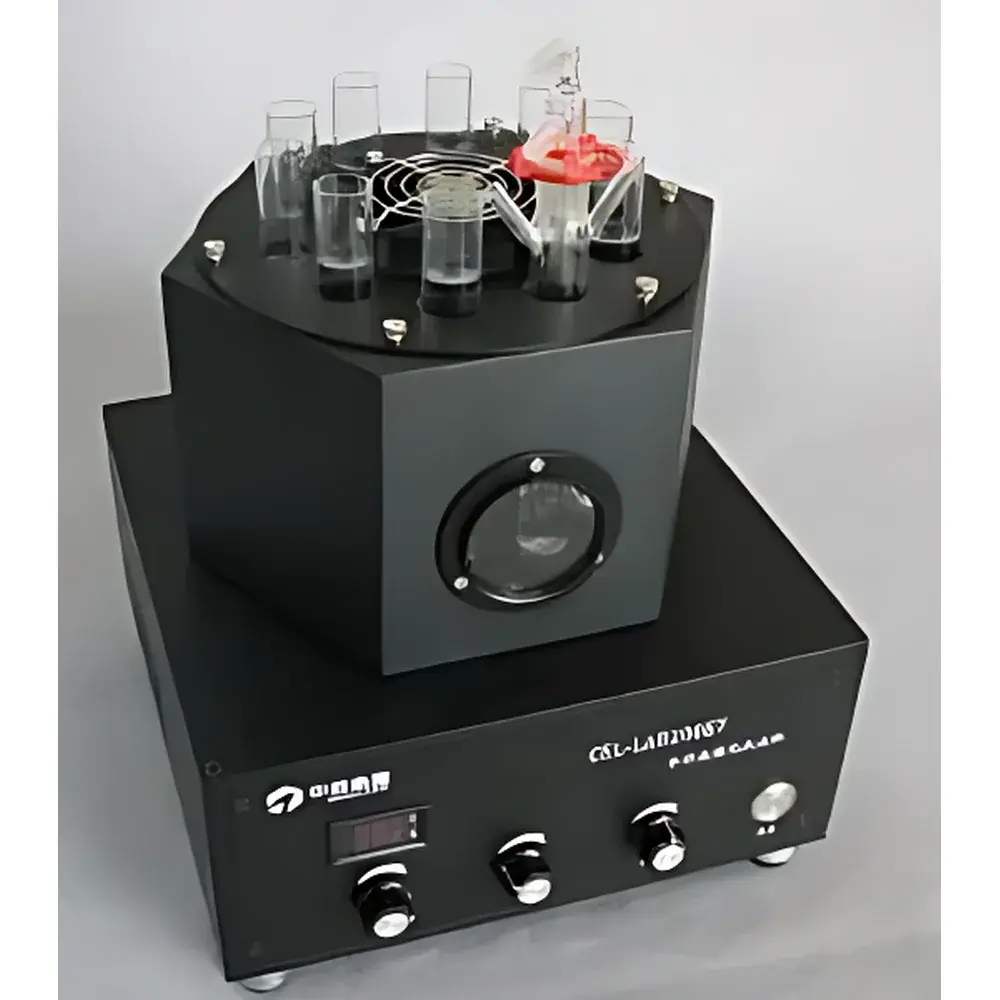
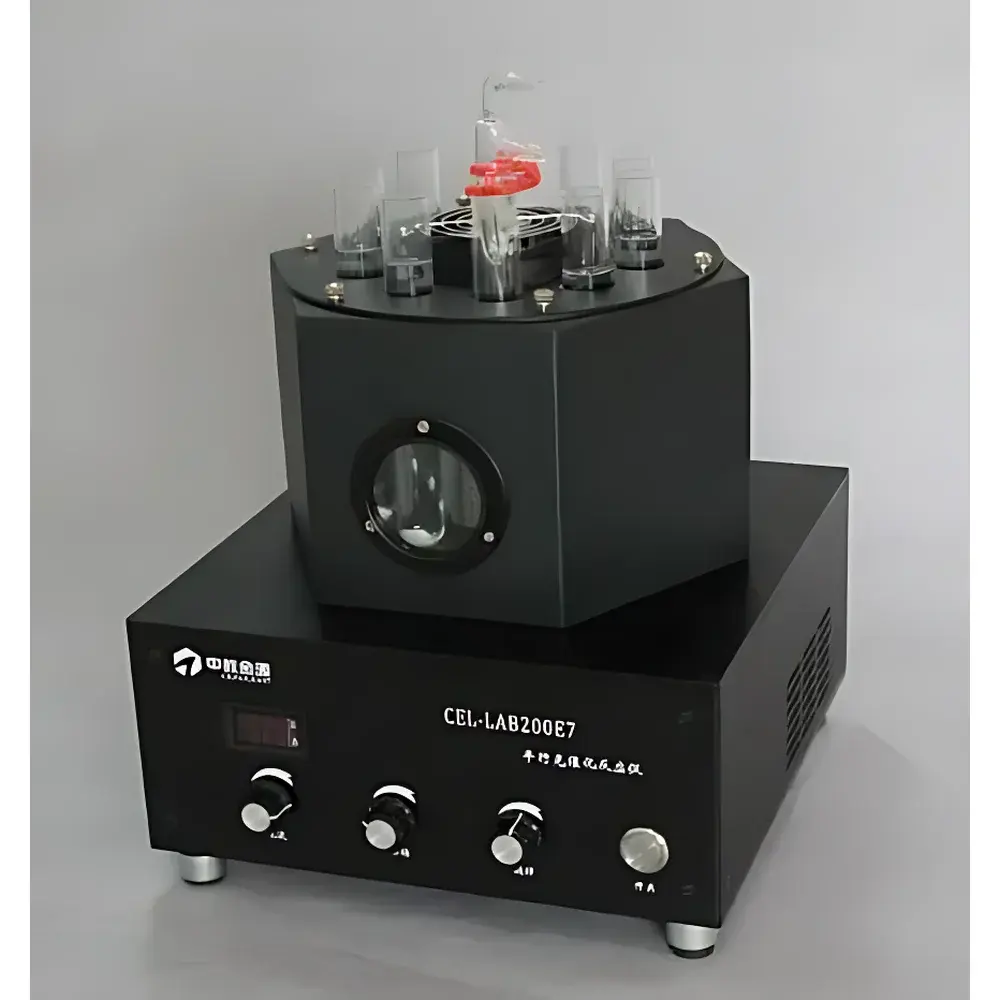
CEL-LAB200E7 Parallel Photochemical Reactor
| Brand | CEAULIGHT (Zhongjiaojinyuan) |
|---|---|
| Model | CEL-LAB200E7 |
| Light Source Type | High-Power Rotating LED Array (365–940 nm, 15 discrete wavelengths + white light & simulated solar spectrum) |
| Irradiation Mode | Internal coaxial radial illumination with rotational uniformity |
| Reaction Stations | 10-position parallel configuration |
| Reactor Material | Quartz (QRT50, 19/22 standard taper) with integrated temperature jacket, gas inlet/outlet, septum sampling port, and internal magnetic stirring |
| LED Power Range | 30–200 W per station, continuously adjustable |
| Rotation Speed | Motor-driven axial rotation of LED array (programmable RPM) |
| Cooling | Integrated forced-air thermal management |
| Control Architecture | Independent, synchronized control of irradiance, rotation speed, stirring speed, and temperature (via external chiller interface) |
| Input Power | 240 W, 220 V / 50 Hz |
| Compliance | Designed for GLP-compliant photochemical screening |
Overview
The CEL-LAB200E7 Parallel Photochemical Reactor is an engineered platform for high-throughput, quantitative photocatalytic screening under rigorously controlled and reproducible irradiation conditions. Unlike conventional batch or sequential photoreactors, the CEL-LAB200E7 employs a central rotating high-power LED array that delivers spatially uniform, radially symmetric illumination to ten identical quartz reaction vessels simultaneously. Its core measurement principle is based on controlled photon flux delivery—defined by wavelength, irradiance (W/m²), exposure duration, and spectral distribution—to enable direct comparison of quantum efficiency, reaction kinetics, and product selectivity across multiple catalysts or reaction conditions in a single experiment. The system operates under ambient or regulated thermal environments (via optional HX105 chiller), supports both gas-phase and liquid-phase reactions, and accommodates static or dynamic flow configurations. It is purpose-built for laboratories requiring traceable, repeatable, and statistically robust photochemical data—particularly where wavelength-specific response, thermal management, and parallel statistical sampling are critical.
Key Features
- 10-position parallel architecture with individual magnetic stirring (0–1200 rpm, adjustable)
- Central rotating LED light engine (CEL-CLED200R) delivering homogeneous irradiance across all reactors via continuous axial rotation
- 15 discrete monochromatic wavelengths (365, 395, 405, 420, 455, 470, 500, 520, 590, 620, 660, 740, 810, 850, 940 nm) plus broadband white light (410–760 nm) and simulated solar spectrum
- Per-channel LED power control: 30–200 W continuous adjustment, enabling precise photon flux calibration
- Hot-swappable LED modules—no system shutdown required for wavelength reconfiguration
- Quartz reaction tubes (CEL-QRT50, 19/22 standard taper) featuring double-wall temperature jackets, dual gas ports (inlet/outlet), PTFE-septum sampling ports, and internal stir bars
- Integrated forced-air cooling for LED thermal stability; maintains spectral fidelity and output consistency over extended operation
- Independent digital control interfaces for irradiance, rotation speed, stirring speed, and external temperature regulation
Sample Compatibility & Compliance
The CEL-LAB200E7 supports heterogeneous photocatalysis (e.g., TiO₂, g-C₃N₄, MOFs), homogeneous photoredox catalysis (e.g., Ru(bpy)₃²⁺, Ir(ppy)₃), and gas-phase degradation studies (VOCs, NOₓ). Reaction media include aqueous suspensions, organic solvents, slurry systems, and fixed-bed configurations using custom adapters. All wetted components comply with USP Class VI and ISO 10993-5 biocompatibility standards. Quartz tubing meets ASTM F798 for UV transmission (>90% at 365 nm). System design facilitates audit-ready documentation: timestamped irradiance logs, temperature profiles, and stirring parameters are exportable in CSV format. When paired with an HX105 chiller (0–95 °C range), the platform satisfies temperature control requirements outlined in ISO 22197-2 (NO removal testing) and ASTM E2533-22 (photocatalyst activity quantification). Optional LB70 shielded enclosure provides Class 1 laser safety compliance (IEC 60825-1) and UV containment per OSHA 1910.133.
Software & Data Management
The CEL-LAB200E7 operates via a dedicated embedded controller with local touchscreen interface and optional RS485/Modbus RTU connectivity for integration into lab-wide SCADA or LIMS environments. All operational parameters—including real-time LED power output (monitored via calibrated photodiode feedback), rotation RPM, stirring speed, and external temperature setpoints—are logged at user-defined intervals (1 s to 60 min resolution). Data files conform to FAIR principles (Findable, Accessible, Interoperable, Reusable) and support post-processing in MATLAB, Python (Pandas), or OriginLab. Audit trails include operator ID, parameter change history, and system error codes—fully compliant with FDA 21 CFR Part 11 when used with electronic signature-enabled middleware. No cloud dependency or proprietary runtime is required.
Applications
- High-throughput photocatalyst screening for hydrogen evolution, CO₂ reduction, and pollutant degradation
- Wavelength-dependent quantum yield determination (ΦCO, ΦH₂) per ISO 25922
- Photoinduced C–H activation, [2+2] cycloadditions, and asymmetric photoredox synthesis
- Environmental photocatalysis validation under simulated urban sunlight (ASTM G173-03 AM1.5G spectrum)
- Stability and deactivation kinetics assessment of immobilized catalysts under cyclic illumination
- Reaction mechanism elucidation via in-situ GC-MS or HPLC sampling from individual reactors
FAQ
What is the spectral irradiance uniformity across the 10 reaction positions?
Measured irradiance deviation is ≤ ±3.2% (k = 2) at the reactor center plane when using the rotating LED array at 100 W output and 3 rpm rotation speed, verified with NIST-traceable spectroradiometer (Bentham TMc300).
Can the system be operated under inert or pressurized atmospheres?
Yes—gas-tight quartz reactors support vacuum (≤10⁻² mbar via CEL-GDT12 gas distribution unit) and positive pressure up to 0.5 MPa with appropriate fittings and pressure-rated septa.
Is temperature control internal or external?
Temperature regulation is external: reactors feature double-wall jackets for circulation of thermostatic fluid from an optional HX105 chiller; no Peltier or resistive heating is built into the base unit.
How is photon flux calibrated and validated?
Each LED module is factory-calibrated using a cosine-corrected Si photodiode and NIST-traceable reference lamp; users may perform field recalibration using the included CEL-PLQY1 quantum yield kit per ISO 11554.
Does the system meet regulatory requirements for GMP/GLP laboratories?
Yes—the hardware architecture, parameter logging, and audit trail functionality satisfy key elements of EU Annex 11, USP , and OECD TG 111 for photochemical test guidelines when deployed with documented SOPs and qualified accessories.





