
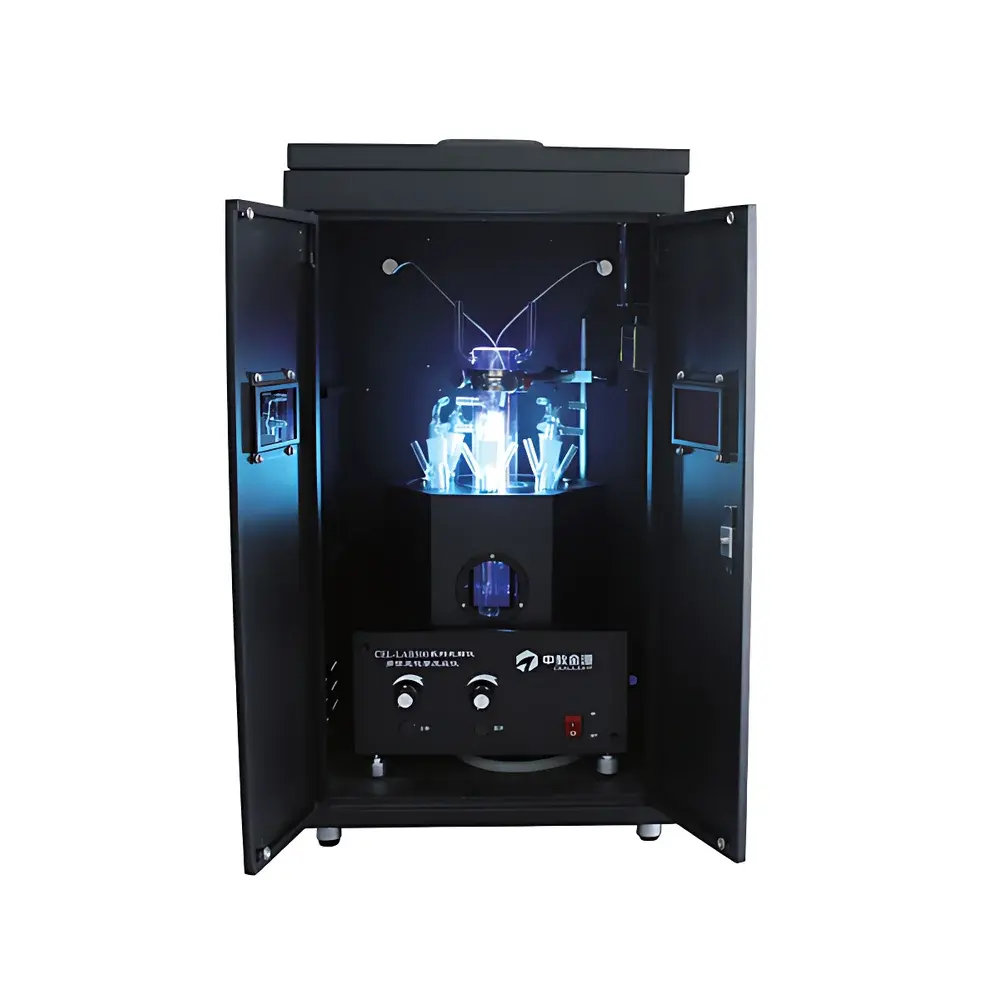
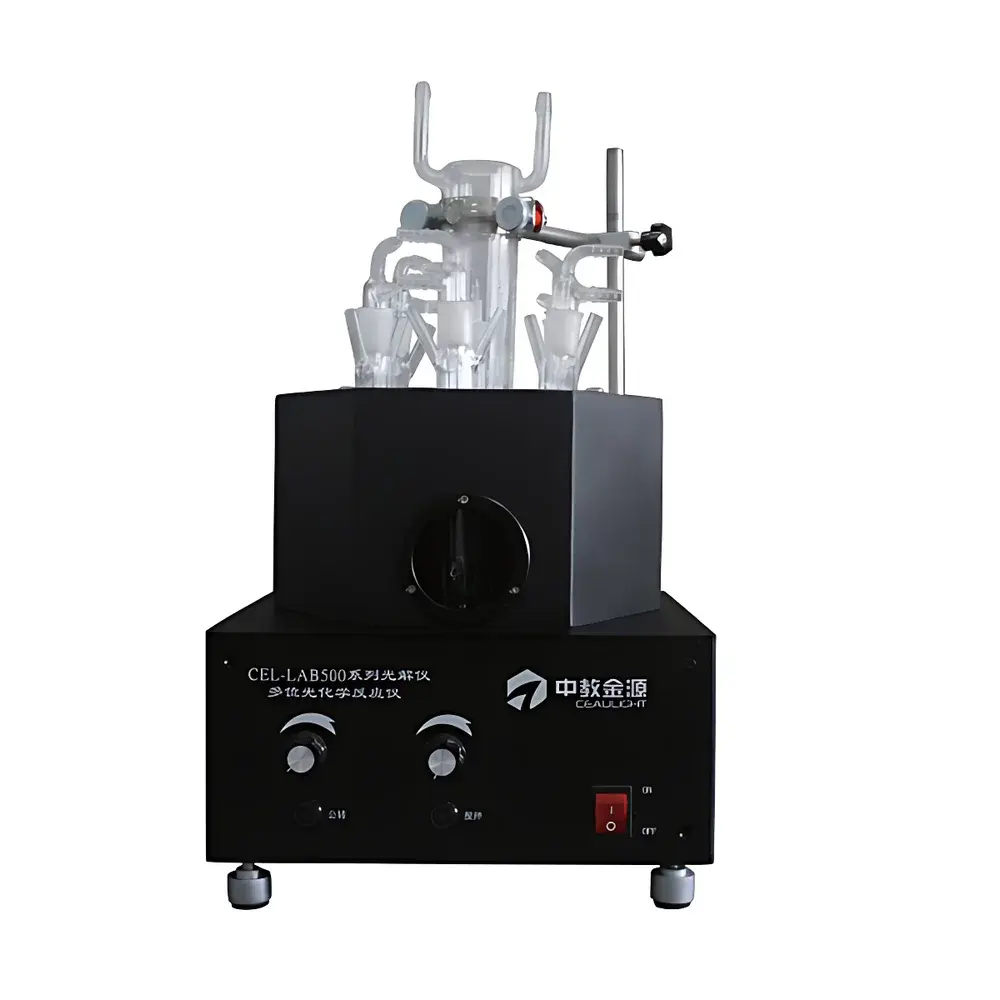
CEL-LAB500E4 Multi-Position Photochemical Reactor by CEAULIGHT
| Brand | CEAULIGHT |
|---|---|
| Origin | Beijing, China |
| Manufacturer Type | Direct Manufacturer |
| Product Origin | Domestic (China) |
| Model | CEL-LAB500E4 |
| Light Source Type | Xenon Lamp |
| Irradiation Mode | External Illumination |
| Sample Capacity | 6–12 Positions |
| Rotation Mechanism | Centralized Orbital Rotation with Independent Magnetic Stirring per Vessel |
| Cooling Interface | Integrated Water-Circulation Port for External Chiller |
| Optical Filtering | Dual-Band Quartz-Coated Interchangeable Filters (UV + Visible) |
| Standard Configuration | Xenon Lamp Source, Rotating Host Unit, Safety Enclosure with Hydraulic Lid, UV/Vis Filter Set, CEL-QRT50 Quartz Reaction Tubes (with Built-in Stir Bar, Gas Inlet/Outlet, Condensation Jacket, and Temperature Control Ports) |
| Optional | Mercury Lamp Module, Low-Temperature Circulating Chiller (e.g., –10 °C to +40 °C) |
Overview
The CEL-LAB500E4 Multi-Position Photochemical Reactor is an engineered platform designed for high-throughput, controlled photochemical experimentation under reproducible irradiation conditions. It operates on the principle of external illumination using a collimated, high-intensity xenon lamp—spectrally tunable via interchangeable quartz-coated bandpass filters—to simulate solar-spectrum irradiation or isolate specific UV/visible wavelength ranges (e.g., UVA: 315–400 nm; visible: 400–780 nm). The system employs orbital rotation of up to 12 independently stirred quartz reaction tubes (CEL-QRT50) around a central light source, ensuring uniform photon flux distribution across all samples—a critical requirement for kinetic comparability in catalyst screening, quantum yield determination, and structure–activity relationship studies. Its architecture supports both gas-phase and liquid-phase reactions under static or dynamic flow conditions, with integrated thermal management via external coolant circulation to mitigate photothermal artifacts.
Key Features
- Parallel reaction capability: 6- or 12-position configuration with individual magnetic stirring in each CEL-QRT50 quartz tube, enabling statistically robust comparative photochemistry.
- Orbital rotation drive mechanism ensures consistent angular exposure and eliminates shadowing effects common in static multi-vial setups.
- Dual-band optical filtering system: Interchangeable quartz-coated filters for precise spectral selection—UV-range (e.g., 254 nm, 365 nm) and visible-range (e.g., 420 nm cutoff) — compliant with ISO 105-A02 and ASTM E2912 for irradiance standardization.
- Integrated cooling interface compatible with external low-temperature circulating chillers (–10 °C to +40 °C), maintaining sample temperature stability within ±0.5 °C during prolonged irradiation.
- Hydraulic-assisted safety enclosure with quartz observation window allows real-time visual monitoring without interrupting reaction conditions or compromising operator safety.
- Lamp power control via digital current regulation (0–100% full output) enables linear intensity modulation for dose–response calibration and Arrhenius-type photokinetic analysis.
- Modular lamp compatibility: Factory-configured for 300–500 W xenon arc lamps; optional mercury lamp module available for narrow-band UV emission lines (e.g., 254 nm, 365 nm).
Sample Compatibility & Compliance
The CEL-LAB500E4 accommodates a wide range of sample formats including homogeneous solutions, colloidal suspensions, immobilized photocatalysts on substrates (e.g., TiO₂-coated glass beads), and gas–solid heterogeneous systems. CEL-QRT50 reaction tubes are constructed from high-purity synthetic quartz (≥99.99% SiO₂), transmitting >90% of incident radiation from 190 nm to 2.5 µm, and feature standardized 1/4″ NPT ports for inert gas purging, vacuum evacuation, and condensate reflux. The system meets IEC 61000-6-3 EMC emission standards and incorporates interlocked safety cutoffs conforming to EN 60204-1 for industrial machinery. For regulated environments, it supports GLP-compliant data traceability when paired with validated temperature logging and irradiance dosimetry protocols.
Software & Data Management
While the CEL-LAB500E4 operates as a hardware-controlled platform without embedded software, its modular design facilitates integration with third-party data acquisition systems. Analog outputs (0–10 V) for lamp current, coolant temperature, and rotational speed enable synchronization with spectrophotometers (e.g., Agilent Cary 60), GC-MS (e.g., Thermo ISQ LT), or online FTIR systems. All mechanical and optical components are labeled with serial-numbered calibration tags, supporting audit-ready documentation for FDA 21 CFR Part 11–aligned workflows when used with compliant electronic lab notebooks (ELNs) such as LabArchives or Benchling.
Applications
- Photocatalytic material screening: Rapid evaluation of metal–organic frameworks (MOFs), g-C₃N₄ variants, and doped TiO₂ under standardized irradiance.
- Quantum yield determination per IUPAC recommendations (Pure Appl. Chem. 2011, 83, 1859), using actinometry with potassium ferrioxalate or Aberchrome 540.
- Environmental photocatalysis: Degradation kinetics of micropollutants (e.g., carbamazepine, diclofenac) in aqueous matrices under simulated sunlight.
- Photoinduced organic synthesis: [2+2] cycloadditions, C–H functionalizations, and asymmetric photocatalysis requiring precise wavelength control and thermal management.
- Life science applications: UV-induced DNA crosslinking studies, ROS generation assays (e.g., using terephthalic acid probe), and photodynamic therapy sensitizer evaluation.
FAQ
What lamp types are supported, and how is spectral output verified?
The system ships with a 450 W xenon short-arc lamp; mercury lamp modules (125–400 W) are optional. Spectral irradiance profiles are characterized using NIST-traceable calibrated spectroradiometers (e.g., Ocean Insight QE Pro) prior to shipment.
Can the system operate under inert or reducing atmospheres?
Yes—each CEL-QRT50 tube includes dual gas ports (inlet/outlet) with Swagelok fittings, enabling continuous purge with N₂, Ar, or H₂/Ar mixtures while maintaining pressure equilibrium.
Is temperature control active or passive?
Active: The reaction tubes integrate a double-jacketed condenser path connected to an external chiller; temperature is monitored at the jacket inlet/outlet via PT100 sensors.
How is light intensity calibrated across positions?
A rotating cosine-corrected silicon photodiode sensor (Hamamatsu S1337-33BR) is used to map spatial irradiance uniformity; typical deviation across 12 positions is ≤±3.2% at 365 nm.
Does the system comply with laser safety standards?
No laser components are used; the xenon lamp is classified as Class 3R per IEC 60825-1, with full enclosure interlocks meeting ANSI Z136.1 requirements for non-laser optical radiation hazards.




