
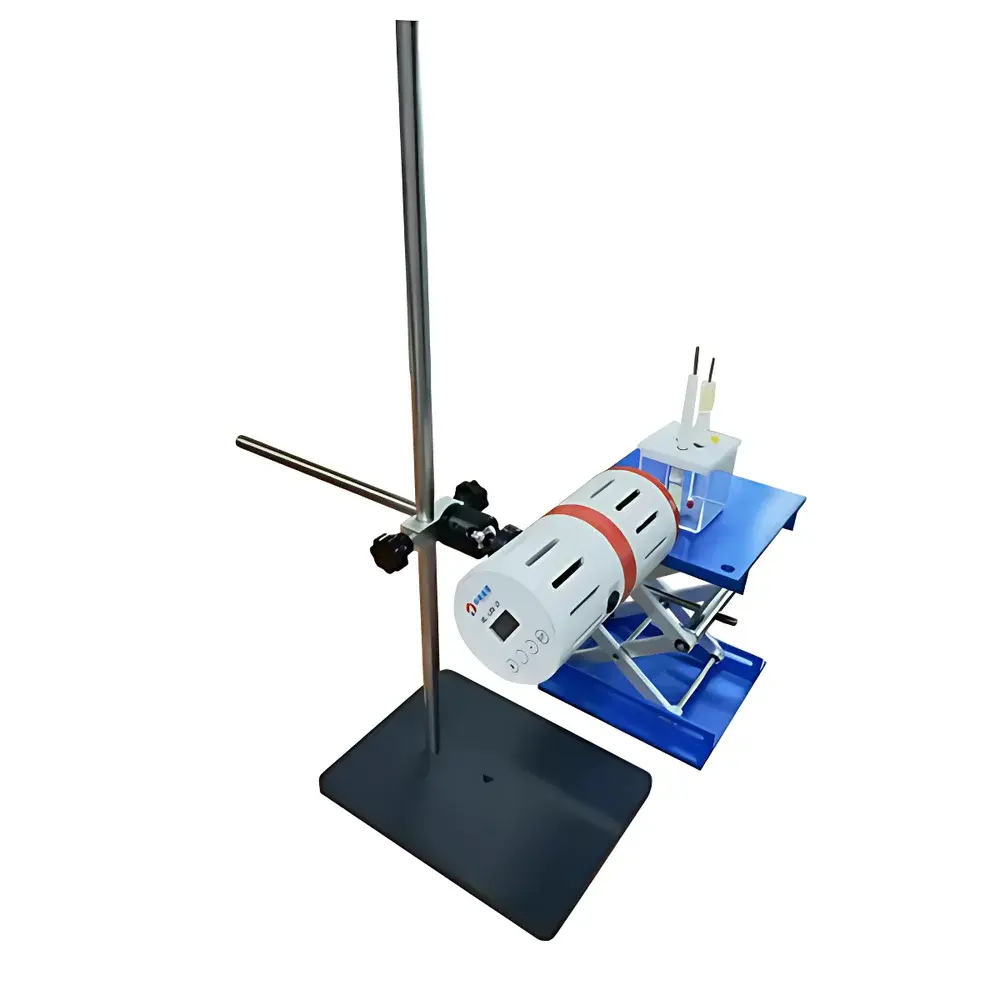
CEL-LED-25W Single-Channel High-Stability Monochromatic LED Light Source
| Brand | CEAULIGHT (CEL) |
|---|---|
| Model | CEL-LED-25W |
| Origin | Beijing, China |
| Manufacturer Type | OEM Manufacturer |
| Light Source Type | Monochromatic Solid-State LED Array |
| Emission Wavelengths (Selectable) | 365, 395, 405, 420, 455, 470, 500, 520, 590, 620, 660, 740, 810, 850, 940 nm & White Light |
| Control Modes | Continuous Illumination / Programmable Pulsed Flash (10 preset frequencies) |
| Max. Optical Output Power | 25 W |
| Input Power | 30 W (AC 220 V to DC 24 V converter integrated) |
| Operating Current | <3.5 A |
| Emitting Aperture Diameter | 40 mm |
| Radiant Flux Density | ≤200 mW/cm² (measured with CEL-NP2000 radiometer |
| Rated Lifetime | ≥10,000 h (L70, except 365 nm UV LED) |
| Cooling | Separated Forced-Air Thermal Management (optical path isolated from airflow) |
| Mechanical Dimensions | 150 mm × φ72 mm |
| Standard Accessories | Manual Height-Adjustable Mount |
| Optional Accessories | LMP400 Motorized Dual-Axis Positioning Stage (400 mm vertical + horizontal travel), LB70 Photoreaction Chamber |
Overview
The CEL-LED-25W is a precision-engineered single-channel monochromatic LED light source designed for quantitative photochemical and photophysical experimentation in research laboratories. Unlike broadband arc lamps or filtered halogen sources, this system employs high-purity, narrow-bandwidth semiconductor LEDs—each individually selected and thermally stabilized—to deliver spectrally defined irradiance with exceptional temporal stability and spatial uniformity. Its core architecture follows the principles of solid-state photonics: minimal spectral drift (<0.5 nm over 8 h at constant drive current), negligible warm-up time (<100 ms to steady-state output), and immunity to mechanical vibration or ambient temperature fluctuations within operational limits (15–35 °C). The device operates on a regulated DC 24 V supply derived from integrated AC 220 V conversion, eliminating line-frequency ripple in optical output—a critical requirement for kinetic studies in photocatalysis, transient absorption spectroscopy, and quantum yield determination.
Key Features
- Monolithic LED array using imported high-luminance chips, optimized for peak wavelength accuracy and angular emission control (Lambertian profile with ±5° half-angle divergence)
- Energy-efficient operation: >80% reduction in electrical power consumption versus equivalent-output xenon or mercury arc lamps
- Dual illumination modes—continuous (CW) and programmable pulsed flash (10 fixed frequency settings from 1 Hz to 1 kHz)—enabling time-resolved reaction initiation and duty-cycle modulation
- Mechanically decoupled forced-air cooling: dedicated thermal channel isolates airflow from optical path, preventing convective turbulence and beam distortion
- Modular mechanical interface supporting arbitrary orientation (0–360° rotation, ±90° tilt) and precise axial positioning via standard M6 threaded mounting points
- Stable radiant flux output (±1.5% RMS over 8 h, measured with NIST-traceable thermopile sensor) under constant-current drive conditions
- Compact cylindrical form factor (150 mm length × 72 mm diameter) compatible with glovebox integration, vacuum feedthroughs, and multi-source optical benches
Sample Compatibility & Compliance
The CEL-LED-25W is routinely deployed in ISO/IEC 17025-accredited laboratories for method validation in photocatalytic degradation (ISO 10676, ISO 22197-1), photoelectrochemical cell characterization (ASTM E2535), and photostability testing (ICH Q1B). Its discrete wavelength options—including deep-UV (365 nm), visible (405–660 nm), and NIR (740–940 nm)—align with common molecular absorption bands in dye-sensitized solar cells, TiO₂-based catalysts, and optogenetic probes. All units undergo factory calibration against reference photodiodes traceable to the Chinese National Institute of Metrology (NIM). While not intrinsically explosion-proof, the device meets IEC 61010-1 safety requirements for laboratory electrical equipment and complies with RoHS 2011/65/EU and REACH (EC 1907/2006) material restrictions.
Software & Data Management
The CEL-LED-25W operates as a standalone analog-controlled instrument with no embedded firmware or USB interface. However, it is fully compatible with third-party digital control systems via 0–5 V TTL-compatible analog input for intensity modulation and external trigger signals (BNC) for flash synchronization. Users integrating the source into automated workflows commonly pair it with LabVIEW, Python (PyVISA), or MATLAB-based DAQ platforms for closed-loop irradiance regulation and timestamped event logging. Audit trails for exposure duration, mode selection, and manual parameter adjustments are maintained externally per GLP-compliant documentation protocols. No data storage or user authentication features are implemented—consistent with its role as a deterministic physical stimulus generator rather than a regulated data acquisition endpoint.
Applications
- Quantitative photocatalytic hydrogen evolution and CO₂ reduction assays under defined photon flux (µmol·m⁻²·s⁻¹)
- Spectral responsivity mapping of photodetectors and solar cells using calibrated monochromatic irradiance
- Photoinduced electron transfer kinetics in molecular dyads and hybrid perovskite films
- Light-dependent enzyme activity profiling (e.g., photolyase, cryptochrome) under physiologically relevant irradiances
- Accelerated photodegradation screening of polymers, pigments, and pharmaceutical intermediates per ASTM G154
- In situ Raman and FTIR monitoring of surface reactions under controlled monochromatic excitation
- Optical pumping of solid-state lasers and saturable absorber characterization
FAQ
Is the 365 nm variant rated for the same 10,000-hour lifetime as other wavelengths?
No—the 365 nm deep-UV LED exhibits accelerated lumen depreciation due to inherent material limitations in AlGaN-based semiconductors; its rated L70 lifetime is 5,000 hours under nominal drive conditions.
Can multiple CEL-LED-25W units be synchronized for multi-wavelength irradiation experiments?
Yes—external BNC trigger inputs allow precise temporal alignment of flash modes across independent units, provided a common master clock signal is distributed.
What is the spectral bandwidth (FWHM) for each wavelength option?
Typical FWHM ranges from 12 nm (455 nm) to 28 nm (365 nm), as verified by calibrated Ocean Insight HR4000 spectrometer measurements.
Does the system include radiometric calibration certificates?
A factory-issued calibration report (traceable to NIM) is included with each unit; full ISO/IEC 17025 certification requires separate third-party verification.
Is the LMP400 motorized stage compatible with LabVIEW drivers?
Yes—CEAULIGHT provides documented SCPI command sets and NI-VISA-compatible .dll libraries for seamless integration into LabVIEW 2018 and later environments.






