
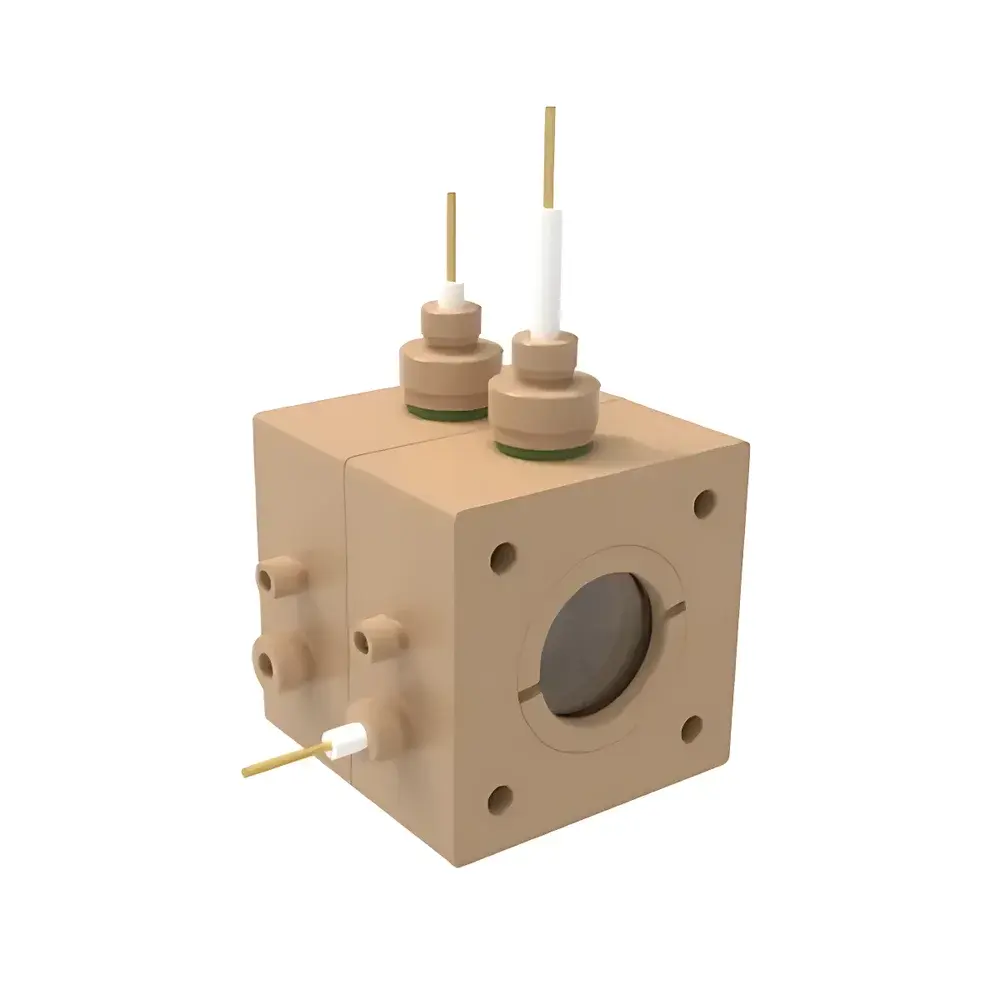
CEL-PEFC-25D Dual-Chamber, Dual-Optical-Path Electrochemical Flow Reactor
| Brand | CEAULIGHT (Zhongjiaojinyuan) |
|---|---|
| Origin | Beijing, China |
| Manufacturer Type | OEM Manufacturer |
| Model | CEL-PEFC-25D |
| Construction Material | Full PEEK (Polyether Ether Ketone) |
| Chamber Configuration | Dual-compartment with ion-exchange membrane separation |
| Working Volume per Chamber | 26 mL |
| Optical Windows | Two UV-grade fused silica windows (Ø35 mm) |
| Electrode Configuration | Three-electrode system (WE: custom substrate |
| CE | Pt wire |
| RE | Ag/AgCl in same chamber as WE) |
| Electrical Isolation | Low-R<sub>s</sub> design via co-localized WE and RE |
| Compliance | Compatible with ASTM E2515, ISO 14770, and GLP-aligned electrochemical testing workflows |
| Integration Ready | Designed for seamless coupling with potentiostats (e.g., BioLogic SP-300), GC analyzers (e.g., GC-7920), LED/laser light sources (300–800 nm), recirculation pumps, and online sampling manifolds |
Overview
The CEL-PEFC-25D is a precision-engineered dual-chamber, dual-optical-path electrochemical flow reactor designed for quantitative evaluation of photoelectrocatalytic and electrocatalytic activity in semiconductor-based materials. It operates on the fundamental principle of controlled three-electrode electrochemistry under simultaneous or sequential irradiation from two independent optical paths—enabling symmetrical illumination of both sides of a planar working electrode (e.g., photoanode or photocathode). This architecture supports rigorous kinetic analysis of charge-transfer processes at solid–liquid interfaces, particularly under operational conditions mimicking real-world electrolyzer or solar fuel synthesis configurations. The reactor is optimized for steady-state and transient measurements—including chronoamperometry, linear sweep voltammetry, and impedance spectroscopy—under illuminated or dark conditions. Its modular geometry allows integration into closed-loop gas-liquid circulation systems, facilitating continuous product quantification (e.g., CO, CH4, H2, O2) during CO2 reduction, water splitting, or organic pollutant degradation studies.
Key Features
- Full-body construction from medical-grade PEEK polymer ensures exceptional chemical resistance to strong acids, bases, halides, and organic solvents—critical for long-term stability in corrosive electrolytes (e.g., 0.5 M KHCO3, 1 M KOH, or acidic phosphate buffers).
- Dual UV-transparent fused silica windows (Ø35 mm, transmission >90% from 190–2500 nm) permit collimated or focused illumination from both anode and cathode compartments—enabling bifacial excitation of asymmetric photoelectrodes or tandem device architectures.
- Integrated three-electrode configuration places the reference electrode (Ag/AgCl, 3 M KCl) in the same chamber as the working electrode, minimizing uncompensated solution resistance (Ru) and improving potential control fidelity—especially essential for low-conductivity non-aqueous or diluted aqueous media.
- Modular chamber sealing with FFKM O-rings and torque-controlled fasteners ensures leak-tight operation up to 3 bar backpressure—supporting high-flow-rate recirculation (up to 50 mL/min) without electrolyte leakage or gas crossover.
- Standardized 1/4″-28 UNF ports and Swagelok-compatible tubing interfaces allow direct connection to commercial electrochemical workstations, gas chromatographs, mass flow controllers, and vacuum manifolds—eliminating custom adapter requirements.
Sample Compatibility & Compliance
The CEL-PEFC-25D accommodates a wide range of electrode substrates—including FTO/ITO/glassy carbon plates (up to 25 × 25 mm), metal foams, sputtered thin films, and printed catalyst layers—mounted via spring-loaded PEEK electrode holders. Each chamber holds 26 mL of electrolyte, with optional customization available for volumes ranging from 15 to 50 mL. Ion-exchange membranes (e.g., Nafion® 117, Fumasep® FAA-3, or custom anion-exchange variants) are inserted between chambers to enforce selective ion transport while suppressing gaseous product mixing. The system conforms to ASTM E2515-17 (Standard Test Method for Photoelectrochemical Performance of Semiconductor Electrodes) and supports audit-ready data acquisition when paired with 21 CFR Part 11-compliant software platforms. All wetted surfaces meet USP Class VI biocompatibility standards.
Software & Data Management
While the CEL-PEFC-25D is a hardware platform without embedded firmware, it is fully compatible with industry-standard electrochemical control software (e.g., EC-Lab®, NOVA, AfterMath®) and chromatographic data systems (e.g., Chromeleon™, OpenLab CDS). When used with time-synchronized triggers (TTL pulses), it enables precise alignment of potentiostat sweeps, light-on/off events, and GC injection cycles—critical for correlating Faradaic efficiency with reaction turnover frequency. Raw voltage/current/time traces, along with calibrated GC peak areas and retention times, can be imported into Python- or MATLAB-based analysis pipelines for kinetic modeling (e.g., Butler–Volmer fitting, Tafel analysis, or reaction order determination).
Applications
- Quantitative assessment of CO2 electroreduction selectivity and stability on Cu-, Sn-, or Bi-based catalysts under simulated solar illumination.
- In situ investigation of charge-carrier dynamics in metal oxide photoanodes (e.g., BiVO4, Fe2O3) during photoelectrochemical water oxidation.
- Bifacial photocatalyst screening for H2 evolution using MoS2/CdS heterostructures under dual-wavelength excitation.
- Long-duration accelerated stress testing (AST) of PEM electrolyzer anodes under 100+ hour galvanostatic operation.
- Method development for ISO/IEC 17025-accredited laboratories performing trace-level product detection in low-turnover photocatalytic systems.
FAQ
Can the CEL-PEFC-25D be operated under positive pressure for gas-phase reactant delivery?
Yes—the reactor body is rated for continuous operation up to 3 bar gauge pressure and includes pressure-relief venting options for safe integration with CO2 or H2 supply lines.
Is the Ag/AgCl reference electrode included with the cell?
No—the reference electrode must be sourced separately; however, the cell features a dedicated, shielded Luggin capillary port with standardized 6 mm OD threading for direct insertion of commercial Ag/AgCl electrodes.
What membrane thicknesses are recommended for optimal ion conductivity and gas separation?
For aqueous carbonate/bicarbonate electrolytes, 50 µm Nafion® 117 is typical; for alkaline media, 25 µm Fumasep® FAA-3 demonstrates lower OH− transport resistance and reduced H2/O2 crossover.
How is temperature controlled during extended experiments?
The reactor includes two 1/8″ NPT threaded ports per chamber for external thermostatic fluid circulation (e.g., Julabo FP50-HL chiller loop), enabling ±0.2 °C thermal regulation across 10–60 °C.
Are custom window materials available upon request?
Yes—CaF2 (for deep-UV <190 nm), MgF2, or sapphire windows can be substituted for specialized spectral ranges, subject to minimum order quantity and lead time confirmation.
Related Products



