
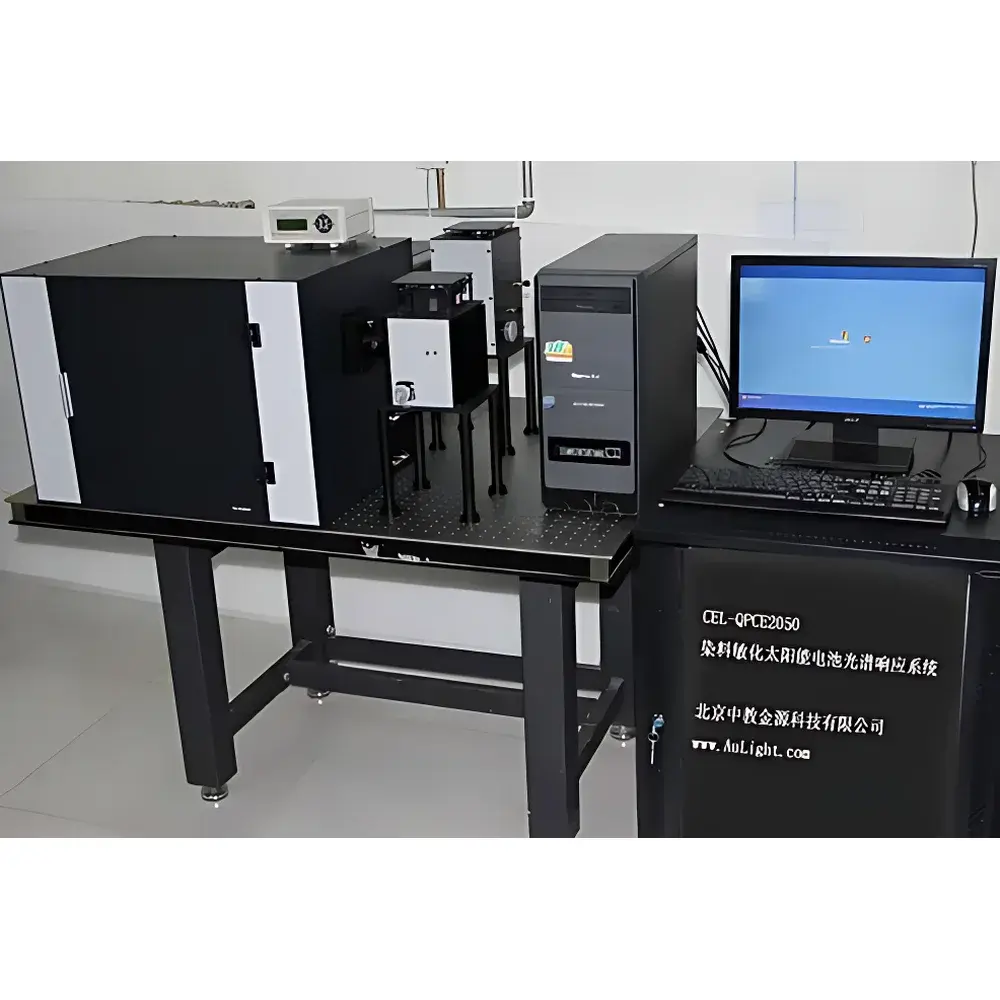
CEL-QPCE2050 Perovskite & Dye-Sensitized Solar Cell Spectral Response Measurement System
| Brand | CEL |
|---|---|
| Origin | Beijing, China |
| Manufacturer Type | Manufacturer |
| Origin Category | Domestic |
| Model | CEL-QPCE2050 |
| Price | USD 36,800 (FOB) |
| Trigger Mode | Steady-State DC |
| Spectral Range | 200–1100 nm |
| Wavelength Resolution | ≥1 nm (continuously adjustable) |
| Scan Mode | Fully Automated Sequential Scanning |
| Repeatability | <0.3% (short-circuit current density, J<sub>sc</sub>) |
| Bias Light | Integrated AM1.5G white-light source (~0.5 SUN, ±5% uniformity) |
| Monochromator | 300 mm or 150 mm focal length options |
| Detection | Keithley 2400/2450 SourceMeter (IEEE-488 & USB-TMC compliant) |
| Temperature Control (optional) | 5–40 °C (±0.5 °C) |
| Chopping Frequency | 5–1000 Hz |
| Compliance | ASTM E1021-12, IEC 60904-8:2014, GB/T 6495.8–2002 |
Overview
The CEL-QPCE2050 Spectral Response Measurement System is an engineered platform for quantitative characterization of external quantum efficiency (EQE), incident photon-to-current conversion efficiency (IPCE), and absolute spectral responsivity of single-junction photovoltaic devices—specifically optimized for dye-sensitized solar cells (DSSCs), perovskite solar cells (PSCs), and other semiconductor absorbers requiring DC-biased, steady-state photoresponse evaluation. Unlike AC-modulated systems, the CEL-QPCE2050 operates exclusively in steady-state DC mode, eliminating phase lag artifacts inherent in slow-recombination devices where carrier lifetime exceeds 100 ms. Its optical architecture implements a dual-beam, sequential illumination scheme: monochromatic light (200–1100 nm) is spatially filtered to ensure uniform spot size smaller than both reference detector active area and sample electrode geometry, while a calibrated broadband bias source (AM1.5G spectrum, ~0.5 SUN intensity) maintains full-area charge extraction and suppresses surface recombination losses during measurement. This configuration directly addresses the electrochemical kinetics of DSSCs—where redox shuttle diffusion, TiO2/dye interfacial electron transfer, and electrolyte ion mobility govern response time constants on the order of seconds—thus ensuring thermodynamic equilibrium conditions prior to each data point acquisition.
Key Features
- Fully automated, software-controlled scanning with zero manual intervention: automatic calibration sequence, reference/sample switching, background subtraction, and dark-current compensation.
- High-stability monochromatic illumination: Czerny-Turner monochromator (300 mm or 150 mm focal length) with holographic grating, enabling <0.3 nm wavelength accuracy and <0.1% stray light suppression across UV-VIS-NIR range.
- Dual-source optical path: collimated monochromator output and independently stabilized broadband bias lamp share common optical axis via reflective beam combiner—eliminating transmission-based aberrations and polarization-dependent errors.
- Integrated Keithley 2450 SourceMeter with 6½-digit resolution, 100 nA–1 A current range, and sub-millisecond sampling—optimized for low-noise DC photocurrent measurement under variable bias conditions.
- Thermally stabilized sample stage (optional): Peltier-driven temperature control (5–40 °C, ±0.5 °C) enables kinetic studies of temperature-dependent charge transport and recombination.
- Compliance-ready firmware: audit trail logging, user access levels, electronic signature support, and timestamped raw data export—aligned with GLP/GMP documentation requirements per FDA 21 CFR Part 11.
Sample Compatibility & Compliance
The CEL-QPCE2050 supports planar and mesoporous thin-film architectures including FTO/TiO2/dye/Pt, ITO/SnO2/perovskite/spiro-OMeTAD/Au, and organic bulk-heterojunction cells fabricated on rigid or flexible substrates. Sample holders accommodate standard 1×1 cm² to 2×2 cm² active areas with spring-loaded edge contact to minimize series resistance variability. All measurement protocols conform to internationally harmonized standards: spectral irradiance calibration traceable to NIST SRM 2270 (silicon photodiode), spectral mismatch correction per IEC 60904-7, and uncertainty budgeting per ISO/IEC 17025:2017 Annex A. Test reports include full metrological traceability statements, repeatability validation data (n ≥ 5 per wavelength), and compliance certificates for ASTM E1021-12 (standard practice for EQE measurements) and GB/T 6495.8–2002 (Chinese national standard for PV spectral response testing).
Software & Data Management
CEL-Scan v4.2 software provides native support for Windows 10/11 (64-bit), featuring real-time spectral mapping, multi-curve overlay, batch processing of IPCE/Jsc/absorptance datasets, and export to CSV, MATLAB .mat, and ASTM E2848-compliant XML formats. All raw analog-to-digital conversions, voltage sweeps, and timing metadata are stored in HDF5 containers with embedded instrument configuration snapshots. The software enforces SOP-driven workflows: pre-defined test templates enforce mandatory parameter validation (e.g., minimum integration time ≥ 3× carrier lifetime estimate, bias light intensity verification prior to scan initiation). Audit logs record operator ID, timestamp, system state, and any parameter override—enabling full forensic reconstruction of measurement history for regulatory review.
Applications
- Quantitative IPCE mapping of perovskite composition gradients (e.g., Br/I ratio effects on bandgap-dependent response).
- Electrolyte optimization studies in DSSCs: correlating iodide/triiodide redox kinetics with wavelength-resolved photocurrent loss mechanisms.
- Interface engineering validation: measuring EQE enhancement after ALD-deposited SnO2 electron transport layers or self-assembled monolayer (SAM) treatments.
- Stability benchmarking: accelerated aging protocols with in-situ spectral response tracking under thermal stress (5–40 °C cycling) and continuous illumination.
- Calibration transfer between labs: certified reference cell intercomparison using identical monochromator slit functions and bias intensities.
FAQ
Why does the CEL-QPCE2050 use DC mode instead of AC lock-in detection?
DC operation avoids phase-shift errors in devices with millisecond-to-second carrier lifetimes (e.g., DSSCs, low-mobility perovskites). Lock-in amplifiers require modulation frequencies >10× inverse lifetime for accurate signal recovery—often impractical below 1 Hz, where 1/f noise dominates.
Can the system measure reflectance or absorbance simultaneously with IPCE?
Yes—by integrating a calibrated integrating sphere (optional accessory), users can acquire concurrent %R and %A spectra aligned to IPCE peaks, enabling direct calculation of internal quantum efficiency (IQE).
Is the bias light intensity adjustable?
The default white-light bias is fixed at 0.5 SUN (AM1.5G), but optional neutral density filters allow attenuation down to 0.01 SUN for low-intensity recombination analysis.
What is the minimum measurable photocurrent?
With 10-second averaging and optimized grounding, the system resolves photocurrents ≥ 50 nA (SNR > 60 dB) across the full spectral range.
Does the software support custom spectral weighting functions?
Yes—users may import arbitrary weighting spectra (e.g., CIE photopic, plant PAR, or custom LED emission profiles) to compute weighted responsivity integrals beyond standard AM1.5G.






