
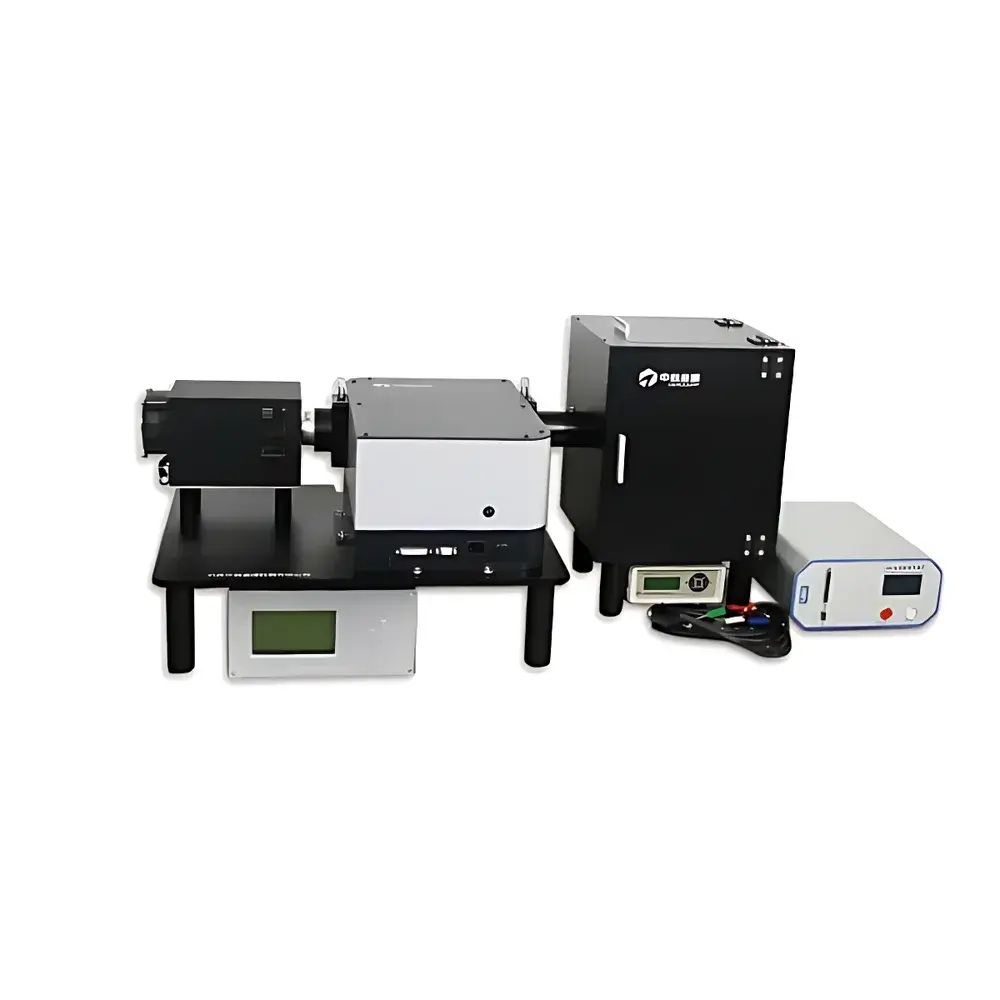
CEL-SLF300 Tunable Monochromatic Light Source System
| Brand | CEL (China Education Goldsource) |
|---|---|
| Origin | Beijing, China |
| Manufacturer Type | OEM Manufacturer |
| Product Origin | Domestic (China) |
| Model | CEL-SLF300 Tunable Monochromatic Light Source System |
| Light Source Type | Xenon Arc Lamp (300 W) |
| Illumination Mode | External Irradiation |
| Spectral Range | 200–1600 nm (with optional extensions) |
| Output Power Density | Up to 50 mW/cm² (typical: 10 mW/cm²) |
| Spectral Bandwidth (FWHM) | Continuously Adjustable from 0.1 to 30 nm |
| Optical Stability | < ±0.5% RMS over 8 h |
| Monochromator | Dual-grating Scanning Monochromator (e.g., CEL-IS151 or CEL-IS302) |
| Grating Options | Multiple interchangeable gratings (e.g., 300, 600, 1200, 2400 grooves/mm) |
| Slit Width Accuracy | Symmetrical motorized slits with automatic edge protection |
| Drive Mechanism | Precision worm-gear transmission |
| Stray Light Suppression | Dual-order filtering (motorized filter wheel IFW6), nitrogen purge port, Czerny-Turner optical design with secondary dispersion correction and coma-free alignment |
| Software Interface | USB 2.0 + RS232, wavelength scanning, delay triggering, automated grating/filter sequencing |
| Compliance | Designed for GLP-compliant photonic testing environments |
Overview
The CEL-SLF300 Tunable Monochromatic Light Source System is an engineered photonic platform designed for high-fidelity, wavelength-resolved optical excitation in advanced laboratory research. Built around a stabilized 300 W xenon arc lamp—selected for its continuous, solar-matched spectral output from 200 nm to 2500 nm—the system integrates a dual-grating scanning monochromator (e.g., CEL-IS151 or CEL-IS302) with precision optical mechanics to deliver spectrally pure, intensity-stable illumination across the UV-Vis-NIR range (300–1600 nm). Its core operating principle relies on Czerny-Turner optical architecture, incorporating asymmetric horizontal beam path design, coma-corrected optics, and secondary dispersion suppression to minimize stray light and ensure symmetrical spectral line profiles. Unlike broadband sources, the CEL-SLF300 enables discrete, reproducible monochromatic irradiation essential for quantum yield determination, action spectrum analysis, incident photon-to-current efficiency (IPCE) mapping, and wavelength-dependent photoelectrochemical kinetics.
Key Features
- Stabilized 300 W xenon lamp with optical output stability better than ±0.5% RMS over 8 hours—achieved via active current regulation and thermal management.
- Dual-grating monochromator with motorized grating selection (RS232/USB-controlled), supporting interchangeable gratings (300–2400 grooves/mm) for optimized resolution vs. throughput trade-offs.
- Continuously adjustable spectral bandwidth (0.1–30 nm FWHM) via motorized symmetrical slits with automatic blade protection and micron-level repeatability.
- Integrated motorized filter wheel (IFW6) with long-pass and bandpass filters to suppress higher-order diffraction artifacts—critical for eliminating 2nd/3rd-order contamination (e.g., 300 nm 2nd order at 600 nm setting).
- Nitrogen purge port enables operation in atmospheric absorption bands (e.g., 185–200 nm vacuum UV, 1350–1450 nm water vapor bands), extending usable spectral range.
- Rigid cast-alloy monochromator housing separates optical and mechanical drive compartments—preventing lubricant outgassing and stray light ingress.
- Full USB 2.0 and RS232 software control: automated wavelength scanning, time-delayed shutter triggering (0.1 ms resolution), synchronized filter/grating sequencing, and real-time parameter logging.
Sample Compatibility & Compliance
The CEL-SLF300 interfaces seamlessly with standard photoelectrochemical cells (e.g., CEL-CPE50, 300–1600 nm transmission window), quartz cuvettes, thin-film substrates, and semiconductor wafers. Its external irradiation geometry supports both normal-incidence and oblique-angle excitation configurations. The system conforms to foundational photometric and radiometric standards underpinning materials characterization workflows—including ASTM E903 (solar absorptance), ISO 9050 (optical properties of glazing), and IEC 60904-8 (spectral responsivity calibration of PV devices). While not FDA-certified as standalone hardware, its data acquisition architecture (audit-trail-capable software, timestamped metadata export) aligns with GLP documentation requirements for traceable photonic testing in academic and industrial R&D labs.
Software & Data Management
CEL’s proprietary LightControl v3.x software provides a deterministic command interface for wavelength programming, scan speed definition (0.1–500 nm/min), dwell time assignment per step, and shutter synchronization. All operational parameters—including grating position, slit width, filter index, and lamp status—are logged in CSV-compatible structured files with ISO 8601 timestamps. The API supports integration with third-party platforms (LabVIEW, Python via PySerial), enabling closed-loop control in automated test sequences. No cloud dependency or telemetry is embedded; all data remains local and exportable without DRM restrictions—ensuring compliance with institutional data sovereignty policies.
Applications
- Photoelectrochemical (PEC) characterization: IPCE spectra, wavelength-dependent photocurrent onset, and charge transfer efficiency mapping.
- Optoelectronic device testing: EQE measurement of perovskite solar cells, organic photodetectors, and quantum dot LEDs.
- Photocatalytic reaction kinetics: Action spectrum derivation for TiO₂, g-C₃N₄, MOFs, and covalent organic frameworks under monochromatic excitation.
- Time-resolved spectroscopy: Pump-probe initiation with gated detection (when paired with fast shutters and lock-in amplifiers).
- Calibration-grade light source: Reference irradiance generation for spectroradiometer validation and detector linearity assessment (per NIST-traceable protocols).
- Materials science: Bandgap determination via Tauc plot analysis, defect-state probing via sub-bandgap excitation, and exciton binding energy estimation.
FAQ
What spectral range is physically achievable with the standard CEL-SLF300 configuration?
The base system covers 300–1600 nm using the 300 W xenon lamp and standard fused silica optics. With optional MgF₂ windows and vacuum UV-compatible gratings, operation down to 185 nm is feasible; NIR extension to 2500 nm requires quartz/bare-grating configurations and InGaAs detection.
How is second-order light suppressed during visible-range operation?
Motorized long-pass filters (e.g., cut-on at 550 nm for 600 nm output) are automatically selected by the filter wheel to block shorter-wavelength harmonics—verified via calibrated fiber-coupled spectrometer (e.g., AULTT-P4000) before each experiment.
Can the system be integrated into an existing electrochemical workstation?
Yes. The optical output is spatially decoupled and mechanically isolated; standard BNC-triggered shutter control and analog voltage output for power monitoring enable synchronization with potentiostats (e.g., CHI, BioLogic, Metrohm Autolab) without signal interference.
Is the monochromator vacuum-compatible?
No—the optical chamber is sealed but not rated for vacuum. However, the nitrogen purge port permits inert-atmosphere purging to reduce O₃ generation below 240 nm and suppress H₂O/O₂ absorption features in NIR.
What maintenance intervals are recommended for long-term radiometric stability?
Lamp replacement every 1,000–1,500 hours; annual recalibration of slit width and grating angular encoder using interferometric reference; biannual cleaning of optical mounts and filter surfaces with spectroscopic-grade solvents per ISO 10110 surface cleanliness guidelines.



