
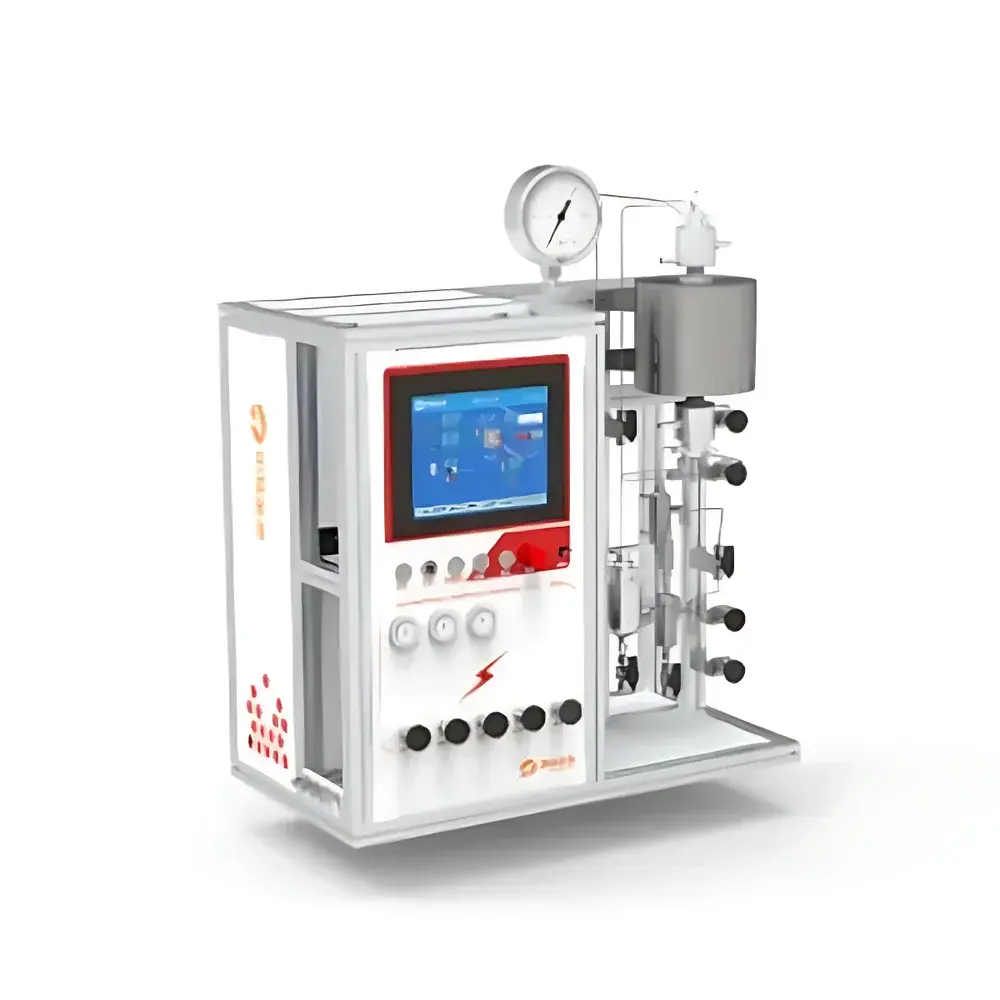
CEL-SOFC-SOEC High-Temperature Solid Oxide Fuel Cell and Electrolysis Cell Testing System
| Brand | CEA-Light |
|---|---|
| Origin | Beijing, China |
| Manufacturer Type | Direct Manufacturer |
| Product Category | Domestic |
| Model | CEL-SOFC-SOEC |
| Light Source Type | High-Temperature Compatible Broadband Thermal Radiator (External Irradiation Configuration) |
| Illumination Mode | External Irradiation |
Overview
The CEL-SOFC-SOEC High-Temperature Solid Oxide Fuel Cell and Electrolysis Cell Testing System is a rigorously engineered platform for bidirectional electrochemical energy conversion research under controlled thermal and gas-phase environments. Unlike optical instrumentation focused on photonic excitation, this system operates on the principles of solid-state electrochemistry and high-temperature catalytic kinetics—leveraging oxygen-ion-conducting ceramic electrolytes (e.g., YSZ, GDC, or LSGM) to enable reversible operation between fuel cell (SOFC) and electrolysis (SOEC) modes. Designed for operation in the 600–900 °C range, it supports thermodynamically favorable internal reforming of hydrocarbon fuels (e.g., CH₄, C₂H₅OH, CH₃OH) in SOFC mode and low-overpotential steam electrolysis or CO₂ co-electrolysis in SOEC mode. The system integrates precise temperature ramping (up to 1000 °C with ±1 °C stability), dual-zone furnace architecture, and galvanostatic/potentiostatic control compliant with ASTM D7566 Annex A5 and ISO 14687-2 for hydrogen purity validation in electrolysis-derived H₂ streams.
Key Features
- Modular dual-mode operation: seamless switching between SOFC (power generation) and SOEC (electrolysis) configurations via software-defined current/voltage polarity and gas routing logic
- Integrated multi-channel gas delivery system with mass flow controllers (MFCs) for H₂, O₂, N₂, CH₄, CO₂, H₂O(v), and synthetic syngas mixtures; all lines heated to >200 °C to prevent condensation
- High-precision electrochemical workstation (±0.1 mV potential resolution, ±10 nA current resolution) with built-in impedance spectroscopy (EIS) capability from 10 mHz to 1 MHz
- Real-time exhaust gas analysis via integrated quadrupole mass spectrometer (QMS) and/or GC-TCD/FID modules for quantitative speciation of H₂, CO, CO₂, CH₄, H₂O, and trace impurities
- Thermally insulated reaction chamber with alumina or mullite tube reactors (ID: 12–25 mm), compatible with button-cell, planar stack, or tubular test geometries
- Full data synchronization across thermal, electrical, and compositional domains using time-stamped acquisition at ≥10 Hz sampling rate
Sample Compatibility & Compliance
The system accommodates a wide range of solid oxide electrochemical components: anode-supported, electrolyte-supported, or cathode-supported cells; cermet (Ni-YSZ, Ni-GDC), perovskite (LSCF, LSM), and mixed ionic-electronic conductor (MIEC) electrodes; and doped-ceria or scandia-stabilized zirconia electrolytes. All hardware interfaces comply with ISO/IEC 17025 calibration traceability requirements for measurement uncertainty reporting. Gas handling components meet ASME B31.3 process piping standards for high-temperature service. Software logging adheres to FDA 21 CFR Part 11 electronic record and signature requirements, including audit trail, user access control, and data integrity validation protocols required for GLP/GMP-compliant catalyst durability testing.
Software & Data Management
The proprietary CEA-Light TestSuite v4.2 provides unified control of thermal profiles, gas composition, polarization curves, EIS sweeps, and transient response measurements. It features automated experiment sequencing (e.g., I–V sweep → EIS → chronoamperometry → gas composition hold), real-time Faradaic efficiency calculation, and stoichiometric balance validation against inlet/outlet mass flow and QMS data. Raw datasets are exported in HDF5 format with embedded metadata (temperature setpoint, ambient pressure, calibration coefficients, operator ID). Integration with MATLAB, Python (via PyCEA API), and LabVIEW enables advanced modeling workflows—including Butler–Volmer fitting, transport loss deconvolution, and degradation rate quantification per IEC 62282-2 Annex D.
Applications
- Accelerated lifetime testing of SOFC anodes under redox cycling and sulfur poisoning conditions (ASTM D7214)
- CO₂/H₂O co-electrolysis optimization for syngas (H₂/CO) ratio tuning in Power-to-X applications
- In situ characterization of electrode microstructure evolution via impedance arc decomposition during thermal aging
- Validation of kinetic models for steam methane reforming coupled with electrochemical oxidation in hybrid SOFC-reformer systems
- Material screening for proton-conducting ceramics (e.g., BCY, BZY) operating below 600 °C
- System-level efficiency mapping of combined heat and power (CHP) operation with waste heat recovery integration
FAQ
Can this system operate under pressurized conditions?
Yes—optional high-pressure reactor modules support up to 5 bar absolute inlet pressure, with pressure-compensated MFCs and reinforced quartz or Inconel housings.
Is the system compatible with reference electrodes for three-electrode measurements?
Yes—dedicated ports allow insertion of Pt or Au quasi-reference electrodes, enabling accurate overpotential resolution at individual electrodes.
Does the software support automated long-term stability tests (e.g., 1000+ hours)?
Yes—scheduled shutdown/restart, automatic data backup, and failure-triggered safety interlocks (e.g., temperature excursion >±5 °C) are fully implemented.
What calibration standards are provided for gas analysis accuracy?
NIST-traceable gas mixtures (e.g., 1% H₂ in N₂, 500 ppm CO in air) are included, with calibration certificates valid for 12 months.
Can third-party potentiostats be integrated?
Yes—via Ethernet-based SCPI command interface or analog voltage/current I/O, supporting Gamry, BioLogic, and Metrohm Autolab instruments.





