
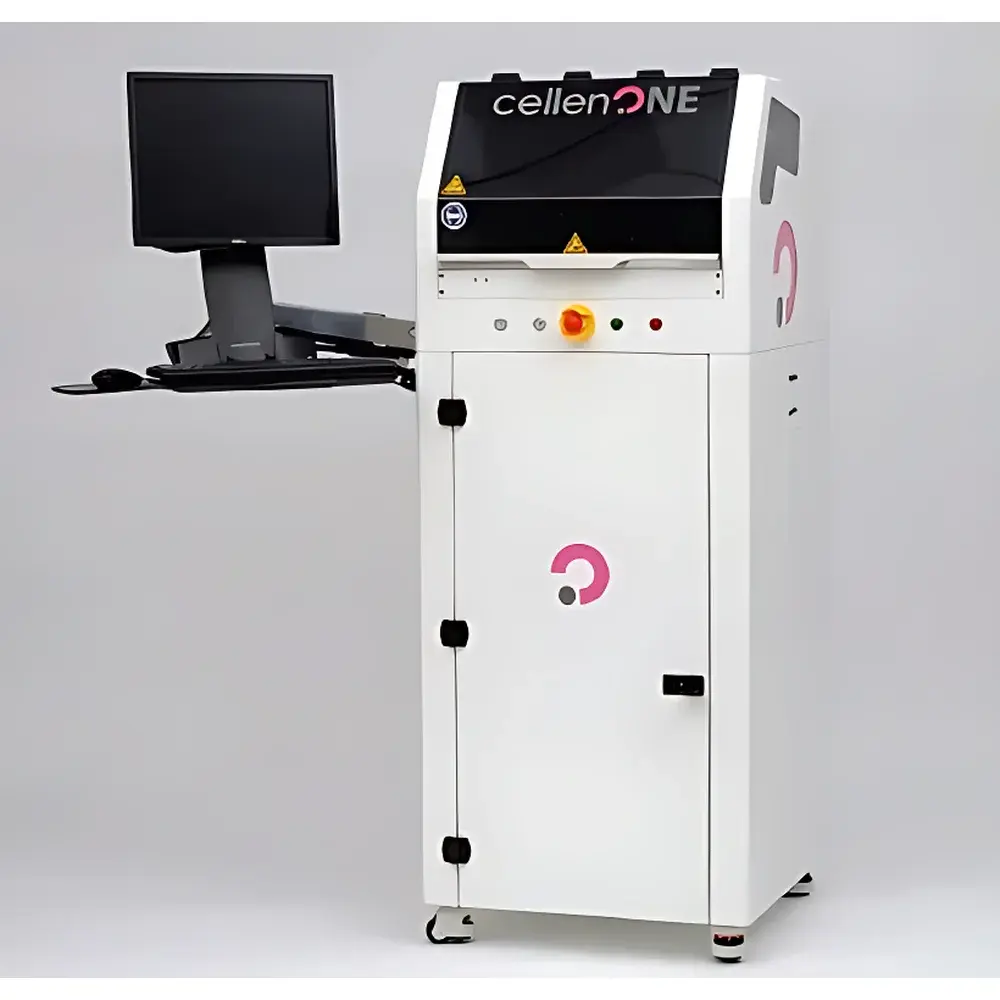
cellenION cellenONE F1.1 Automated Single-Cell Dispensing and Sorting System
| Origin | Germany |
|---|---|
| Manufacturer Type | Authorized Distributor |
| Origin Category | Imported |
| Model | cellenONE F1.1 |
| Product Type | Automated Single-Cell Dispensing System |
| Application Domain | Research |
| Laser Excitation Efficiency | 95% |
| Detection Channels | 3 |
| Optical Resolution (Spatial) | 200 nm |
| Fluorescence Sensitivity Threshold | ≥10,000 cells/s |
| Cell Processing Throughput | 0.2 cells/s (single-cell validation rate) |
| Core Technology | Piezoelectric Acoustic Droplet Ejection (ADE) with Real-Time Optical Monitoring |
Overview
The cellenION cellenONE F1.1 is an automated, non-contact, single-cell dispensing and sorting system engineered for precision, viability preservation, and assay flexibility in early-stage life science research. Unlike conventional flow cytometry-based sorters (FACS) or microfluidic partitioning platforms such as 10X Genomics Chromium, the cellenONE operates on piezoelectric acoustic droplet ejection (ADE) — a contactless, low-shear fluid handling principle that eliminates nozzle clogging, hydrodynamic stress, and electrostatic damage. Each droplet (typically 1–10 nL) is generated by high-frequency acoustic pulses focused at the liquid-air interface of a source well, enabling deterministic deposition of individual cells into user-defined wells of standard or custom microplates. The system integrates real-time brightfield and fluorescence imaging to verify cell presence, morphology, and marker expression *before* dispensing — ensuring true single-cell resolution without post-hoc statistical inference. Designed for applications demanding high cell viability and clonal fidelity — including monoclonal antibody development, CRISPR screening, organoid initiation, and low-input scRNA-seq library preparation — the cellenONE delivers deterministic single-cell isolation from ultra-low input samples (as few as 50 cells in 5 µL suspension), bypassing the minimum cell number constraints inherent to FACS and microfluidic encapsulation.
Key Features
- Deterministic single-cell dispensing with ≥95% verified single-cell occupancy per target well, validated via integrated optical monitoring prior to ejection
- Piezoelectric acoustic droplet ejection (ADE) technology — zero mechanical shear, no capillary contact, no voltage bias, preserving membrane integrity and functional viability
- Real-time dual-mode imaging: high-resolution brightfield + up to 3-channel fluorescence detection (ex: 488 nm, 561 nm, 640 nm lasers; emission filters configurable per application)
- Flexible plate compatibility: supports 96-, 384-, 1536-well plates, as well as custom-patterned substrates and chambered slides
- Nanoliter-scale reagent dispensing capability (1–10 nL per pulse) for cost-effective library prep, antibody titration, and multiplexed assay setup
- Automated workflow calibration: machine-learning-assisted nozzle characterization and droplet trajectory mapping for each sample batch
- Integrated environmental control option: optional CO₂ and temperature regulation (37°C) for extended live-cell handling
Sample Compatibility & Compliance
The cellenONE F1.1 accommodates a broad range of primary and cultured mammalian cells (e.g., PBMCs, iPSCs, hybridomas, tumor spheroids, neurons), as well as yeast, bacteria, and magnetic bead-conjugated targets. Its non-contact ADE mechanism ensures compatibility with fragile cell types — including dendritic cells, primary T cells, and organoid fragments — where traditional FACS-induced laminar shear or microfluidic confinement compromises recovery and proliferative capacity. The system complies with ISO 13485 design controls for medical device-associated R&D instrumentation and supports audit-ready documentation per GLP and GMP-aligned workflows. While not a clinical diagnostic device, its data traceability architecture — including timestamped image logs, dispensing event metadata, and user-accessible raw TIFF stacks — aligns with FDA 21 CFR Part 11 requirements for electronic records and signatures when deployed in regulated preclinical environments.
Software & Data Management
The cellenONE Control Suite (v3.2+) provides a modular, scriptable interface for experimental design, image-based cell classification, and closed-loop dispensing logic. Users define gating strategies using morphological (area, circularity, intensity gradient) and fluorescence parameters; the software then generates a spatial map of candidate cells and schedules dispensing events only for those meeting pre-set criteria. All image data, dispensing coordinates, and system telemetry are stored in vendor-agnostic HDF5 format with embedded MIAME-compliant metadata. Integration with third-party analysis pipelines (e.g., Seurat, CellxGene, FlowJo) is supported via API-driven export. Audit trails record operator ID, session timestamps, parameter modifications, and image acquisition settings — essential for reproducibility tracking and regulatory submissions.
Applications
- Single-cell RNA sequencing (scRNA-seq) library prep from rare or low-yield samples (e.g., fine-needle aspirates, circulating tumor cells, embryonic tissues)
- Monoclonal antibody discovery: high-fidelity single-B-cell or single-hybridoma dispensing into 384-well plates with >90% post-sort viability and clonal expansion rates exceeding manual limiting dilution
- Functional genomics: CRISPR-Cas9 knockout screening with precise delivery of sgRNA/Cas9 ribonucleoprotein complexes into individual cells
- Stem cell and organoid research: deterministic seeding of single pluripotent stem cells or dissociated organoid fragments into microwells for lineage tracing
- Microbiome and synthetic biology: isolation of rare bacterial variants or engineered yeast clones without centrifugation or pressure-based sorting artifacts
FAQ
How does cellenONE achieve higher single-cell accuracy than 10X Genomics?
It uses deterministic, image-verified dispensing rather than probabilistic microfluidic partitioning — eliminating Poisson distribution-related doublets and empty droplets.
Can cellenONE sort cells based on morphological features alone?
Yes — brightfield imaging enables label-free classification by size, shape, texture, and refractive index contrast, independent of fluorescent labeling.
Is the system compatible with sterile, laminar-flow hood operation?
The instrument footprint and open-deck design allow full integration into Class II biosafety cabinets; optional UV sterilization cycles are available for nozzle and stage surfaces.
What is the minimum viable cell concentration for reliable operation?
As low as 10 cells/µL in 5 µL total volume — enabled by high-sensitivity imaging and adaptive focus scanning across sparse suspensions.
Does cellenONE support multi-parametric sorting (e.g., two markers + morphology)?
Yes — up to three fluorescence channels plus brightfield-derived features can be combined in hierarchical or Boolean gating logic within the Control Suite.




