
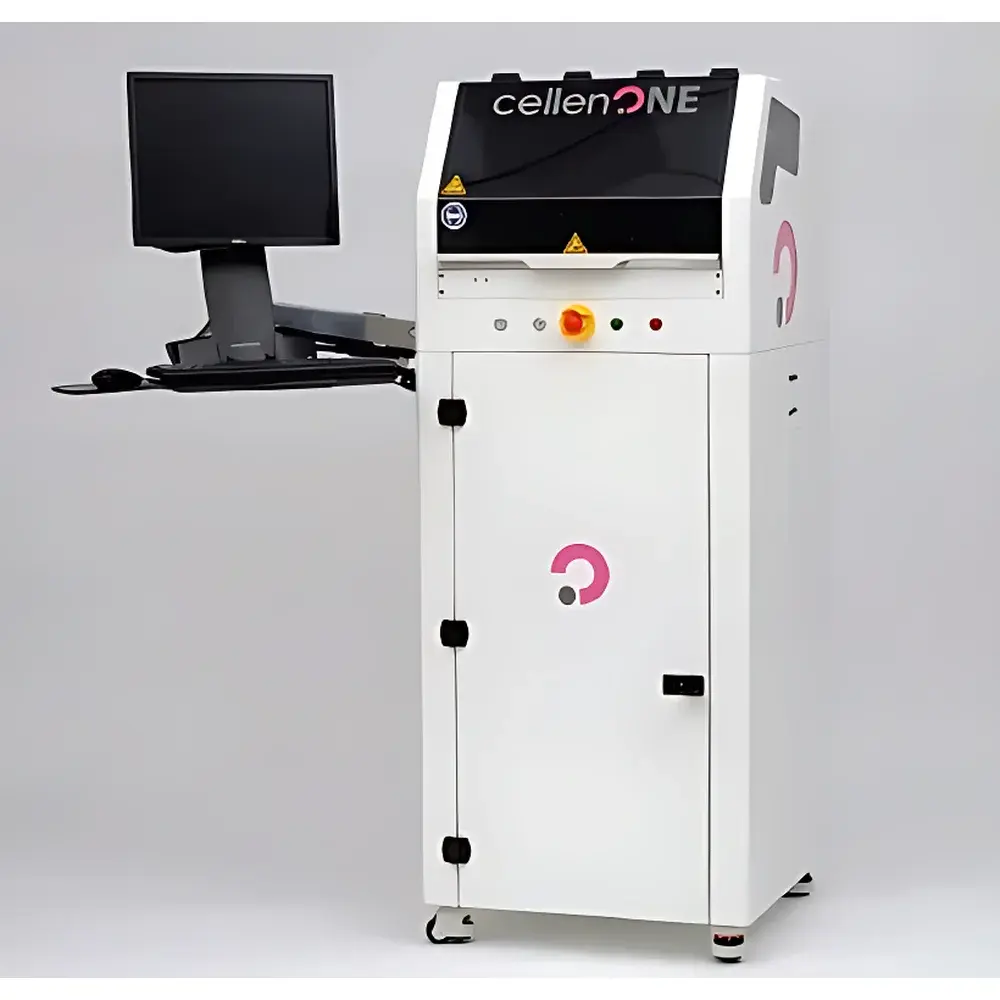
cellenONE X1 Automated Single-Cell Dispensing and Sorting System
| Origin | France |
|---|---|
| Manufacturer Type | Authorized Distributor |
| Origin Category | Imported |
| Model | X1 |
| Pricing | Upon Request |
Overview
The cellenONE X1 is an automated, vision-guided single-cell dispensing and sorting system engineered for high-fidelity isolation of individual viable cells, nuclei, and functional microbeads. Unlike conventional flow cytometry (FACS) or stochastic dilution-based methods governed by Poisson statistics, the cellenONE X1 employs piezoelectric acoustic dispensing coupled with real-time brightfield imaging to achieve deterministic, non-contact single-cell deposition. Each droplet is optically analyzed in situ—prior to ejection—to verify the presence, count, and morphology of cells within the nozzle observation zone. Only droplets containing exactly one intact, morphologically qualified cell are dispensed into user-defined wells (e.g., 96-, 384-, 1536-, or 5184-well plates, including custom microfabricated substrates). Cells failing the single-cell criterion are retained in the source reservoir for re-sampling—ensuring zero loss of precious material and enabling iterative refinement of sorting parameters. This closed-loop, image-verified architecture delivers >98% single-cell accuracy and >85% post-sort viability across diverse primary and immortalized cell types, including shear-sensitive populations such as neurons, cardiomyocytes, and PBMC subsets.
Key Features
- Piezoelectric acoustic dispensing technology: Non-contact, low-shear fluid handling minimizing mechanical stress on fragile cells and nuclei.
- Real-time optical verification: Integrated high-resolution microscope captures frame-by-frame images of each dispensing event; full experimental audit trail stored with timestamped metadata.
- Deterministic single-cell sorting: Eliminates reliance on Poisson distribution—guarantees one cell per well without statistical overloading or underloading.
- Ultra-low input compatibility: Operates reliably with as few as 50 cells in ≤1 µL suspension—no minimum cell number or volume constraints typical of FACS platforms.
- Multi-modal payload handling: Simultaneously dispenses single cells, nuclei (from fresh-frozen or FFPE-derived tissue), functionalized microspheres (2–30 µm), and nanoliter-scale reagents for on-chip library preparation.
- Plate-flexible platform: Supports standardized SBS-compliant microplates (96–5184-well) and custom-designed substrates via programmable coordinate mapping.
Sample Compatibility & Compliance
The cellenONE X1 has been validated across a broad spectrum of biological specimens, including adherent and suspension cell lines (CHO, HEK293T, HeLa, A549, Jurkat), primary human cells (PBMCs, T/B lymphocytes, HUVECs, dermal fibroblasts, melanocytes, keratinocytes, neural stem cells, cardiomyocytes), isolated nuclei from cultured cells and clinical tissue sections (FF and FFPE), and calibrated polymeric microspheres used in barcoded single-cell assays. The system complies with ISO 13485 design control principles for medical device-related research instrumentation and supports GLP/GMP-aligned workflows through secure user access control, electronic signature capability, and full audit-trail generation—including raw image archives, dispensing logs, and plate map metadata. All software operations adhere to ALCOA+ data integrity standards and are compatible with 21 CFR Part 11–compliant environments when deployed with validated IT infrastructure.
Software & Data Management
The cellenONE Control Suite provides intuitive, scriptable workflow automation via a Windows-based GUI with drag-and-drop protocol builder. Users define cell morphology thresholds (size, contrast, circularity), dispensing coordinates, and decision logic (e.g., “accept only if single, round, non-aggregated”) prior to run initiation. Every dispensing cycle generates a time-stamped image stack, plate occupancy map, and JSON-formatted log file containing droplet ID, cell count, confidence score, and positional metadata. Export options include CSV, TIFF, and HDF5 formats for downstream integration with analysis pipelines (e.g., Seurat, Cellxgene, or custom Python/R scripts). Remote monitoring and multi-user role management (administrator, operator, reviewer) are supported, with optional integration into LIMS environments via RESTful API.
Applications
- Single-cell cloning for monoclonal antibody development and stable cell line generation.
- Pre-sequencing sample preparation: Direct deposition of single cells into lysis buffer-containing wells for scRNA-seq, scATAC-seq, or multi-omics library construction.
- Functional single-cell screening: Coupling with CRISPR perturbation libraries or drug-response assays in microwell arrays.
- Nucleus isolation and sorting from archived clinical biospecimens for epigenomic profiling.
- Microbead-based multiplexed assays requiring precise co-dispensing of cells and barcoded particles.
- Low-input QC validation of dissociated tumor digests or rare circulating cell isolates.
FAQ
What is the minimum viable cell concentration required for reliable operation?
The system does not require a minimum concentration—it operates effectively with total inputs as low as 50 cells suspended in ≤1 µL. Performance is optimized at 100–10,000 cells/mL depending on target size and morphology.
Can the cellenONE X1 sort cells directly into lysis buffer for scRNA-seq?
Yes—nanoliter-level reagent dispensing allows pre-spotting of lysis buffers, RT enzymes, or barcoded primers into destination wells prior to cell deposition, enabling fully integrated on-plate library prep.
Is the system compatible with sterile, closed-tube workflows?
All fluidic paths are disposable and autoclavable; the instrument supports laminar-flow hood integration and offers optional glove-box mounting kits for GMP-grade applications.
How is calibration and performance verification performed?
Daily QC includes automated nozzle alignment, droplet size validation using fluorescent microspheres, and image-based accuracy assessment using reference cell suspensions—reports are auto-generated and exportable for regulatory documentation.
Does the system support integration with third-party sequencing library kits?
As an open-platform instrument, the cellenONE X1 imposes no vendor lock-in; it has been successfully deployed with 10x Genomics, BD Rhapsody, Parse Biosciences, and custom in-house protocols.




