
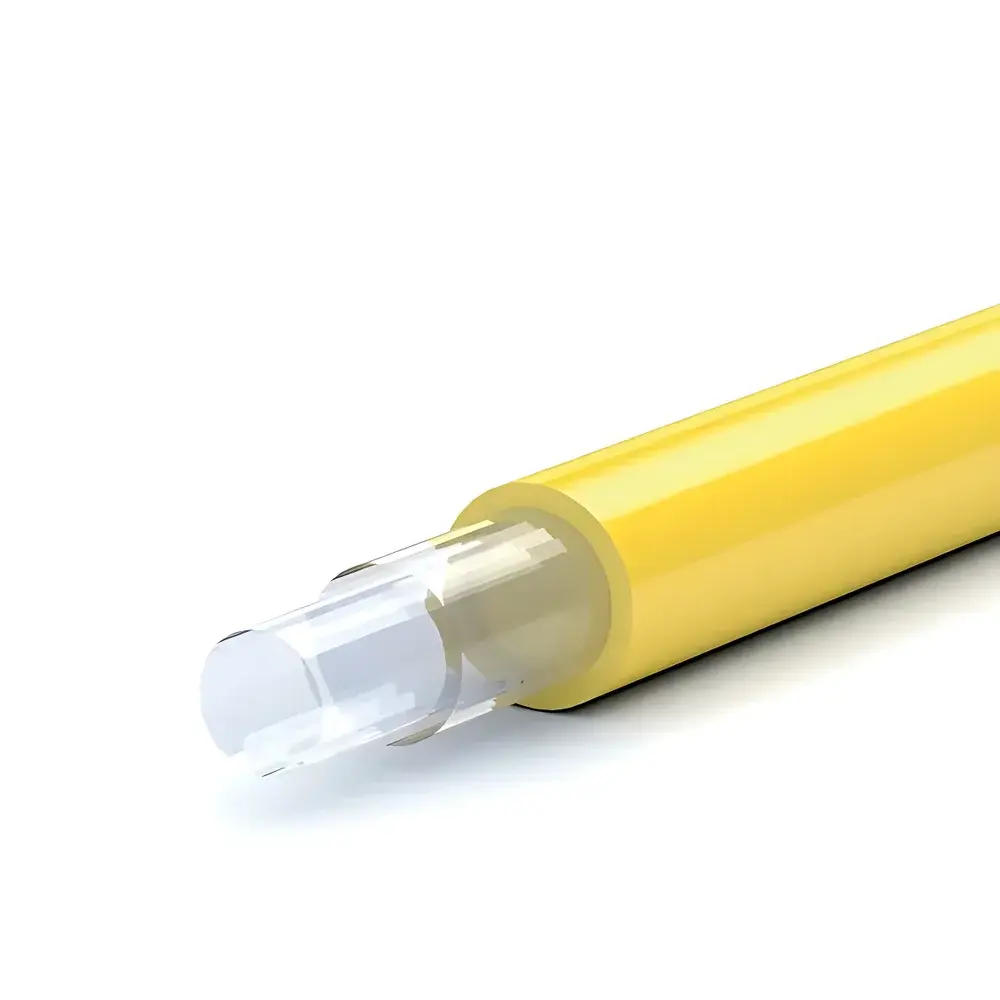
CeramOptec OPTRAN HUV / OPTRAN HWF Hard Polymer-Clad Silica Fiber (350–2200 nm)
| Brand | CeramOptec |
|---|---|
| Origin | Germany |
| Product Type | Hard Polymer-Clad Silica Optical Fiber |
| Wavelength Range | 350–2200 nm |
| Numerical Aperture (NA) | 0.37 / 0.48 / 0.52 (model-dependent) |
| Core Material | Synthetic Fused Silica |
| Cladding | Hard Polymer (e.g., acrylate or proprietary thermoset) |
| OH Content | <1 ppm |
| Tensile Strength | ≥100 kpsi |
| Biocompatibility Certification | ISO 10993-compliant test report available |
| Coating Type | UV-cured hard polymer cladding with silica core |
Overview
The CeramOptec OPTRAN® HUV and OPTRAN® HWF series represent a class of high-performance hard polymer-clad silica (HPCS) optical fibers engineered for demanding illumination, spectroscopic coupling, and high-flux light delivery applications across the deep ultraviolet (UV) to near-infrared (NIR) spectrum (350–2200 nm). Unlike standard plastic-clad silica (PCS) fibers, these fibers utilize a robust, thermally stable hard polymer cladding—typically a proprietary UV-cured acrylate or epoxy-based formulation—that maintains mechanical integrity under elevated thermal load and repeated flexing, while preserving the low-loss, radiation-resistant transmission characteristics of high-purity synthetic fused silica core. The large numerical aperture (NA = 0.37, 0.48, or 0.52, depending on model) enables exceptional light-gathering efficiency and efficient coupling from broadband sources such as arc lamps, LEDs, and supercontinuum lasers—making them especially suitable for applications where source brightness is limited or étendue matching is critical.
Key Features
- Ultra-broad spectral transmission window: 350–2200 nm, validated for minimal solarization in UV-C and UV-B regions (OPTRAN HUV variant optimized for UV non-solarizing performance)
- High NA design (0.37–0.52) enabling superior coupling efficiency and reduced alignment sensitivity in illumination and collection optics
- Low hydroxyl (OH⁻) content (<1 ppm), minimizing absorption bands at 1380 nm and 2730 nm—critical for NIR spectroscopy and laser delivery
- Hard polymer cladding provides enhanced crush resistance, abrasion resistance, and long-term dimensional stability versus soft polymer-clad alternatives
- Proven mechanical reliability: tensile strength ≥100 kpsi (per ASTM F1736-22), validated via controlled proof testing
- Biocompatibility confirmed per ISO 10993-5 (cytotoxicity) and ISO 10993-10 (irritation/sensitization) test reports—enabling use in regulated biomedical instrumentation
Sample Compatibility & Compliance
These fibers are compatible with standard SMA 905, FC/PC, and custom termination interfaces, and are routinely integrated into OEM systems requiring Class I or Class II laser safety compliance (IEC 60825-1). They meet material traceability requirements for GLP and GMP environments when supplied with full CoA (Certificate of Analysis) including spectral attenuation curves, NA verification data, and mechanical test summaries. While not inherently FDA 510(k)-cleared as a standalone device, the biocompatibility documentation supports integration into FDA-regulated analytical or diagnostic platforms. Conformance to RoHS 3 (2015/863/EU) and REACH SVHC declarations are provided upon request.
Software & Data Management
As passive optical components, OPTRAN HUV/HWF fibers do not incorporate embedded electronics or firmware. However, they are fully interoperable with industry-standard optical system calibration workflows—including NIST-traceable spectral radiance mapping, fiber-optic power meter validation (per IEC 61228), and end-to-end throughput modeling in Zemax OpticStudio or FRED. When deployed in automated spectrometer or process monitoring systems, fiber performance parameters (e.g., NA, attenuation vs. wavelength, bend-induced loss thresholds) are programmatically referenced in instrument control software for real-time correction of intensity drift or spectral responsivity shifts.
Applications
- High-efficiency illumination in UV-Vis-NIR microspectroscopy and fluorescence microscopy systems
- Raman spectroscopy probe arms requiring high NA and UV stability (e.g., 244 nm, 325 nm, 532 nm excitation)
- Fiber-coupled plasma and arc lamp sources for semiconductor inspection and thin-film metrology
- Embedded sensing elements in harsh-environment industrial process analyzers (e.g., chemical reactors, combustion chambers)
- Military-grade free-space optical link backup channels and ruggedized data distribution harnesses
- OEM integration into CE-marked medical devices for photodynamic therapy (PDT) light delivery and diagnostic endoscopy
FAQ
What distinguishes hard polymer cladding from standard acrylate or silicone coatings?
Hard polymer cladding exhibits higher glass transition temperature (Tg > 120 °C), lower coefficient of thermal expansion, and superior resistance to solvent swelling—making it suitable for sterilization cycles and prolonged exposure to organic vapors.
Can these fibers be connectorized with angled physical contact (APC) polish?
Yes—standard SMA 905 and FC/APC terminations are available; however, NA-dependent modal noise considerations require careful mode-scrambling design in APC-coupled configurations.
Is there documented evidence of solarization resistance below 250 nm?
OPTRAN HUV variants undergo accelerated UV aging per MIL-STD-810G Method 505.6 and demonstrate <0.1 dB/m degradation after 1000 h at 244 nm @ 10 mW/cm² irradiance.
Do you supply cut-length fibers with factory-polished ends and power calibration certificates?
Yes—custom lengths (0.5–50 m) with certified end-face geometry (RA < 20 nm), insertion loss measurement (±0.05 dB accuracy), and spectral attenuation profiles are available under CeramOptec’s QA-4000 quality protocol.
Are these fibers compliant with IEC 60793-2-40 category A1a specifications?
While classified as “hard-clad silica” rather than standard A1a (soft-clad), OPTRAN HUV/HWF meet or exceed IEC 60793-2-40 mechanical and geometric tolerances for multimode step-index fibers, with additional qualification per DIN EN 61300-2-4 (crush resistance) and DIN EN 61300-2-19 (bend performance).





