
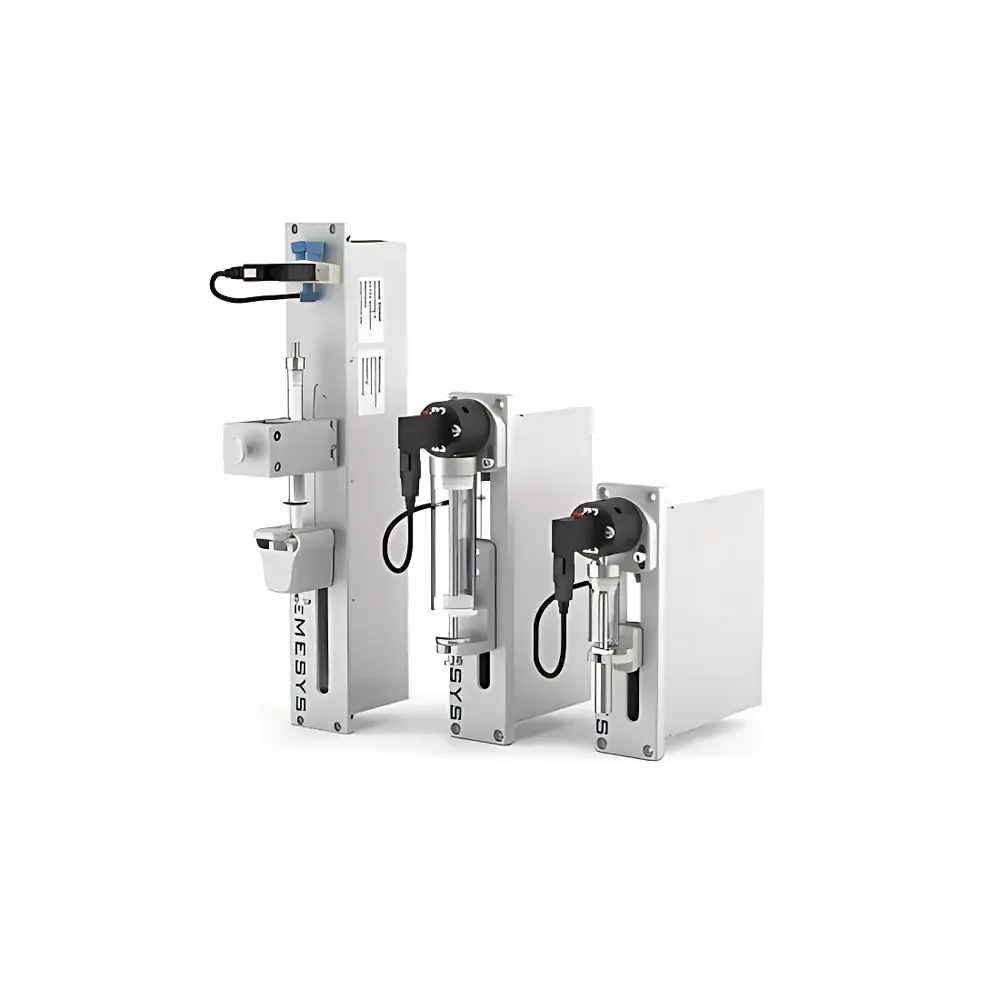
Cetoni neMESYS OEM Precision Microfluidic Syringe Pump
| Brand | CETONI (Germany) |
|---|---|
| Origin | Germany |
| Model | neMESYS OEM |
| Type | OEM-Grade Microfluidic Syringe Pump |
| Flow Rate Range | 1 nm/s – 6 mm/s (model-dependent) |
| Positional Resolution | Sub-nanometer (via integrated high-resolution stepper motor and encoder feedback) |
| Stroke Compatibility | 6–40 mm (OEM 310: up to 40 mm |
| OEM 200 & 160 | up to 30 mm) |
| Syringe Capacity | Up to 25 mL (glass or stainless steel) |
| Integrated Valve | 3/2-way solenoid valve (configurable for 3, 6, or 10 bar pneumatic actuation) |
| Mounting | Modular OEM footprint with standardized mechanical and electrical interfaces (M3/M4 mounting holes, 24 V DC input, TTL/RS-485 control) |
| Software Support | Native drivers for Windows (DLL/.NET) and LabVIEW (VI libraries), compliant with NI-VISA and TCP/IP protocols |
| Compliance | CE-marked, RoHS-compliant, designed per IEC 61000-6-2/6-4 for industrial EMC environments |
Overview
The Cetoni neMESYS OEM Precision Microfluidic Syringe Pump is an engineered solution for applications demanding ultra-stable, pulse-free fluid delivery at nanoliter-to-milliliter scales. Based on a closed-loop stepper motor architecture with real-time position feedback via optical encoders, the neMESYS OEM series eliminates mechanical backlash and flow pulsation inherent in conventional syringe drives. Its operation relies on precise linear displacement control—translating rotational motor motion into sub-micrometer-per-second linear actuation of the syringe plunger—enabling true continuous flow profiles even at ultra-low rates (down to 1 nm/s). Designed explicitly for integration into automated analytical platforms, microfluidic instruments, and custom lab-on-a-chip systems, the neMESYS OEM family (models 310, 200, and 160) offers scalable form factors without compromising metrological integrity. All variants share identical control firmware, timing resolution, and communication protocols—ensuring interchangeability and system-level reproducibility across development, prototyping, and volume deployment.
Key Features
- Sub-nanometer positional resolution and <0.1% volumetric repeatability over extended operation cycles
- OEM-optimized mechanical footprint: compact chassis (as small as 160 × 44 × 192 mm for neMESYS OEM 160) with standardized M3/M4 mounting patterns and 24 V DC power interface
- Integrated 3/2-way solenoid valve (3, 6, or 10 bar configurable) for automated flow path switching—eliminating need for external pneumatic manifolds
- Universal syringe holder accommodating glass (e.g., Hamilton, SGE) and stainless-steel syringes (6–25 mL), with adjustable stroke limiters for 6–40 mm travel range
- Dual-mode control: local manual jog via front-panel encoder + remote programmable operation via TTL, RS-485, or Ethernet (TCP/IP)
- Real-time status monitoring: plunger position, motor current, valve state, and thermal sensor output accessible via API
Sample Compatibility & Compliance
The neMESYS OEM supports a wide range of chemically compatible syringes—including borosilicate glass, PTFE-coated stainless steel, and chemically inert polymer barrels—making it suitable for aqueous, organic, and mildly corrosive media. It complies with CE Directive 2014/30/EU (EMC) and 2014/35/EU (LVD), conforms to RoHS 2011/65/EU, and meets IEC 61000-6-2 (immunity) and IEC 61000-6-4 (emission) standards for industrial environments. While not certified for medical device use (IEC 62304) or explosive atmospheres (ATEX), its robust construction and sealed electronics support deployment in ISO Class 7 cleanrooms and GLP-compliant laboratories. For regulated workflows requiring audit trails, the pump’s firmware logs all command executions and error states—compatible with third-party data acquisition systems implementing 21 CFR Part 11 electronic signature requirements when paired with validated software layers.
Software & Data Management
Cetoni provides native software development kits (SDKs) for Windows (C++ DLL, .NET wrapper) and National Instruments LabVIEW (fully documented VIs with error handling and asynchronous callback support). All drivers expose low-level access to motor step count, valve state, and real-time position—enabling synchronization with external triggers (e.g., camera exposure, laser pulses, or chromatographic detectors). The pump operates as a deterministic peripheral: command latency is fixed at ≤1.2 ms (RS-485) or ≤0.8 ms (Ethernet), with jitter under ±50 µs—critical for time-resolved microfluidic assays. Configuration files (.xml) store calibrated syringe parameters (inner diameter, dead volume, material expansion coefficient), ensuring consistent volumetric output across instrument generations. Data export supports CSV and HDF5 formats, facilitating integration with Python-based analysis pipelines (e.g., SciPy, Pandas) and MATLAB instrument control toolboxes.
Applications
- Petroleum core flooding experiments requiring constant-rate injection under elevated backpressure (paired with external pressure transducers and flow sensors)
- Single-cell manipulation and microinjection in electrophysiology rigs, where pulse-free delivery prevents membrane rupture
- Perfusion systems for 3D organoid culture, enabling programmable nutrient/growth factor gradients over 72+ hour durations
- Droplet generation in microfluidic T-junctions and flow-focusing devices—achieving CV <0.8% in monodisperse emulsion production
- Microscale reagent dispensing for digital ELISA and spatially resolved immunoassays on planar substrates
- Rheological characterization of non-Newtonian fluids using controlled shear-rate ramps in Couette or capillary geometries
- Automated calibration of mass spectrometry sample introduction systems via gravimetrically verified infusion rates
FAQ
What syringe sizes and materials are supported?
Glass syringes (6–25 mL, e.g., Hamilton 1000 series, SGE 100 µL–10 mL) and stainless-steel syringes (up to 25 mL) are fully supported. Custom adapters are available for Luer-lock, female Luer-slip, and threaded barrel interfaces.
Can multiple neMESYS OEM pumps be synchronized?
Yes—via hardware trigger lines (TTL) or master-slave Ethernet configuration. Jitter between units is <100 µs when using shared clock distribution, enabling coordinated multi-inlet mixing or parallel reaction arrays.
Is firmware update capability included?
Yes—field-upgradable via USB-C or Ethernet using Cetoni’s Qmix Elements configuration utility. All updates preserve user-calibrated syringe parameters and maintain backward compatibility with existing SDK versions.
How is accuracy maintained over temperature fluctuations?
Each unit includes an internal thermistor monitoring motor housing temperature. Firmware applies real-time compensation to step-size calibration tables based on thermal drift models derived from factory characterization across 15–40 °C.
Does the OEM version support analog voltage input for flow rate control?
No—neMESYS OEM uses digital command protocols only (RS-485, Ethernet, TTL). Analog control is available in the benchtop neMESYS Pro series but intentionally omitted in OEM modules to ensure noise immunity and deterministic timing in embedded systems.



