
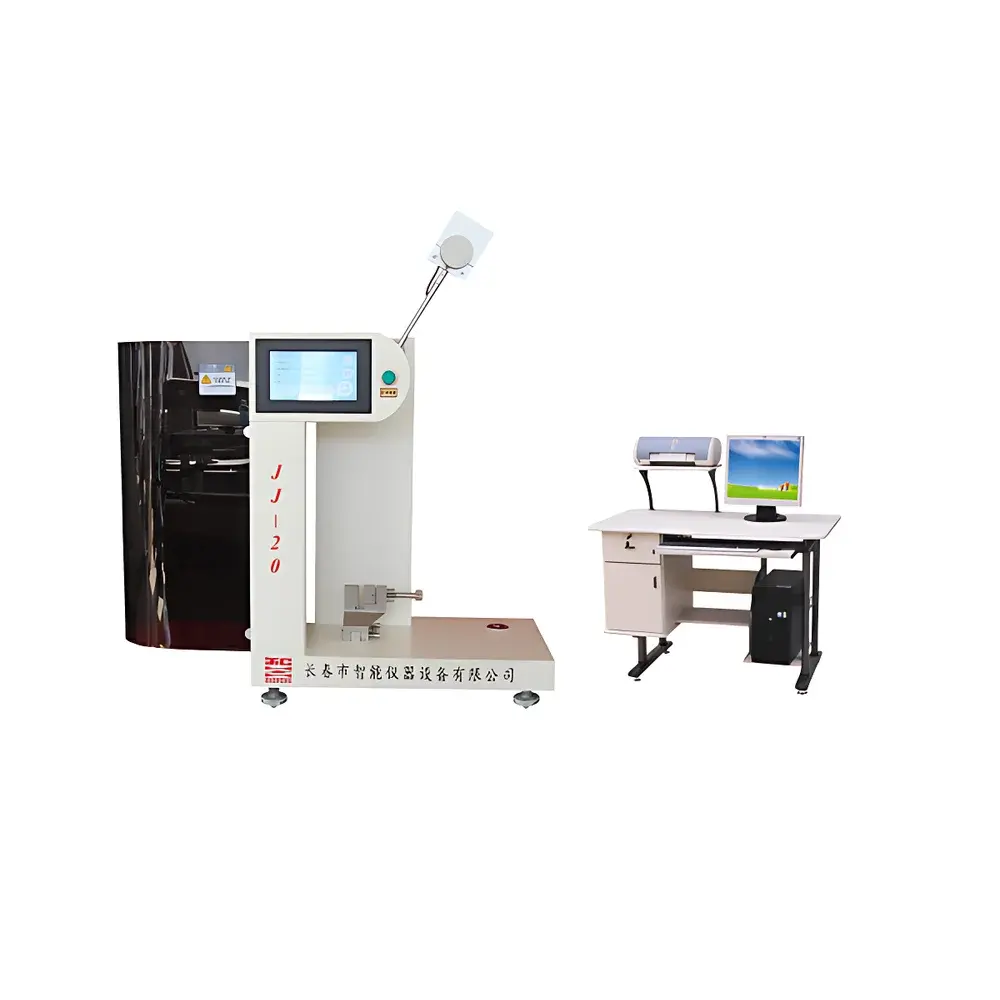
Changchun Intelligent JJ-4 Memory-Enabled Pendulum Impact Tester
| Brand | Changchun Intelligent |
|---|---|
| Origin | Jilin, China |
| Model | JJ-4 |
| Instrument Type | Pendulum Impact Tester |
| Impact Energies | 2 J, 4 J, 7.5 J, 11 J, 15 J, 22 J, 25 J, 50 J, 2.75 J, 5.5 J |
| Impact Velocities | 2.9 m/s, 3.5 m/s, 3.8 m/s |
| Pendulum Torques (Impact Constants) | 0.5359 N·m, 1.0718 N·m, 1.4737 N·m, 2.1436 N·m, 2.9474 N·m |
| Load Cell Range | 50 J |
| Maximum Pendulum Lift Angle | 150° |
| Sampling Rate | 10 µs |
| Resolution | 1/4096 (load), 1/65536 (angular position) |
| Load Accuracy | ≤1% |
| Hammer Nose Angle | 30° (Charpy), 75° (Izod) |
| Nose Radius | 2 mm (Charpy), 0.8 mm (Izod) |
| Support Radius | 1 mm |
| Support Front/Back Angles | 5° / 10° |
| Span Lengths | 40 mm, 60 mm, 62 mm, 70 mm, 95 mm |
| Specimen Dimensions (Charpy) | 80 × 10 × 4 mm, 50 × 6 × 4 mm, 120 × 15 × 10 mm |
| Specimen Dimensions (Izod) | 63.5 × 12.7 × 3.2 mm, 63.5 × 12.7 × 6.4 mm, 63.5 × 12.7 × 12.7 mm, 80 × 10 × 4 mm (standard) |
| Power Supply | AC 220 V, 50 Hz |
Overview
The Changchun Intelligent JJ-4 Memory-Enabled Pendulum Impact Tester is a dual-mode, microprocessor-controlled impact testing system engineered for high-fidelity characterization of fracture behavior in non-metallic engineering materials. It operates on the classical pendulum principle—converting gravitational potential energy into kinetic energy upon release—to deliver controlled, repeatable impact loading to standardized specimens. Unlike conventional analog pendulum testers, the JJ-4 integrates synchronized high-speed force transduction (via calibrated load cells) and angular displacement monitoring (via high-resolution optical encoders), enabling real-time acquisition of both force–time (F–t) and energy–time (J–t) profiles during the entire impact event. This capability supports dynamic mechanical analysis of brittle-to-ductile transitions, crack initiation thresholds, and post-yield energy absorption—critical parameters in polymer formulation development, composite qualification, and quality assurance of structural plastics.
Key Features
- Dual-test configuration: switchable between Charpy (simply supported beam) and Izod (cantilever beam) modes via modular pendulum hammers and specimen supports
- Multi-energy range operation: 10 discrete impact energy levels (2 J to 50 J) selectable by pendulum mass and length adjustment, compliant with ASTM D6110, ISO 179-1, and ISO 180-1
- High temporal resolution: 10 µs sampling interval ensures accurate capture of transient load peaks and fracture onset events
- Angular position tracking: 16-bit encoder (65,536 counts/revolution) delivers angular resolution of 0.001°, enabling precise determination of residual swing angle and absorbed energy
- Automated data processing: embedded firmware computes impact energy (J), impact strength (kJ/m²), and normalized toughness indices; stores up to 10 consecutive test results with statistical averaging
- Dynamic curve visualization: simultaneous display of F–t and J–t curves on integrated LCD or exported via USB to PC; supports overlay comparison of multiple specimens
- Compliance-ready architecture: built-in audit trail logging, user-access level control, and timestamped result export—facilitating GLP/GMP-aligned documentation per FDA 21 CFR Part 11 requirements
Sample Compatibility & Compliance
The JJ-4 accommodates standardized geometries defined in major international standards: Charpy specimens per GB/T 1043.1–2008 and ISO 179-1:2010 (e.g., 80 × 10 × 4 mm bars); Izod specimens per GB/T 1843–2008 and ISO 180:2019 (e.g., 63.5 × 12.7 × 3.2–12.7 mm notched bars). It supports variable span lengths (40–95 mm) and notch configurations (depth 2 mm, tip radius 0.25 mm) to evaluate sensitivity to stress concentration. The system conforms to metrological verification requirements outlined in JJG 145–2007 and mechanical inspection criteria in GB/T 3808–2018. All hardware and firmware are designed to meet ISO/IEC 17025 traceability requirements when used with certified reference specimens and calibrated load cells.
Software & Data Management
The JJ-4 employs proprietary Windows-based software (v3.2+) that provides full instrument control, real-time waveform monitoring, and post-test analysis. Data files are saved in CSV and XML formats, supporting integration with LIMS platforms and third-party statistical tools (e.g., JMP, Minitab). Software features include: automatic pass/fail flagging against user-defined specification limits; batch report generation with customizable templates (PDF/Excel); digital signature support for electronic records; and secure local database archiving with encrypted backups. Audit logs record operator ID, test date/time, calibration status, parameter changes, and result modifications—ensuring full compliance with regulatory data integrity expectations.
Applications
This tester is routinely deployed in R&D laboratories developing automotive thermoplastics (e.g., PP/EPDM blends for bumpers), aerospace composites (carbon-fiber-reinforced PA6), electrical insulation materials (phenolic laminates), and biomedical polymers (PEEK orthopedic components). Its ability to resolve sub-millisecond fracture dynamics makes it especially valuable for comparative studies of toughening mechanisms—such as rubber particle cavitation in ABS, crystallinity effects in PET, or fiber-matrix debonding in glass-filled nylon. Industrial users—including SAIC Motor, FAW Group, and Fujian Southeast Motor—leverage its memory-enabled multi-test functionality to accelerate DOE-driven material screening and production lot release testing.
FAQ
What standards does the JJ-4 comply with for calibration and verification?
The JJ-4 meets national verification regulation JJG 145–2007 and mechanical inspection standard GB/T 3808–2018; its force measurement subsystem is traceable to NIM-certified reference standards.
Can the JJ-4 perform both unnotched and notched impact tests?
Yes—equipped with interchangeable anvils and hammers, it supports notched Izod (ISO 180) and notched/unnotted Charpy (ISO 179) configurations per user-defined specimen preparation.
Is the system compatible with laboratory information management systems (LIMS)?
Yes—CSV/XML export, ODBC connectivity, and structured metadata tagging enable seamless integration with enterprise LIMS and ELN platforms.
What is the maximum specimen thickness supported in Izod mode?
Up to 12.7 mm, using the standard 63.5 × 12.7 × 12.7 mm specimen geometry specified in ISO 180:2019.
Does the JJ-4 support remote diagnostics or firmware updates?
Firmware updates are performed via USB interface; remote diagnostic access requires optional Ethernet module (sold separately) and secure VPN configuration.



