
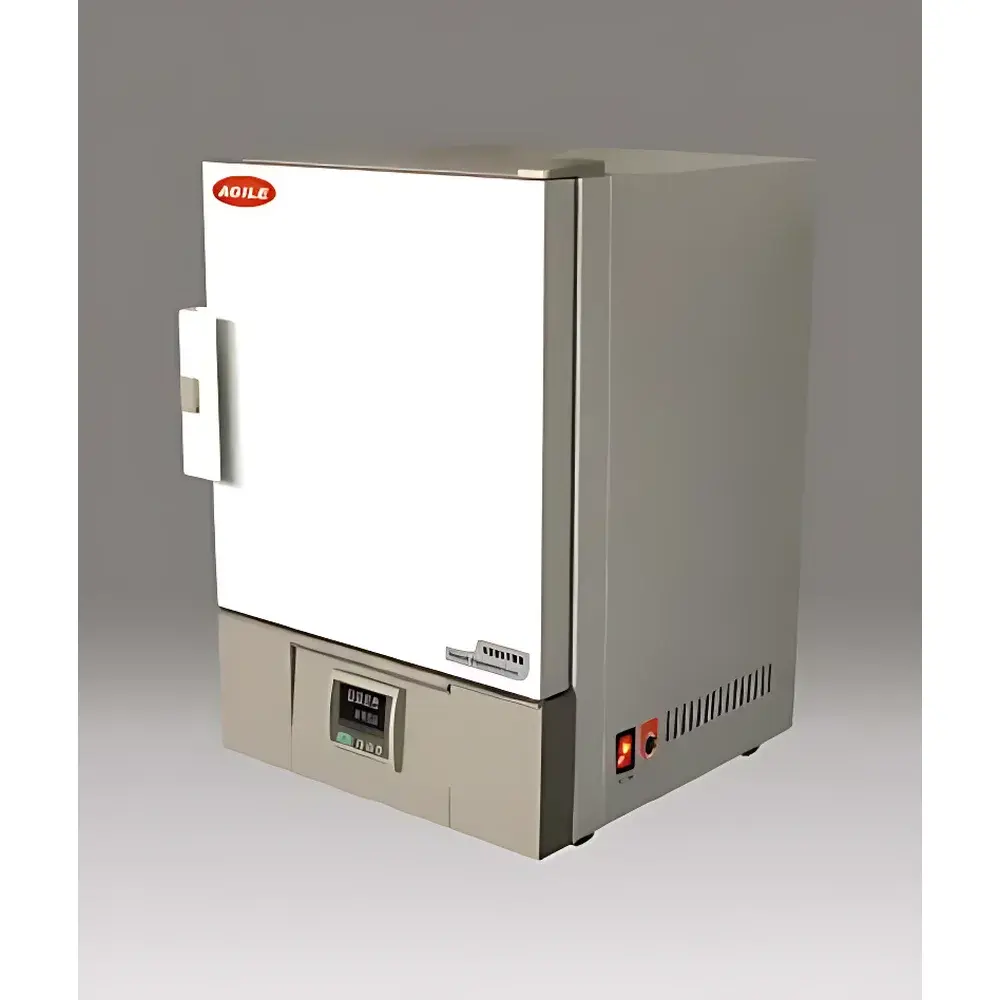
Changsha Hengyu CS101-E Series Forced-Air Laboratory Drying Oven
| Key | Origin: China |
|---|---|
| Manufacturer Type | Authorized Distributor |
| Model | CS101-1E, CS101-1EB, CS101-2E, CS101-2EB, CS101-3E, CS101-3EB |
| Temperature Range | R.T.+20 °C to 300 °C |
| Temperature Uniformity | ±2.5% |
| Temperature Fluctuation | ±0.5 °C |
| Chamber Volume | 72 L / 140 L / 240 L |
| Power Rating | 1.8 kW / 2.7 kW / 3.6 kW |
| Construction | Stainless Steel Interior (B variant) |
| Compliance | JB/T 5520–91, CE |
Overview
The Changsha Hengyu CS101-E Series Forced-Air Laboratory Drying Oven is an engineered solution for precise thermal processing in research, quality control, and production environments. Designed around a forced-convection heating architecture, it ensures rapid heat transfer and uniform temperature distribution across the working chamber via a rear-mounted centrifugal blower and optimized air duct geometry. This principle—governed by controlled laminar-to-turbulent airflow—minimizes thermal gradients and supports reproducible drying, baking, sterilization, and aging protocols. The oven operates within a calibrated range of ambient +20 °C to 300 °C, meeting the performance requirements defined in JB/T 5520–91, the Chinese national standard for industrial drying equipment, and certified to EU CE directives for electromagnetic compatibility and low-voltage safety.
Key Features
- Microprocessor-based PID temperature controller with digital LED display, enabling setpoint accuracy within ±0.5 °C and stable dwell performance under load variation.
- Forced-air circulation system featuring a high-efficiency axial blower and symmetrically arranged baffle plates to ensure airflow uniformity and minimize hot/cold spots—validated to ±2.5% temperature uniformity across the chamber volume.
- Robust double-wall construction with mineral fiber insulation; outer shell finished in electrostatic epoxy coating for corrosion resistance and cleanroom-compatible aesthetics.
- Dual independent safety mechanisms: a mechanical overtemperature cut-off switch (separate from the main controller) and circuit-level short-circuit protection integrated into the power distribution module.
- Stainless steel interior chamber (standard on “B” variants), electropolished and welded for seamless joints—resistant to oxidation, chemical residue buildup, and compliant with ISO 14644-1 Class 8 cleanroom maintenance protocols.
- Modular design supporting three scalable chamber volumes (72 L, 140 L, 240 L), each configured as a vertical upright unit with front-hinged double-glazed door and silicone gasket sealing.
Sample Compatibility & Compliance
The CS101-E series accommodates a broad spectrum of sample types—including polymer pellets, pharmaceutical excipients, ceramic green bodies, electronic substrates, and biological culture plates—without risk of cross-contamination or thermal degradation due to its inert stainless steel chamber and absence of catalytic surfaces. It complies with JB/T 5520–91 for thermal stability, recovery time, and insulation efficiency. CE marking confirms conformity with Directive 2014/30/EU (EMC) and 2014/35/EU (LVD). While not inherently 21 CFR Part 11–compliant, the device supports integration into GLP/GMP workflows when paired with validated external data loggers and audit-trail-enabled software platforms.
Software & Data Management
The oven operates via embedded firmware without proprietary PC software. However, analog voltage output (0–5 V or 4–20 mA) is available on request for connection to third-party SCADA systems or programmable logic controllers (PLCs). Optional RS485 Modbus RTU interface enables remote monitoring of real-time temperature, setpoint, and alarm status—facilitating automated batch logging in accordance with ISO/IEC 17025 documentation requirements. All models support manual calibration offset adjustment per ASTM E220–22 guidelines using NIST-traceable reference thermometers.
Applications
- Moisture content determination per AOAC 950.46 and USP for raw materials and finished dosage forms.
- Thermal aging of elastomers and composites per ASTM D573 and ISO 188.
- Baking of printed circuit board (PCB) solder masks and conformal coatings prior to reflow profiling.
- Pre-conditioning of filter membranes and chromatography columns before analytical use.
- Low-temperature sterilization of glassware and stainless steel tools in non-regulated labs (160 °C for 2 hours).
- Accelerated stability testing of active pharmaceutical ingredients (APIs) under ICH Q1A(R3) long-term and accelerated storage conditions.
FAQ
What is the maximum recommended operating temperature for continuous use?
The oven is rated for continuous operation up to 300 °C. For extended service life above 250 °C, periodic verification of door seal integrity and heater element resistance is advised.
Can the CS101-E be used for ash content analysis (e.g., ASTM D297–19)?
Yes—when equipped with a stainless steel crucible tray and operated at 550 °C (requires optional high-temp upgrade kit; standard model max is 300 °C).
Is validation documentation (IQ/OQ/PQ) provided with the unit?
Factory-issued calibration certificates are included. Full qualification packages must be developed onsite per user-defined protocols and verified using accredited metrology services.
How does the forced-air system improve drying efficiency compared to natural convection ovens?
Forced convection reduces boundary layer thickness at sample surfaces, increasing convective heat transfer coefficients by 3–5× and cutting typical drying cycles by 30–50% for porous or hygroscopic materials.
Are replacement parts such as fan motors and PID controllers readily available?
Yes—Hengyu maintains a global spare parts inventory; lead time for critical components is typically 2–4 weeks ex-warehouse in Changsha, China.



