
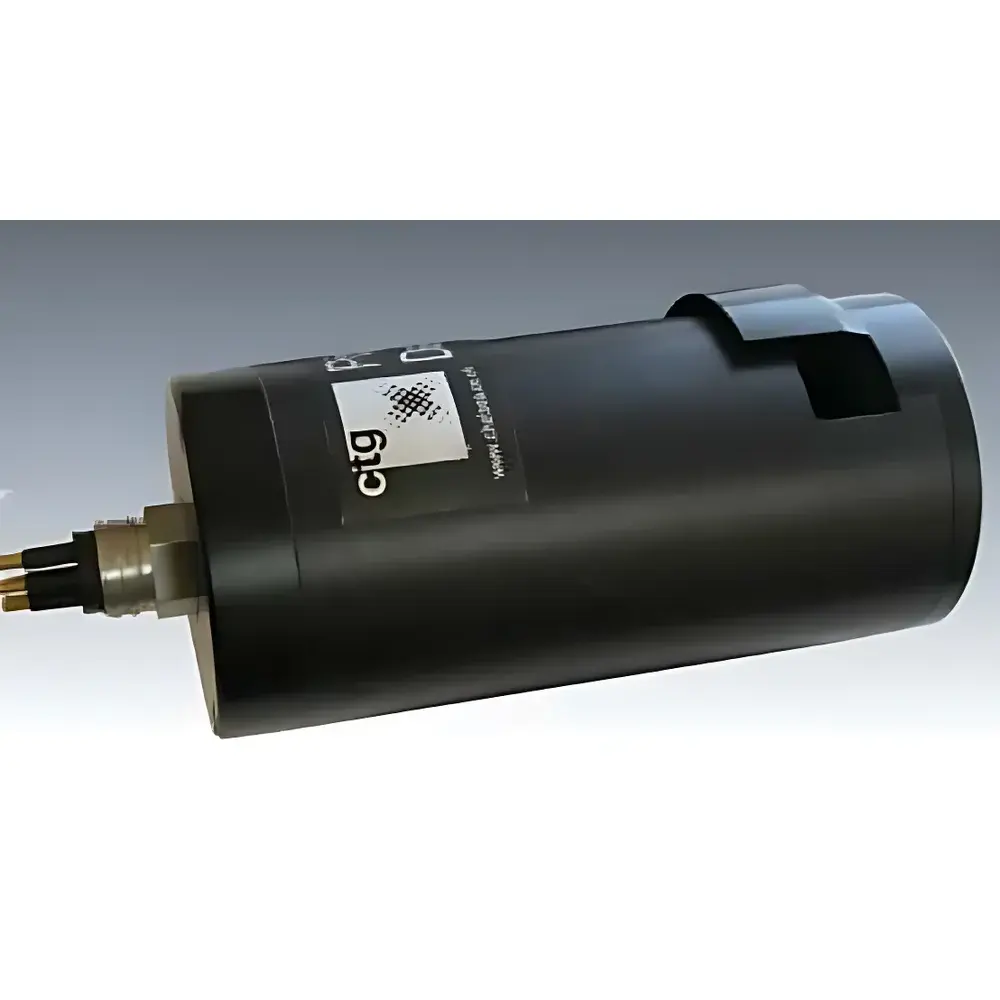
Chelsea Technologies Group UviLux-RO Online Oil-in-Water Fluorescence Sensor with RS232 and 0–5 V Analog Output
| Brand | CTG |
|---|---|
| Origin | UK |
| Model | UviLux-RO |
| Instrument Type | Online |
| Measurement Principle | Ultraviolet-Induced Fluorescence Spectroscopy |
| Measurement Range | 0–300 µg/L |
| Detection Limit | 0.005 µg/L |
| Accuracy | ±0.005 ppm |
| Resolution | 0.005 ppm |
| Sampling Frequency | 10 Hz |
| Dimensions | Ø70 mm × 149 mm |
| Air Weight | 0.8 kg |
| In-Water Buoyant Weight | 0.15 kg |
| Pressure Rating | 600 m |
| Housing Material | Acetal C |
| Electrical Interface | Subcon MCBH6M |
| Power Input | 9–36 V DC |
| Power Consumption | <1 W @ 12 V |
| Operating Temperature | −2 to +40 °C |
| Storage Temperature | −40 to +70 °C |
| Digital Output | RS232 (RS422 & SDI-12 optional) |
| Analog Output | 0–5 V DC |
| Excitation Wavelength | UV (265 nm typical) |
| Emission Detection Band | Optimized for PAHs (e.g., naphthalene, phenanthrene, pyrene) |
Overview
The Chelsea Technologies Group UviLux-RO is a submersible, real-time oil-in-water fluorescence sensor engineered for continuous, in-situ monitoring of hydrocarbon contamination in aqueous environments. It operates on the principle of ultraviolet-induced fluorescence spectroscopy: polycyclic aromatic hydrocarbons (PAHs)—key molecular markers of petroleum-derived oils—absorb UV light at ~265 nm and emit characteristic fluorescence in the visible range. The sensor’s optical architecture includes a stable UV LED excitation source, a high-transmission interference filter, and a low-noise photodiode detector optimized for signal-to-noise ratio in turbid or sunlit conditions. Unlike absorbance-based methods, fluorescence detection provides exceptional selectivity for aromatic hydrocarbons over background organic matter, enabling reliable quantification at trace levels without chemical reagents or sample extraction. Designed for permanent deployment in wastewater effluents, offshore production zones, ballast water systems, and coastal surveillance networks, the UviLux-RO delivers high reproducibility under dynamic flow, variable salinity, and fluctuating ambient light conditions.
Key Features
- Submersible stainless-steel and acetal housing rated to 600 m depth, compliant with IP68 and ISO 8502-9 for underwater integrity
- UV-specific optical path with built-in reference channel to compensate for LED drift and fouling-induced signal attenuation
- Dual-output interface: asynchronous RS232 serial protocol (ASCII format, configurable baud rate) and isolated 0–5 V analog output (4–20 mA optional via external converter)
- User-configurable sampling frequency from 0.1 Hz to 3 Hz; factory default set to 10 Hz for transient event capture
- Low-power operation (<1 W @ 12 V DC), suitable for solar-battery telemetry nodes and long-term unattended deployments
- Dynamic range adjustment via software command—enables optimization for low-level environmental screening (0–10 µg/L) or high-concentration industrial discharge (up to 300 µg/L)
- Integrated daylight rejection algorithm using synchronized pulsed excitation and phase-sensitive detection to suppress solar-induced background fluorescence
Sample Compatibility & Compliance
The UviLux-RO is validated for use in freshwater, seawater, brackish effluent, and treated wastewater matrices. It exhibits minimal interference from dissolved organic carbon (DOC), chlorophyll-a, and common surfactants when calibrated against certified PAH standards (e.g., naphthalene, fluorene, phenanthrene). The sensor meets requirements for regulatory-grade monitoring under EU Water Framework Directive (WFD) Annex VIII parameter definitions for “hydrocarbon indicators” and aligns with ASTM D7678–18 (Standard Test Method for Determination of Oil and Grease in Water by Fluorescence). Its digital output supports audit-ready data logging compatible with EPA-approved SCADA platforms and satisfies traceability requirements per ISO/IEC 17025:2017 for field-deployed measurement systems. No routine calibration gas or solvent standard is required—field verification uses NIST-traceable liquid PAH reference standards.
Software & Data Management
CTG provides Windows-based UviLux Control Suite v4.x, featuring real-time waveform visualization, spectral baseline correction, alarm threshold configuration (with hysteresis), and CSV export with UTC timestamps. The software supports automated firmware updates, remote gain adjustment, and diagnostic reporting (e.g., LED intensity decay, temperature-compensated dark current). All digital outputs include embedded metadata: sensor ID, firmware version, temperature reading, and internal diagnostics flag. For integration into centralized environmental monitoring networks, the RS232 frame structure complies with Modbus RTU mapping (custom register map available), and raw fluorescence intensity values are reported in engineering units (µg/L) after application of user-loaded calibration coefficients. Data integrity is preserved via cyclic redundancy check (CRC-16) in each transmission packet.
Applications
- Real-time leak detection in subsea oil pipelines and risers, including early warning of micro-seepage events prior to visual confirmation
- Monitoring produced water discharge compliance at offshore platforms—supporting OSPAR Decision 2000/3 and UK Offshore Petroleum Licensing Terms
- Runoff surveillance at aviation refuelling aprons and military fuel storage facilities per ICAO Annex 16 Vol II guidance
- Tracking PAH dispersion plumes during dredging, drilling, or remediation activities in sensitive estuarine habitats
- Integration into autonomous underwater vehicles (AUVs), ROVs, and moored profiler arrays for spatially resolved hydrocarbon mapping
- Long-term trend analysis of background petroleum hydrocarbon loading in municipal wastewater reuse streams per ISO 16075-2:2015
FAQ
What hydrocarbons does the UviLux-RO specifically detect?
It responds primarily to polycyclic aromatic hydrocarbons (PAHs) with 2–4 fused rings—including naphthalene, acenaphthene, fluorene, phenanthrene, and pyrene—which are robust fluorescent tracers of crude oil, diesel, and lubricating oils.
Can it distinguish between biogenic and petrogenic sources of fluorescence?
No—fluorescence alone cannot differentiate origin; however, spectral deconvolution using multi-wavelength variants (e.g., UviLux TriLux) or co-deployment with dissolved oxygen and turbidity sensors enables empirical source attribution in field studies.
Is factory calibration sufficient for regulatory reporting?
Yes, when deployed with documented field verification using matrix-matched PAH standards at least quarterly—or per site-specific QA/QC protocols aligned with ISO 5667-16 and US EPA Method 1664B validation criteria.
How is biofouling mitigated during extended deployments?
The optical window features a hydrophobic acetal surface and optional copper-alloy antifouling sleeve; periodic cleaning is recommended every 30–90 days depending on local biomass load, and CTG supplies a validated wet-cleaning procedure using ethanol-free, non-abrasive wipes.
Does the sensor require temperature compensation?
Yes—internal thermistor measurements are applied in real time to correct for thermal drift in LED output and photodiode responsivity; all published accuracy specifications assume active temperature compensation enabled.
Related Products







