
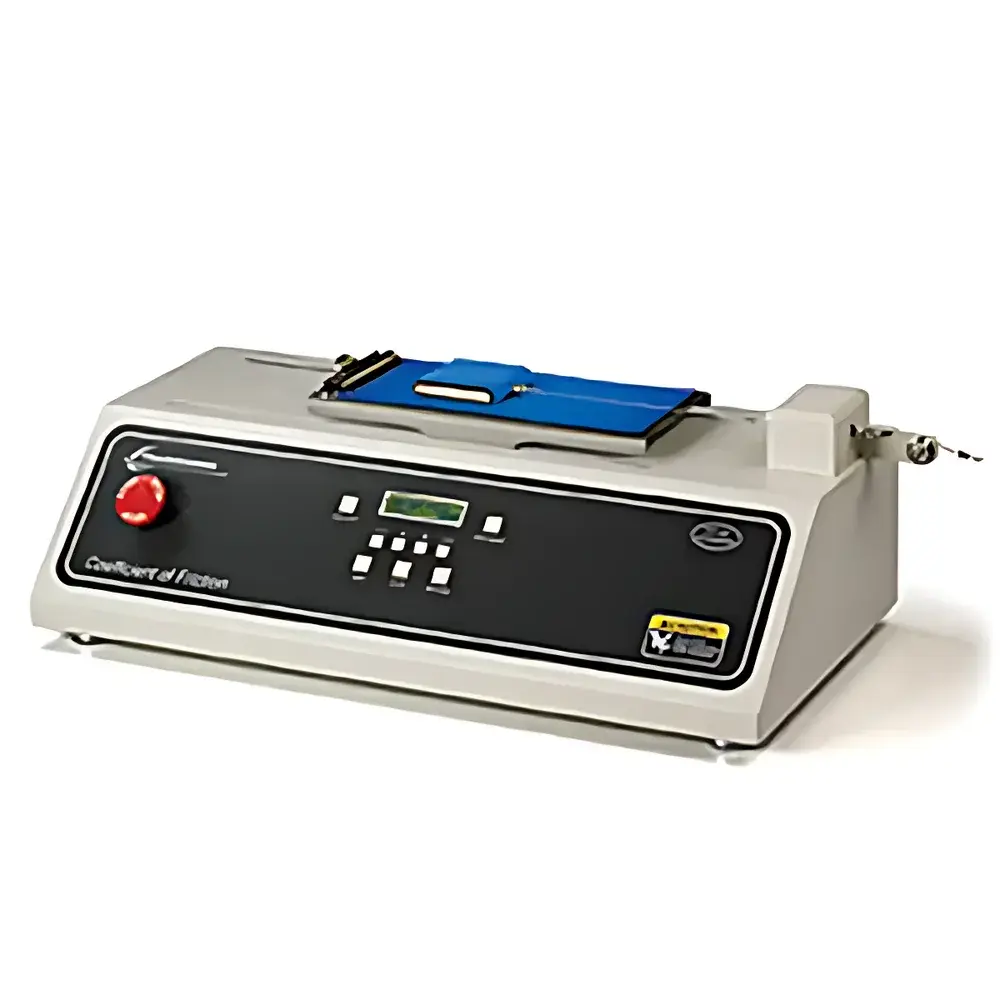
ChemInstruments COF-1000 Coefficient of Friction Tester
| Origin | USA |
|---|---|
| Manufacturer Type | Authorized Distributor |
| Origin Category | Imported |
| Model | COF-1000 |
| Price | Upon Request |
| Test Speeds | 6, 12, and 24 in/min (15, 30, and 60 cm/min) |
| Static & Kinetic COF Measurement | Simultaneous, automated calculation |
| Stroke Length | 6 in (15.2 cm) |
| Test Platform Dimensions | 5 × 11 in (12.7 × 27.9 cm) |
| Standard Sled Mass | 200 g with ASTM-compliant rubber pad (2.5 in × 2.5 in / 6.35 cm × 6.35 cm) |
| Adjustable Sled Mass Range | 1–1000 g |
| Load Cell Capacity | 5 lbf (22.2 N / ~2.27 kgf) |
| Power Supply | 120 V or 240 V AC, 50/60 Hz |
| Operating Temperature | 0–70 °C |
| Software Interface | EZ-Lab™ compatible |
| Dimensions (H×W×D) | 10 × 26 × 12 in (25.4 × 66.0 × 30.5 cm) |
| Weight | 29 lb (13.2 kg) |
Overview
The ChemInstruments COF-1000 Coefficient of Friction Tester is a precision-engineered benchtop instrument designed for the quantitative determination of static (μs) and kinetic (μk) coefficients of friction between two solid surfaces under controlled normal load and relative motion. It operates on the fundamental principle of horizontal pull testing: a sled of defined mass and surface geometry is drawn across a stationary test specimen at constant velocity, while a calibrated load cell measures the tangential force required to initiate and sustain motion. The resulting ratio of measured frictional force to applied normal force yields μs (peak force prior to slip) and μk (average steady-state force during sliding). This methodology aligns rigorously with the physical basis of ASTM D1894 – Standard Test Method for Static and Kinetic Coefficients of Friction of Plastic Film and Sheeting – and is equally applicable to coated papers, laminates, packaging substrates, medical device packaging, and engineered polymers.
Key Features
- Single-test protocol delivering both static and kinetic COF values without manual reconfiguration or recalibration
- Three selectable test speeds (6, 12, 24 in/min) to evaluate velocity-dependent friction behavior per ASTM D1894 Section 7.3
- Integrated 5 lbf (22.2 N) precision load cell with digital signal conditioning for high reproducibility and low hysteresis
- Modular sled system supporting standardized 200 g mass with ASTM D1894-compliant 2.5 in × 2.5 in rubber-faced interface, plus optional masses from 1 g to 1000 g for material-specific normalization
- Fixed-stroke linear drive mechanism with 6 in (15.2 cm) travel ensures consistent displacement and eliminates over-travel artifacts
- Large-format test platform (5 × 11 in / 12.7 × 27.9 cm) accommodates standard sheet specimens and enables edge-effect minimization
- Thermally stable aluminum frame and low-vibration stepper motor drive ensure measurement integrity across ambient operating temperatures (0–70 °C)
Sample Compatibility & Compliance
The COF-1000 accepts flat, rigid or semi-rigid specimens up to 11 in in length and 5 in in width, including plastic films, foils, coated papers, corrugated board liners, nonwovens, and laminated composites. Its mechanical architecture and force resolution support compliance with ASTM D1894, ISO 8295 (Plastics — Film and Sheeting — Determination of the Coefficients of Friction), and TAPPI T 815 om-19 (Coefficient of Friction of Paper and Paperboard). When operated with documented calibration records, traceable to NIST standards, and paired with validated test procedures, data generated by the COF-1000 meets GLP documentation requirements for quality control laboratories in packaging, pharmaceutical secondary packaging, and consumer goods manufacturing.
Software & Data Management
The COF-1000 interfaces seamlessly with ChemInstruments’ EZ-Lab™ software suite via USB 2.0. EZ-Lab provides real-time force vs. time plotting, automatic identification of μs (maximum peak) and μk (mean plateau), statistical summary across replicate tests (n ≥ 3), and export to CSV or PDF formats. Audit trail functionality logs operator ID, date/time stamp, test parameters, calibration status, and raw data files—supporting alignment with FDA 21 CFR Part 11 requirements when deployed in regulated environments. All calibration constants and user-defined sled mass configurations are stored within the software profile, ensuring method consistency across operators and shifts.
Applications
- Quality assurance of plastic film roll stock for printing, converting, and form-fill-seal operations
- Validation of anti-block additives in polyolefin films and masterbatches
- Friction benchmarking of medical pouch sealant layers against Tyvek® and peelable foils
- Development of low-friction release coatings for labels and adhesive tapes
- Root-cause analysis of web handling issues—including telescoping, wrinkling, and slippage—in high-speed packaging lines
- Comparative assessment of surface treatments (e.g., corona, plasma, flame) on polymer substrates
FAQ
Does the COF-1000 comply with ASTM D1894 test conditions?
Yes—the instrument implements all mandatory parameters: specified sled geometry and mass, defined test speeds, minimum specimen dimensions, and force acquisition criteria per Section 7 of ASTM D1894.
Can I use custom sled geometries or materials?
While the standard sled uses ASTM D1894-specified rubber, users may install third-party sleds provided they maintain dimensional fidelity and document interface properties for method validation.
Is calibration traceable to national standards?
Load cell calibration certificates include NIST-traceable documentation; annual recalibration is recommended per ISO/IEC 17025 guidelines.
What environmental conditions affect measurement repeatability?
Relative humidity significantly influences COF of hygroscopic materials (e.g., paper, cellulose); operation within controlled RH (30–50% RH) is advised for comparative studies.
How is data integrity maintained during multi-operator use?
EZ-Lab enforces user login authentication, parameter locking, and electronic signature capture for test initiation—enabling full accountability in GMP-compliant workflows.



