
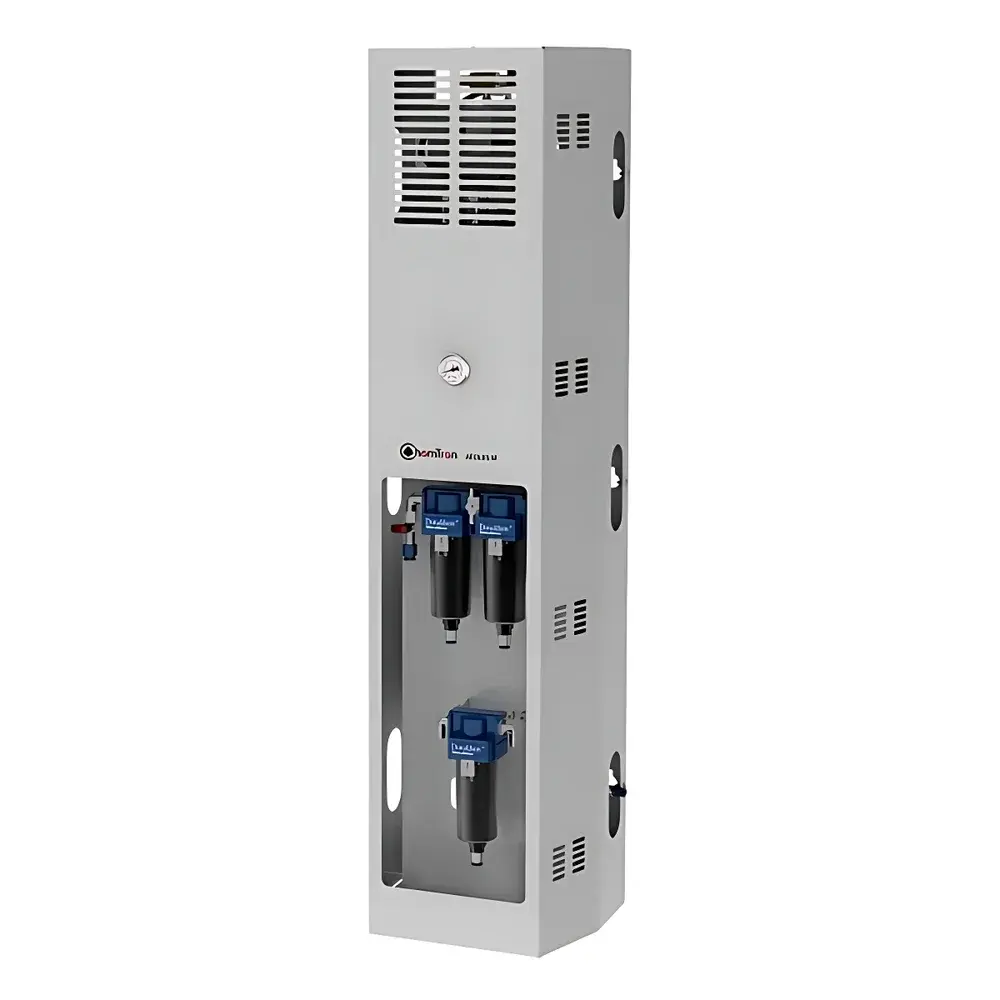
ChemTron AEOLUS Modular Nitrogen Generator
| Brand | ChemTron |
|---|---|
| Origin | Germany |
| Model | AEOLUS |
| Nitrogen Generation Principle | Hollow Fiber Membrane Technology |
| Output Flow Rates | 40, 80, or 120 L/min per module (scalable via modular combination) |
| Output Pressure | 7.6 bar |
| Nitrogen Purity | 99% |
| Dew Point | –40 °C |
| Compressed Air Inlet Requirement | 8.5–10 bar, oil-free and dry (ISO 8573-1 Class 1.3.1), dew point < –20 °C |
| Dimensions (H×W×D) | 324×265×120 mm (AEOLUS M), 400×265×120 mm (AEOLUS L), 480×265×120 mm (AEOLUS XL) |
| Weight | 25–27 kg |
| Air Inlet Connection | OD 10 mm or G1/4" |
| N₂ Outlet Connection | OD 6 mm or G1/4" |
Overview
The ChemTron AEOLUS Modular Nitrogen Generator is an engineered solution for on-demand, high-reliability nitrogen supply in laboratory and light industrial environments. It operates on the principle of selective gas permeation through asymmetric hollow fiber membranes—where oxygen, water vapor, and carbon dioxide diffuse faster than nitrogen across the membrane wall under pressure differential, yielding a nitrogen-enriched stream. Unlike pressure swing adsorption (PSA) systems, the AEOLUS requires no electrical power for gas separation, eliminating electromagnetic interference, heat generation, and cycling-related wear. This passive membrane-based architecture ensures continuous, silent, and vibration-free operation—critical for sensitive analytical instrumentation such as GC, LC-MS, FTIR, and elemental analyzers requiring stable, background-free purge or carrier gas.
Key Features
- Modular scalability: Three standardized flow modules—AEOLUS M (40 L/min), AEOLUS L (80 L/min), and AEOLUS XL (120 L/min)—can be combined in parallel to achieve custom output capacities (e.g., 200 L/min or 400 L/min), supporting evolving lab infrastructure without system replacement.
- Zero-power separation: Nitrogen generation occurs solely via compressed air pressure; no internal electronics, heaters, or valves are involved in the core separation process—ensuring intrinsic safety and operational simplicity.
- Integrated three-stage compressed air filtration: Built-in coalescing, particulate, and activated carbon filters remove oil aerosols, particles down to 0.01 µm, and hydrocarbon vapors—meeting ISO 8573-1 Class 1.3.1 requirements prior to membrane entry.
- Flexible installation: Compact footprint and dual-mount capability (benchtop or wall-mounted) optimize space utilization in constrained laboratory settings. No dedicated ventilation or cooling is required.
- Stable output specification: Delivers consistent 99% nitrogen purity at rated flow (e.g., 20 L/min for AEOLUS M, 40 L/min for AEOLUS L, 60 L/min for AEOLUS XL), with a guaranteed dew point of –40 °C—compatible with moisture-sensitive applications including Karl Fischer titration and glovebox purging.
- Two-mode air inlet configuration: Supports direct connection to high-flow compressors (≥360 L/min @10 bar) or low-flow compressors with integrated storage tanks—adapting seamlessly to existing facility air infrastructure.
Sample Compatibility & Compliance
The AEOLUS is designed for compatibility with a broad range of analytical and process equipment requiring instrument-grade nitrogen. Its oil-free, low-dew-point output meets critical gas quality specifications outlined in ASTM D6349 (for elemental analysis), ISO 8573-1 (compressed air purity), and USP (for pharmaceutical nitrogen used in inerting and blanketing). While not certified to FDA 21 CFR Part 11 out-of-the-box, its analog-only architecture supports integration into validated environments where electronic audit trails are managed at the host instrument or facility SCADA level. The system complies with CE marking requirements for machinery (2006/42/EC) and electromagnetic compatibility (2014/30/EU), and its mechanical design adheres to EN 13445 for unfired pressure vessels.
Software & Data Management
The AEOLUS operates as a fully analog, non-programmable gas generation platform—intentionally omitting digital controls to maximize reliability and eliminate firmware-related failure modes. As such, it does not feature onboard software, data logging, or network interfaces. This design aligns with Good Laboratory Practice (GLP) and GMP Annex 15 principles emphasizing “fit-for-purpose” instrumentation: where gas quality is verified externally (e.g., via inline oxygen analyzers or periodic dew point monitoring), and operational status is confirmed visually via pressure gauges and flow meters. For laboratories requiring traceability, external validation protocols—including challenge testing with calibrated O₂ sensors and dew point hygrometers—are recommended during IQ/OQ execution.
Applications
- Gas chromatography (GC) carrier and detector gases
- LC-MS and GC-MS source and collision gas supply
- Inert atmosphere maintenance in gloveboxes and synthesis reactors
- Blanketing and purging in pharmaceutical stability chambers and API handling
- Karl Fischer titration and moisture-sensitive sample preparation
- NMR spectrometer shimming gas (when paired with additional purification)
- Elemental analyzers (CHNS/O) requiring ultra-dry, hydrocarbon-free nitrogen
FAQ
Does the AEOLUS require electricity to generate nitrogen?
No—the core nitrogen separation process is entirely pneumatic and requires no electrical input. Only optional accessories (e.g., external oxygen monitors or flow controllers) may require power.
What compressed air quality is mandatory for optimal membrane life?
Oil-free, dry air meeting ISO 8573-1 Class 1.3.1 is required: maximum oil content ≤0.01 mg/m³, particles ≤0.1 µm, and dew point ≤–20 °C. Failure to meet this standard accelerates membrane fouling and reduces service life.
Can the AEOLUS be used for medical or breathing air applications?
No—it is strictly intended for instrument and industrial process use. It does not comply with ISO 8573-1 Class 1.2.1 (medical air) or EN 13544-1 standards.
How often must the integrated air filters be replaced?
Filter service intervals depend on upstream air quality and usage hours; typical replacement is every 3,000–6,000 operating hours. A pressure drop >1.5 bar across the filter housing indicates immediate replacement.
Is the nitrogen output suitable for FTIR purge applications?
Yes—its –40 °C dew point and 99% purity meet the stringent moisture and hydrocarbon limits required for mid-IR optical path purging, minimizing atmospheric absorption artifacts.



