
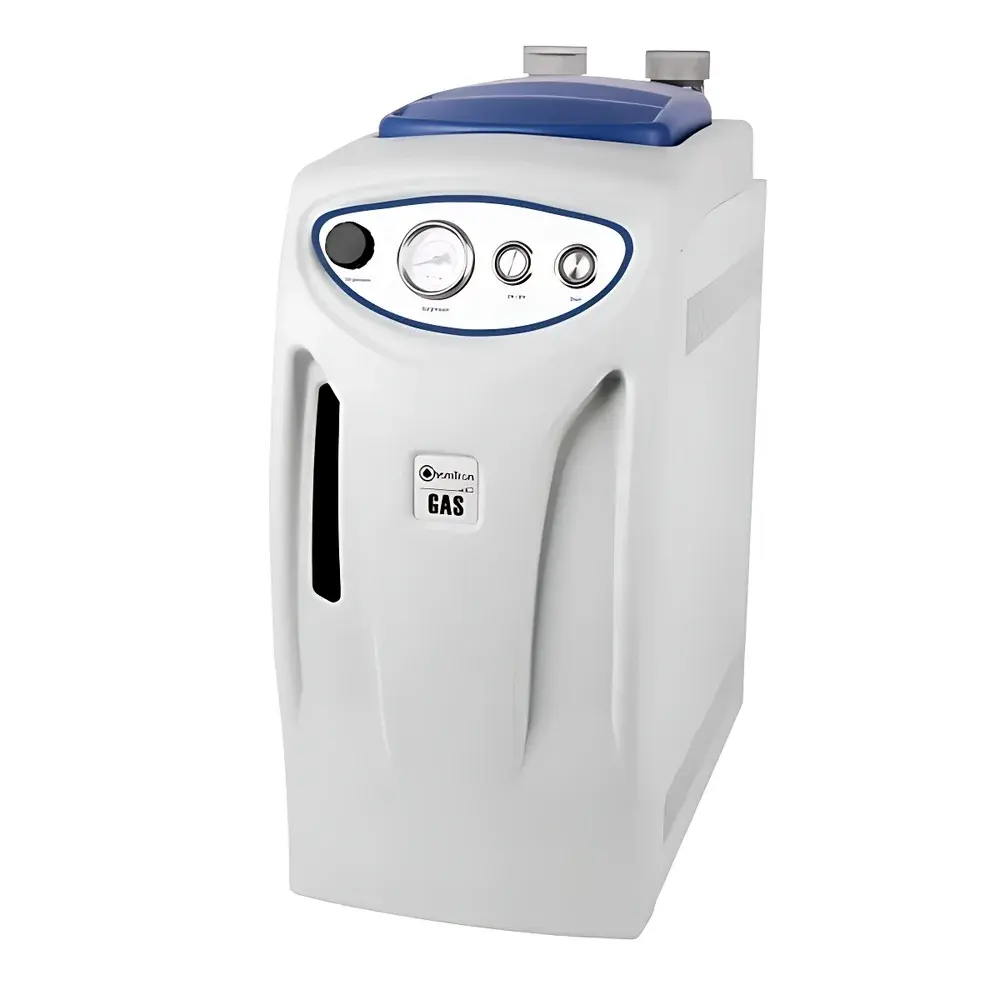
ChemTron EZH 300/600 Compact Maintenance-Free Hydrogen Generator
| Brand | ChemTron |
|---|---|
| Origin | Germany |
| Model | EZH 300 / EZH 600 |
| Hydrogen Generation Principle | Alkaline Water Electrolysis |
| Output Flow Rate | 0–350 mL/min (EZH 300) / 0–650 mL/min (EZH 600) |
| Output Pressure | 0–0.5 MPa |
| Hydrogen Purity | >99.999% |
| Power Consumption | ≤170 W (EZH 300) / ≤350 W (EZH 600) |
| Pressure Stability | <0.001 MPa |
| Dimensions (W×D×H) | 220 × 400 × 490 mm |
| Internal Reservoir Volume | 1 L |
| Weight | 14 kg |
| Operating Temperature | 1–40 °C |
| Relative Humidity | ≤85% RH |
| Gas Outlet Port | 3 mm OD tubing connection |
Overview
The ChemTron EZH 300/600 is a compact, maintenance-free hydrogen generator engineered specifically for laboratory gas chromatography applications—particularly as a dedicated fuel gas source for Flame Ionization Detectors (GC-FID). It employs membrane-assisted alkaline water electrolysis to generate high-purity hydrogen on-demand, eliminating the need for high-pressure cylinders and associated safety, storage, and regulatory burdens. Unlike conventional PEM or solid polymer electrolyte systems, the EZH series utilizes a proven alkaline electrolyte (KOH solution) with a proprietary static CPURE™ dry membrane separation technology, enabling single-step hydrogen purification without consumable desiccants or molecular sieves. The system delivers ultra-high-purity hydrogen (>99.999%) at stable pressure (0–0.5 MPa) and precisely regulated flow (up to 650 mL/min), with real-time digital flow monitoring and visual status indication via integrated LED strip lighting. Designed for seamless integration beside GC instruments, its footprint (220 × 400 × 490 mm) and low thermal load ensure compatibility with standard lab bench layouts and ambient HVAC conditions (1–40 °C, ≤85% RH).
Key Features
- On-demand hydrogen generation via alkaline water electrolysis—no compressed gas cylinders required
- CPURE™ static dry membrane technology: eliminates need for replaceable desiccants (e.g., silica gel or molecular sieves), ensuring true maintenance-free operation
- Dedicated gas-liquid separation trap prevents electrolyte carryover and alkali backflow into the gas stream—critical for GC detector longevity and baseline stability
- Real-time digital flow display with ±2% full-scale accuracy across the operational range (0–350 or 0–650 mL/min)
- Pressure stability better than ±0.001 MPa under dynamic load—essential for consistent FID response and retention time reproducibility
- Integrated 1 L reservoir supports up to 120 hours of continuous operation at 40 mL/min (EZH 300); same reservoir volume applies to EZH 600 with proportional runtime reduction at higher flows
- Low power consumption (≤170 W / ≤350 W) and passive thermal management enable unattended 24/7 operation in shared instrument rooms
- 3 mm OD stainless steel or PTFE-compatible gas outlet fitting ensures leak-tight connection to GC inlet manifolds or auxiliary gas modules
Sample Compatibility & Compliance
The EZH 300/600 is compatible with all major GC platforms requiring hydrogen fuel gas—including Agilent, Thermo Fisher Scientific, Shimadzu, PerkinElmer, and Waters systems—as well as standalone hydrogen-consuming analytical devices such as atomic absorption spectrometers (AAS) with hydride generation modules. Its output purity (>99.999% H₂, with total hydrocarbon impurities <0.1 ppmv and moisture <1 ppmv) meets ASTM D7217–22 specifications for carrier/fuel gas in trace-level organic analysis. The unit complies with IEC 61010-1:2010 for electrical safety in laboratory equipment and incorporates overpressure relief, temperature cutoff, and low-water-level shutdown per EN 62366-1 usability engineering requirements. While not certified for Class I Div 1 hazardous locations, its inherently low hydrogen inventory (<100 mL stored at any time) satisfies OSHA 1910.103 and NFPA 55 guidelines for non-cylinder-based gas supply in general laboratory environments.
Software & Data Management
The EZH 300/600 operates as a standalone hardware device with no embedded firmware or network interface. All operational parameters—including flow rate, pressure, reservoir level, and system status—are conveyed via front-panel LED indicators and analog/digital readouts. No software installation, driver configuration, or data logging capability is provided; this design prioritizes reliability, electromagnetic compatibility (EMC Class B), and audit readiness in regulated environments. For laboratories operating under GLP or GMP frameworks, the absence of configurable software aligns with FDA 21 CFR Part 11 principles by minimizing electronic record complexity—system performance verification is conducted via periodic external calibration using NIST-traceable flow meters and gas analyzers. Maintenance logs are paper-based or entered manually into LIMS, consistent with Annex 11 expectations for low-risk ancillary equipment.
Applications
- Fuel gas supply for GC-FID in environmental testing (EPA Method 8260, 8270), petrochemical analysis (ASTM D3606, D5503), and pharmaceutical residual solvent quantification (ICH Q2(R2))
- Hydrogen source for hydride generation-AAS (HG-AAS) in arsenic, selenium, and antimony speciation studies
- Reducing atmosphere generation in thermal desorption units and purge-and-trap concentrators
- Calibration gas blending support where ultra-high-purity H₂ serves as balance gas or reactant carrier
- Research labs requiring safe, scalable hydrogen supply for catalyst screening or electrochemical cell feed
FAQ
Is deionized water sufficient for electrolyte preparation, or is KOH solution required?
Deionized water alone is insufficient. The unit requires a standardized potassium hydroxide (KOH) electrolyte solution (typically 25–30% w/w), supplied pre-mixed by ChemTron or prepared in-house using ACS-grade KOH and ≥18.2 MΩ·cm DI water.
Can the EZH 600 be used interchangeably with an EZH 300 in existing GC installations?
Yes—both models share identical physical dimensions, mounting interface, gas outlet specification (3 mm OD), and control logic. Upgrading from EZH 300 to EZH 600 requires only electrical circuit verification (230 VAC, 16 A circuit recommended for EZH 600) and flow calibration adjustment in the GC method.
What is the expected service life of the electrolysis cell under continuous operation?
Based on accelerated lifetime testing per DIN EN 60068-2-64, the cell assembly maintains ≥95% nominal efficiency after 20,000 hours of operation (≈2.3 years @ 100% duty cycle), with no scheduled replacement intervals defined under normal usage conditions.
Does the unit require ventilation or external exhaust ducting?
No active ventilation is required. Oxygen byproduct (O₂) is safely vented through a dedicated atmospheric release port located at the rear panel; ambient room air exchange per ASHRAE 62.1 is sufficient to maintain O₂ concentration below 23% v/v.
How is system integrity verified during IQ/OQ qualification?
Installation Qualification (IQ) confirms physical installation, electrical supply, and water reservoir fill procedure. Operational Qualification (OQ) includes flow linearity test (5–100% of max flow), pressure hold test (30 min at 0.4 MPa), purity verification via GC-TCD (per ISO 8573-1 Class 1 for gaseous contaminants), and safety interlock validation (low-water and overtemperature cutouts).



